Notes
|
Topics to be learn :
|
Recall :
Fundamental Concepts of Congruence :
Congruence in geometry refers to figures that are identical in all respects.
- Congruent Figures: Figures that exactly coincide with one another.
- Congruent Segments: Line segments that possess equal lengths.
- Congruent Angles: Angles that possess equal measures.
- Triangle Congruence: When two triangles are congruent, all six pairs of corresponding parts (three sides and three angles) are congruent.
Congruence of triangles :
One-to-One Correspondence :
Congruence is dependent on the specific matching of vertices between two triangles, known as one-to-one correspondence.
- The correspondence between point A and point P is denoted as A ↔ P.
- If Δ ABC is placed on Δ PQR such that they coincide, the correspondence is written as ABC PQR.
- The order of vertices in a congruence statement is mandatory. For instance, if Δ STU ≅ Δ XZY, then writing Δ XYZ ≅ Δ STU is mathematically incorrect because it implies a false correspondence between sides (e.g., side ST ≅ side XY when they are not).
Example :
Draw Δ ABC and Δ PQR on a piece of a paper and cut them with a pair of scissors. There can be six different ways to match the vertices for the triangles to be placed upon each other.
The way of matching the vertices is called one to one correspondence between the vertices of the triangle.
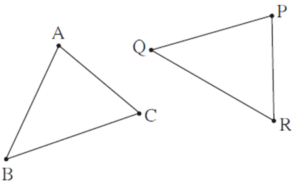
We can express the correspondence between the vertices of Δ ABC and Δ PQR in six different ways as follows :
(1) ABC ↔ PQR (4) ABC ↔ QRP
(2) ABC ↔ PRQ (5) ABC ↔ RPQ
(3) ABC ↔ QPR (6) ABC ↔ RQP
In each of the six correspondences, we get three pairs of corresponding sides and three pairs of corresponding angles e.g. if we take ABC ↔ PQR.
| Pairs of corresponding angles | Pairs of corresponding sides |
| ∠ A ↔ ∠ P | side AB ↔ side PQ |
| ∠ B ↔ ∠ Q | side BC ↔ side QR |
| ∠ C ↔ ∠ R | side AC ↔ side PR |
If for the correspondence ABC ↔ PQR, the triangles exactly coincide with each other then the Δ ABC and Δ PQR are congruent to each other and is written as Δ ABC ≅ Δ PQR.
[Note : Δ ABC ≅ Δ PQR implies the correspondence A ↔ P, B ↔ Q, C ↔ R. Therefore, while writing the congruence of two triangles, we have to take care of the correct order of vertices that observes one to one correspondence ascertaining congruence.]
Defined Tests for Congruence :
To prove two triangles are congruent, it is not necessary to measure all six parts. Specific combinations of three parts, known as "tests," are sufficient to ascertain congruence.
(1) Side-Angle-Side : S-A-S test :
If two sides and the included angle of a triangle are congruent with two corresponding sides and the included angle of the other triangle then the triangles are congruent with each other.
Example :
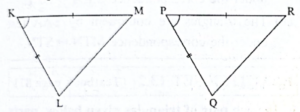
In Δ KLM and Δ PQR,
let KLM ↔ PQR
seg KL ≅ seg PQ
∠ MKL ≅ ∠ RPQ
seg KM ≅ seg PR
∴ by SAS test, Δ KLM ≅ Δ PQR
(2) Side-Side-Side : S-S-S test :
If three sides of a triangle are congruent with three corresponding sides of the other triangle, then the two triangles are congruent.
Example :
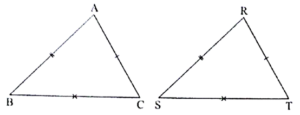
In Δ ABC and Δ RST,
ABC ↔ RST
seg AB ≅ seg RS
seg BC ≅ seg ST
seg AC ≅ seg RT
∴ according to SSS test, Δ ABC ≅ Δ RST.
(3) Angle-Side-Angle : A-S-A test :
If two angles of a triangle and a side included by them are congruent with two corresponding angles and the side included by them of the other triangle, then the triangles are congruent with each other.
Example :
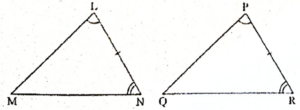
In Δ LMN and Δ PQR,
let LMN ↔ PQR.
∠ LNM ≅ ∠PRQ
side LN ≅ side PR
∠ MLN ≅ ∠ QPR
∴ by ASA test, Δ LMN = Δ PQR
(4) Angle-Angle-Side : A-A-S test :
If two angles of a triangle and a side not included by them are congruent with corresponding angles and a corresponding side not included by them of the other triangle then the triangles are congruent with each other.
Example :
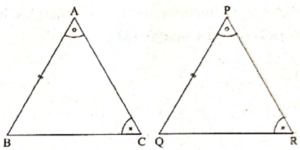
In Δ ABC and Δ PQR,
let ABC ↔ PQR
∠ ACB ≅ ∠ PRQ
∠ BAC ≅ ∠ QPR
side AB ≅ side PQ
∴ by AAS (or SAA) test, Δ ABC ≅ Δ PQR
Logic Behind the AAS (SAA) Test : The AAS test is derived from the fact that the sum of the measures of angles in a triangle is always 1800. If two pairs of corresponding angles are congruent, the third pair must also be congruent, thereby fulfilling the conditions of the ASA test.
(5) Hypotenuse - side test :
If the hypotenuse and a side of a right angled triangle are congruent with the hypotenuse and the corresponding side of the other right angled triangle, then the two triangles are congruent with each other.
Example :
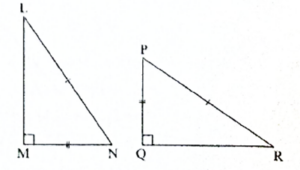
In the right angled triangle LMN and the
right angled triangle PQR,
let LMN ↔ RQP.
∠ M and ∠Q are right angles.
hypt LN ≅ hypt RP
seg MN ≅ seg QP
∴ by hypotenuse side test, Δ LMN ≅ Δ RQP
Key Observations and Common Pitfalls :
- Non-Inclusive Side-Side-Angle: If two sides and an angle not included by them are congruent (SSA), the triangles are not necessarily congruent.
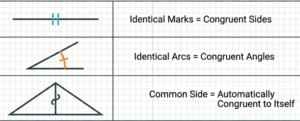
- Common Sides: In many geometric figures (such as quadrilaterals divided by a diagonal), triangles share a side. This "common side" is always congruent to itself and is a frequent component of SSS and SAS proofs.
- Resultant Congruence: Once a test (like SSS) proves two triangles are congruent, all remaining corresponding parts (angles or sides not included in the test) are automatically confirmed as congruent.
- Identical Marks: In geometric diagrams, identical hash marks on sides or arcs on angles are used to indicate which parts are congruent.