
Notes
|
Topics to be learn :
|
Standard unit of volume :
Cuboid, cube, cylinder etc. are three dimensional solid figures. These solid figures occupy some space. The measure of the space occupied by a solid is called the volume of the solid.
Cuboids and Cubes :
Cuboids and cubes are primary three-dimensional solids. Their properties are calculated based on length (l), breadth (b), and height (h).
Cuboids : Cuboid is made up of six surfaces. Each surface is a rectangle.
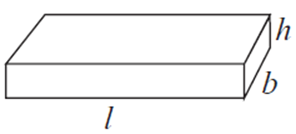
Examples : Brick, matchbox, fish tank, etc.
If l, b, h denote the length, breadth and height of a cuboid, then
- Lateral surface area = 2(l + b)h
- Total Surface Area = 2(lb + bh + lh)
- Volume = l × b × h
Cubes : A cube is a special case of a cuboid where all sides are of equal length (l).
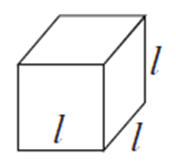
Examples : Ice cubes, sugar crystals, dice, etc.
If l is the length of each edge of a cube, then
- Lateral (vertical) surface area = 4l2
- Total Surface Area = 6l2
- Volume = l3
Practical Applications
- Storage Optimization: The number of items that can fill a space (such as a warehouse) is determined by dividing the volume of the container by the volume of the individual item. For example, a warehouse of 600 × 400 × 400 cm can hold 1,500 boxes of 403 cm.
Material Estimation: Building a wall requires calculating the total volume of the structure and dividing it by the volume of a single brick.
Unit Conversions :
Precise geometric calculation requires consistent units. Following is the conversions for linear, square, and cubic measurements:
| Dimension | Conversion Factors |
| Linear | 1 m = 100 cm; 1 cm = 10 mm |
| Surface Area | 1 sq m = 10,000 sq cm (104 sq cm); 1 sq cm = 100 sq mm (102 sq mm) |
| Volume/Capacity | 1,000 cc = 1 liter; 1 cc = 1 ml; 1,000 ml = 1 liter |
Surface area of cylinder :
Cylinders consist of a curved surface and two circular faces (upper and lower).
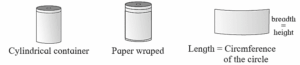
Surface Area Formulas :
The curved surface area is equivalent to a rectangle where the length is the circumference of the cylinder's base (2πr) and the breadth is the height (h).
- Area of the base surface = πr2
- Curved Surface Area (CSA) = 2πrh
- Total Surface Area (TSA) = 2πrh + 2πr2 = 2πr(h + r)
Volume of a cylinder :
The volume of a cylinder is calculated by multiplying the area of its circular base by its height.
- Volume: πr2h
Practical Applications :
- Manufacturing: To determine the number of discs that can be made from a molten solid cylinder, the volume of the original cylinder is divided by the volume of a single disc.
- Resource Management: Calculating the area of a sheet required to create a container (open or closed) or a pipe involves determining the relevant surface area (CSA for pipes; TSA or CSA + one base for containers).
Euler’s Formula for Polyhedra :
The mathematician Leonard Euler discovered a consistent relationship between the faces (F), vertices (V), and edges (E) of solid figures. This is expressed as: F + V = E + 2
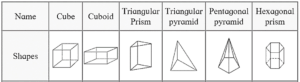
The following table provides data points for various solids used to verify this formula:
| Name of Solid | Faces (F) | Vertices (V) | Edges (E) |
| Cube | 6 | 8 | 12 |
| Cuboid | 6 | 8 | 12 |
| Triangular Prism | 5 | 6 | 9 |
| Triangular Pyramid | 4 | 4 | 6 |
| Pentagonal Pyramid | 6 | 6 | 10 |
| Hexagonal Prism | 8 | 12 | 18 |
Essential Formula Summary :
The document concludes with the primary formulas necessary for geometric analysis:
- Volume of Cuboid: l × b × h
- Volume of Cube: l3
- Curved Surface Area of Cylinder: 2πrh
- Total Surface Area of Cylinder: 2πr(h + r)
- Volume of Cylinder: πr2h