
Solutions
Practice Set 15.1
Question 1.1. If base of a parallelogram is 18 cm and its height is 11 cm, find its area.
Given :
- Base = 18 cm,
- Height = 11 cm
Formula: The area of a parallelogram is calculated as: Area = base × height,.
∴ Area = 18 cm × 11 cm = 198 sq cm.
The area of the parallelogram is 198 sq cm.
Question 1.2. If area of a parallelogram is 29.6 sq cm and its base is 8 cm, find its height.
Given:
- Area = 29.6 sq cm
- Base = 8 cm
- Height = ?
Formula: The area of a parallelogram is given by: Area = base × height.
Substituting the values into the formula: 29.6 = 8 × height
∴ Height = \(\frac{29.6}{8}\) = 3.7 cm.
The height of the parallelogram is 3.7 cm.
Question 1.3. Area of a parallelogram is 83.2 sq cm. If its height is 6.4 cm, find the length of its base.
Given :
- Area = 83.2 sq cm
- Height = 6.4 cm
- Base = ?
Formula: The area of a parallelogram is calculated as: Area = base × height.
Substituting the given values into the formula: 83.2 = base × 6.4
∴ Base = \(\frac{83.2}{6.4}\) = 13 cm.
The length of the base of the parallelogram is 13 cm.
Practice Set 15.2
Question 2.1. Lengths of the diagonals of a rhombus are 15cm and 24 cm, find its area.
Given :
- Length of the first diagonal (d1) = 15 cm
- Length of the second diagonal (d2) = 24 cm
Formula: The area of a rhombus is equal to half the product of the lengths of its diagonals.
∴ Area of a rhombus = \(\frac{1}{2}\) × d1 × d2
Substituting these values into the formula: Area = \(\frac{1}{2}\) × 15 × 24
Area = 15 × 12 = 180 sq cm.
The area of the rhombus is 180 sq cm.
Question 2.2 Lengths of the diagonals of a rhombus are 16.5 cm and 14.2 cm, find its area.
Given :
- Length of the first diagonal (d1) = 16.5 cm
- Length of the second diagonal (d2) = 14.2 cm
Formula: The area of a rhombus is equal to half the product of the lengths of its diagonals.
∴ Area of a rhombus = \(\frac{1}{2}\) × d1 × d2
Substituting these values into the formula: Area = \(\frac{1}{2}\) × 16.5 × 14.2
Area = 16.5 × 7.1 = 117.15 sq cm.
The area of the rhombus is 117.15 sq cm.
Question 2.3. If perimeter of a rhombus is 100 cm and length of one diagonal is 48 cm, what is the area of the quadrilateral?
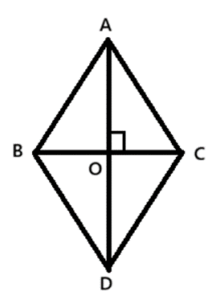
Let □ ABCD be the required rhombus.
AD and BC are the two diagonals intersecting at point O.
AD = 48 cm
Perimeter of the rhombus = 100 cm = 4 x side
∴ 100 = 4 x l(AB)
∴ l(AB) = 100/4 = 25 cm
Thus, each side of the rhombus = 25 cm.
Diagonals of a rhombus are perpendicular bisector of each other.
Length of one diagonal AD = 48 cm ….(Given)
∴ AO = OD = 48/2 = 24 cm
In Δ AOB,
We apply Pythagoras theorem,
AO2 + OB2 = AB2
∴ 242 + OB2 =252
∴ OB2 = 625 – 576 = 49
∴ OB = 7 cm
So, CB = 2 x OB = 2 x 7 = 14 cm
Area of rhombus = \(\frac{1}{2}\) × product of lengths of diagonals
= \(\frac{1}{2}\) × 48 x 14
= 336 sq. cm
The area of the rhombus is 336 sq cm.
Question 2.4. If length of a diagonal of a rhombus is 30 cm and its area is 240 sq cm, find its perimeter.
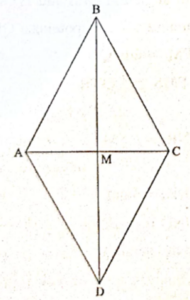
Let □ ABCD be the required rhombus. AC and BD are the two diagonals intersecting at point M.
A(□ ABCD) =240 sq cm, BD = 30 cm
Area of rhombus = \(\frac{1}{2}\) × product of lengths of diagonals
240 = \(\frac{1}{2}\) × l(BD) × l(AC)
240 = \(\frac{1}{2}\) × 30 × l(AC)
240 = 15 × l(AC)
l(AC) = 240/15 = 16 cm
Diagonals of rhombus bisect each other
∴ l(AM) = \(\frac{1}{2}\) × l(AC) and l(BM) = \(\frac{1}{2}\) × l(BD)
∴ l(AM) = \(\frac{1}{2}\) × 16 and l(BM) = \(\frac{1}{2}\) × 30
∴ l(AM) = 8 cm and l(BM) = 15 cm
Diagonals of rhombus are perpendicular to each other
∴ m∠ AMB = 90°
In right angled Δ AMB,
by Pythagoras' theorem,
l(AB)2 = l(AM)2 + l(MB)2
∴ l(AB)2 = 82 + 152
∴ l(AB)2 = 64 + 225
∴ l(AB)2 = 289
∴ l(AB) = 289
∴ l(AB) = 17 cm
∴ side of rhombus is 17 cm
Perimeter of rhombus = 4 x side = 4 × 17 = 68 cm
Perimeter of rhombus is 68 cm.
Practice Set 15.3
Question 3.1. In □ ABCD, l(AB) = 13 cm, l(DC) = 9 cm, l(AD) = 8 cm, find the area of □ ABCD.
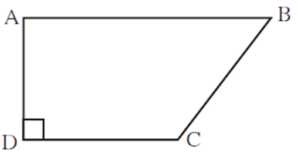
[Note : □ ABCD should be given as trapezium and side AB || side DC]
l(AB) = 13 cm, l(DC) = 9 cm and l(AD) = 8 cm, □ ABCD is a trapezium
Area of a trapezium = \(\frac{1}{2}\) × sum of the lengths of parallel sides × height
∴ A(□ABCD) = \(\frac{1}{2}\) × [l(AB) + l(DC)] × l(AD)
∴ A(□ABCD) = \(\frac{1}{2}\) × [13 + 9] × 8
∴ A(□ABCD) = 22 × 4 = 88 sq cm
The area of □ ABCD is 88 sq cm.
Question 3.2. Length of the two parallel sides of a trapezium are 8.5 cm and 11.5 cm respectively and its height is 4.2 cm, find its area.
Given:
- Lengths of parallel sides = 8.5 cm and 11.5 cm.
- Height = 4.2 cm.
Formula: The area of a trapezium is calculated as: Area = \(\frac{1}{2}\) × (sum of the lengths of parallel sides) × height.
Substituting these values into the formula:
Area = \(\frac{1}{2}\) × (8.5 + 11.5) × 4.2
= \(\frac{1}{2}\) × (8.5 + 11.5) × 4.2
= 10 × 4.2
∴ Area = 42 sq cm.
The area of the trapezium is 42 sq cm.
Question 3.3. □ PQRS is an isosceles trapezium l(PQ) = 7 cm. seg PM ⊥ seg SR, l(SM) = 3 cm, Distance between two parallel sides is 4 cm, find the area of □ PQRS
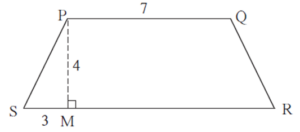
□ PQRS is an isosceles trapezium
l(PQ) =7 cm, l(SM) = 3 cm and l(PS) = l(QR)
Draw QN ⊥ side SR
Distance between parallel lines is constant
∴ QN = 4 cm
In right angled Δ PMS and Δ QNR
Hypotenuse PS = hypotenuse QR
Side PM ≅ side QN
∴ Δ PMS ≅ Δ QNR ... (By hypotenuse side test)
∴ l(NR) = l(SM) ... (Corresponding sides of congruent triangles)
∴ l(NR) =3 cm
PMNQ is a rectangle
∴ l(MN) = l(PQ) = 7 cm …..(Opposite sides of rectangle are equal)
l(SR) = l(SM) + l(MN) + l(NR)
∴ l(SR) = 3 + 7 + 3 ∴ l(SR) = 13 cm
The area of a trapezium = \(\frac{1}{2}\) × (sum of the lengths of parallel sides) × height.
∴ A(□ DPQRS) = \(\frac{1}{2}\) x[l(PQ) + l(SR)] x l(PM)
= \(\frac{1}{2}\) × [7 + 13] × 4 = 20 × 2 = 40 sq cm
Area of □ PQRS is 40 sq cm
Practice Set 15.4
Question 4.1. Sides of a triangle are cm 45 cm, 39 cm and 42 cm, find its area.
Given : Sides: a = 45 cm, b = 39 cm, c = 42 cm.
Semiperimeter (s): s = \(\frac{a+b+c}{2}\)
= \(\frac{45+39+42}{2}\)
= \(\frac{126}{2}\)
∴ s = 63 cm
Using Heron's Formula:
Area of triangle: A = \(\sqrt{s(s-a)(s-b)(s-c)}\)
∴ Area = \(\sqrt{63(63-45)(63-39)(63-42)}\)
= \(\sqrt{63×18×24×21}\)
= \(\sqrt{9×7×9×2×8×3×7×3}\)
= \(\sqrt{9^2×7^2×4^2×3^2}\)
= 9 × 7 × 4 × 3
∴ Area = 756 sq cm.
The area of the triangle is 756 sq cm.
Question 4.2. Look at the measures shown in the adjacent figure and find the area of □ PQRS.
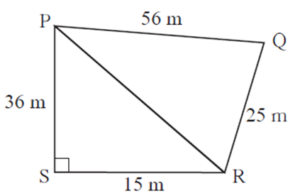
In triangle PSR,
Applying Pythagoras theorem,
PS2 + SR2 = PR2
362 + 152 = PR2
PR2 = 1296 + 225
PR2 = 1521
PR = \(\sqrt{1521}\)
PR = 39 m
Area of triangle PSR = \(\frac{1}{2}\) x 15 × 36 = 270 m2
In triangle PQR,
by using Heron's formula,
Let a = 56, b =25, c = 39
So,
s = \(\frac{a+b+c}{2}\) = \(\frac{56+25+39}{2}\) = \(\frac{120}{2}\)
∴ s = 60 cm
Area of triangle: A = \(\sqrt{s(s-a)(s-b)(s-c)}\)
∴ Area = \(\sqrt{60(60-56)(60-25)(60-39)}\)
= \(\sqrt{60×4×35×21}\)
= \(\sqrt{176400}\)
∴ Area = 420 m2.
Area of PQRS = Area of triangle PSR + Area of triangle PQR
= 270 + 420
= 690 m2
Area of □ PQRS is = 690 m2
Question 4.3. Some measures are given in the adjacent figure, find the area of □ ABCD.
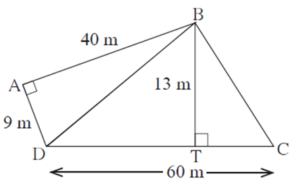
A(□ ABCD) = A(Δ BAD) + A(Δ BDC)
In Δ BAD, m∠ BAD = 90°, l(AB) = 40m, l(AD) = 9m
A(Δ BAD) = \(\frac{1}{2}\) × product of sides forming the right angle
= \(\frac{1}{2}\) × l(AB) × l(AD)
= \(\frac{1}{2}\) × 40 × 9
= 180 sq.m
In Δ BDC, l(BT) = 13m, l(CD) = 60m
A(ABDC) = \(\frac{1}{2}\) x base x height
= \(\frac{1}{2}\) × l(CD) × l(BT)
= \(\frac{1}{2}\) × 60 × 13
= 390 sq. m
A(□ ABCD) = A(Δ BAD) + A(Δ BDC)
= 180 + 390
= 570 sq. m
:. The area of □ ABCD is 570 sq. m.
Practice Set 15.5
Question 5.1. Find the areas of given plots. (All measures are in metres.)
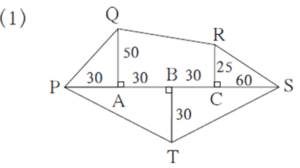
In given Figure,
PA = 30 m, AB = 30 m BC = 30 m, CS = 60 m, QA =5 0m, RC = 25m, TB = 30m.
A(Δ PAQ) = \(\frac{1}{2}\) × PA × QA
= \(\frac{1}{2}\) × 30 × 50
∴ A(Δ PAQ) = 750 m2 .... (1)
A(Δ RCS) = \(\frac{1}{2}\) × CS × RC
= \(\frac{1}{2}\) × 60 × 25
∴ A(Δ RCS) = 750 m2 ...... (2)
∵ P-A-B-C-S
∴ PS = PA + AB + BC + CS
= 30 + 30+30+60
∴ PS = 150 m
Also, AC = AB + BC = 30 + 30 = 60 m
A(Δ PTS) = \(\frac{1}{2}\) × PS × TB
= \(\frac{1}{2}\) × 150 × 30 = 2250
∴ A(Δ PTS) = 2250 m2 .... (3)
QA || RC
QRCA is a Trapezium.
A(□ QRCA) = \(\frac{1}{2}\) × (QA + RC) × AC
= \(\frac{1}{2}\) × (50 + 25) × 60 = \(\frac{1}{2}\) × 75 × 60
A(□ QRCA) = 2250 m2 …..(4)
Area of given Plot = A(Δ PAQ) + A(□ QRCA) + A(Δ RCS) + A(Δ PTS)
= 750 + 2250 + 750 + 2250 …..[From (1), (2), (3) and (4)]
∴ Area of the given Plot = 6000 m2
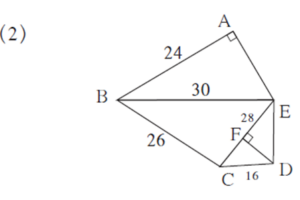
In Δ ABE, m∠ BAE = 90°, l(AB) = 24 m, l(BE) = 30 m
∴ [l(BE)]2 = [l(AB)]2 + [l(AE)]2 ... [Pythagoras theorem]
∴ (30)2 = (24)2 + [l(AE)]2
∴ 900 = 576 + [l(AE)]2
[l(AE)]2 = 900 - 576
∴ [l(AE)]2 = 324
∴ l(AE) = \(\sqrt{324}\) = 18 m ... [Taking square root of both sides]
A(Δ ABE) = \(\frac{1}{2}\) × product of sides forming the right angle
= \(\frac{1}{2}\) × l(AE) × l(AB)
= \(\frac{1}{2}\) × 18 × 24
= 216 sq. m
In Δ BCE, a = 30m, b = 28m, c = 26m
Semiperimeter of Δ BCE,
s = \(\frac{a+b+c}{2}\) = \(\frac{30+28+26}{2}\) = \(\frac{84}{2}\)
= 42 m
A (Δ BCE) = \(\sqrt{s(s-a)(s-b)(s-c)}\)
= \(\sqrt{42(42-30)(42-28)(42-26)}\)
= \(\sqrt{42×12×14×16}\)
= \(\sqrt{7×6×6×2×2×7×8×2}\)
= \(\sqrt{7^2×6^2×2^2×4^2}\)
= 6 × 7 × 2 × 4
= 336 sq. m
In Δ EDC, l(CE) = 28 m, l(DF) = 16 m
A(Δ EDC) = \(\frac{1}{2}\) × base × height
= \(\frac{1}{2}\) × l(CE) × l(DF)
= \(\frac{1}{2}\) × 28 × 16
= 224 sq. m.
∴ Area of plot ABCDE = A(Δ ABE) + A(Δ BCE) + A(Δ EDC)
= 216 + 336 + 224 = 776 sq. m
∴ The area of the given plot is 776 sq.m.