
Notes
Intext Question
Question 1. Why had Joan wanted to meet Captain squire?
Joan wanted to meet the Captain Squire (Robert de Baudricourt) because she needed him to give her a horse, armour, and some soldiers so she could go to the Dauphin.
Question 2. Name the persons who Joan needed to free Orleans.
Joan mentioned several people she wanted to take with her: Polly (Monsieur de Poulengey), Jack (Monsieur de Metz), John Godsave, Dick the Archer, and their servants, John of Honecourt and Julian.
Question 3. Was the Dauphin fit to be a Prince and heir?
No, the Dauphin was not fit to be a Prince and heir. According to Poulengey, the Dauphin was cornered in Chinon "like a rat in a corner" and would not fight, showing he lacked the courage and ability needed to defend his kingdom.
Question 4. What was the squire’s opinion about miracles?
Robert’s opinion was that "miracles are alright," but he believed the problem with them is that "they don’t happen nowadays".
Question 5. What did Robert accuse Poulengey of?
Robert accused Poulengey of being "out of his mind" or mad for seriously believing in Joan's plan and for taking her crazy idea of going to the Dauphin seriously.
Question 6. What shows Joan is a person of immense faith?
- Joan’s immense faith is shown when she tells Robert that soldiering and raising a siege cannot be very difficult "if God is on your side".
- Her absolute confidence that she will succeed despite Robert's initial refusal also demonstrates her deep-seated belief in her mission.
Question 7. Why were the French soldiers always beaten?
According to Joan, the French soldiers were always beaten because they were "fighting only to save their skins," and the quickest way for a soldier to save their skin is to run away.
Question 8. What dress did Joan want?
Joan specifically asked for a soldier’s dress.
Question 9. What made Robert finally agree to the plan?
- Robert agreed because he was moved by Poulengey’s argument that Joan might be their "last chance" and that she herself was "a bit of a miracle".
- He also realized that while the officers' words failed to motivate the troops, Joan’s words might actually inspire the soldiers and even the Dauphin.
- Ultimately, he decided to take a chance and let her go.
ENGLISH WORKSHOP
Question 1. Read the extract from G. B. Shaw’s play on Joan of Arc and fill in the Tree diagram.
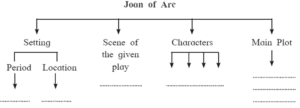
Scene of the given play:
- A room where Captain Robert de Baudricourt, a military officer, is seated at a table with his steward.
Setting:
- Period: The year 1429, during the Hundred Years War (1337 to 1453).
- Location: The castle of Captain Robert de Baudricourt at Vaucouleurs, France (a French city not under English or Burgundian control)
Characters:
- Joan: A 17-to-18-year-old strong, confident peasant girl from Lorraine, also known as "The Maid".
- Captain Robert de Baudricourt (The Squire): A military officer who is initially skeptical and gruff.
- The Steward: Robert's servant who is impressed by Joan's lack of fear.
- Bertrand de Poulengey (Polly): A French guard who believes Joan might be their "last chance" and a "bit of a miracle".
Main Plot:
- Joan, a young peasant girl with immense faith, arrives to meet Captain Robert de Baudricourt to demand a horse, armour, and soldiers. Her mission is to travel to Chinon to meet the Dauphin and lead an army to free Orleans from the English. Despite the Captain’s initial belief that she is "mad" and his soldiers are "cowed," Joan’s confidence and the support of guards like Poulengey eventually convince Robert to take a chance and grant her request.
Question 2. (A) Pick out from the extract of the play two lines that provide evidence for each of the following.
| Joan of Arc | |
| (a)Her confidence | (1) ……………………… |
| (2) ……………………… | |
| (b)Her courage | (1) ……………………… |
| (2) ……………………… | |
| (c)Her optimism | (1) ……………………… |
| (2) ……………………… | |
| (d)Her determination | (1) ……………………… |
| (2) ……………………… | |
| (e)Her patriotism | (1) ……………………… |
| (2) ……………………… |
(a) Her confidence:
- "You are to give me a horse and armour and some soldiers, and send me to the Dauphin."
- "You think you will, squire. But it won’t happen that way. You said you would not see me. But here I am."
(b) Her courage:
- "She really doesn’t seem to be afraid of anything. Perhaps you could frighten her, sir."
- "The squire’s glare neither frightens her nor stops her."
(c) Her optimism:
- "I don’t think it can be very difficult if God is on your side."
- "You and Polly will live to see the day when there will not be a single English soldier on the soil of France."
(d) Her determination:
- "I have arranged it all. You have only to give the order."
- "I can find a soldier’s armour that will fit me well enough. I shall not want many soldiers."
(e) Her patriotism:
- "But I will teach them all to fight for France."
- "Then, they will drive the soldiers before them like sheep."
(B) Using the above points, frame a character-sketch of Joan of Arc, in your own words and write it in your notebook. Suggest an attractive title for the same.
Title: The Maid of Lorraine: A Beacon of Faith and Patriotism
Joan of Arc is depicted as a robust 17-to-18-year-old country girl who possesses a personality so powerful it inspires those around her. Her confidence is striking; she does not ask for permission but tells the Captain what he is "to give" her to complete her mission. This self-belief is supported by immense courage, as she remains completely unfazed by the squire’s intimidating glares or threats of being locked up.
Her determination is seen in how she meticulously plans her journey, even calculating the cost of a horse and deciding to use second-hand armour to save money. Joan’s optimism is fueled by her profound faith, leading her to believe that military success is simple "if God is on your side". Finally, her deep patriotism is the driving force behind her actions; she is dedicated to teaching her countrymen how to fight properly so they can reclaim the "soil of France" from foreign invaders. Overall, she is a "miracle" whose words put "fire" into the hearts of even the most discouraged soldiers.
Question 3. From the extract, find what the following are compared to and why:
(a) as easy as …………………………………………………………..
(b) as mad as …………………………………………………………..
(c) The Dauphin in Chinon is like …………………………………………………………..
(d) The (enemy) soldiers will be driven away like …………………………………..
(e) Joan of Arc is a bit of …………………………………………………………..
(a) as easy as chasing a cow out of a meadow
- Why: Captain Robert uses this comparison to mock Joan, suggesting that she is naive and thinks the difficult military task of raising a siege is as simple as a common farm chore.
(b) as mad as she is
- Why: Robert says this to Poulengey because he believes that anyone who takes Joan and her "crazy ideas" seriously must be just as insane as she appears to be.
(c) The Dauphin in Chinon is like a rat in a corner
- Why: Poulengey uses this comparison to describe the Dauphin’s desperate and helpless state; he is trapped by his enemies and, unlike a cornered rat that might bite, he currently "won’t fight".
(d) The (enemy) soldiers will be driven away like sheep
- Why: Joan uses this simile to express her absolute confidence that once she teaches the French soldiers to fight for France rather than just their own lives, they will become so powerful that the English will flee in a helpless, unorganized panic.
(e) Joan of Arc is a bit of a miracle
- Why: Poulengey describes her this way because he senses "something about her" that is extraordinary and inspiring, believing she is their last chance to save France when all traditional military efforts have failed.
Question 4. Say WHY? Write it in your notebook.
(a) Joan wanted to meet Captain Squire.
Joan wanted to meet Captain Squire (Robert de Baudricourt) because she needed him to provide her with a horse, armour, and soldiers, and to officially send her to the Dauphin so she could fulfill her mission to free Orleans.
(b) Joan did not ask for many soldiers from the Captain Squire.
Joan did not ask for many soldiers because she believed that once she reached the Dauphin, he would provide her with everything she needed to free the city of Orleans.
(c) Poulengey, Jack and Dick had offered to accompany Joan.
They offered to go with her because they felt there was "something about her" that was worth trying. Poulengey, in particular, believed she was a "bit of a miracle" and their "last chance" to save France, as her words had "put fire" into him and inspired him to take a chance.
(d) French soldiers were always beaten in war.
According to Joan, the French soldiers were always beaten because they were "fighting only to save their skins". She explained that for a soldier whose only goal is to stay alive, the shortest and easiest way to do so is to run away from the battle.
(e) Captain Squire Robert said, “I wash my hands off it.”
Robert said this because, although he finally agreed to let Joan go to Chinon, he felt he was taking a "big chance" on an idea that might be "nonsense".
By using this phrase, he indicated that he was no longer taking responsibility for what might happen next, effectively saying he had done all he could and the outcome was now out of his hands.
Question 5. Using a dictionary, find the difference between the following pairs of phrases. Make sentences of your own with each of them.
| Phrases | Meaning | Own Sentences |
| 1. cut in
cut out |
||
| 2. be held by
be held up |
||
| 3. run away
run for |
||
| 4. be known as
be known for |
||
| 5. go with
go after |
||
| 6. put fire into
put fire out |
| Phrases | Meaning | Own Sentences |
| 1. cut in | To interrupt someone while they are speaking. | Please do not cut in while I am answering the question. |
| cut out | To remove something or stop doing something. | The doctor advised him to cut out junk food. |
| 2. be held by | To be possessed, controlled, or occupied by someone or something. | The trophy is held by the winning team. |
| be held up | To be delayed or stopped. | Our bus was held up because of heavy traffic. |
| 3. run away | To escape or leave a place secretly. | The frightened deer ran away into the forest. |
| run for | To compete in an election or race, or to go quickly to get something. | She plans to run for the position of school captain. |
| 4. be known as | To have a particular name or title. | Dr. A. P. J. Abdul Kalam is known as the Missile Man of India. |
| be known for | To be famous because of a particular quality or achievement. | Jaipur is known for its beautiful forts and palaces. |
| 5. go with | To match or accompany something or someone. | These black shoes go with my school uniform. |
| go after | To chase, pursue, or try to achieve something. | The police went after the thieves. |
| 6. put fire into | To encourage or inspire someone with enthusiasm or courage. | The coach's speech put fire into the players before the match. |
| put fire out | To extinguish a fire. | The firefighters quickly put the fire out. |
Question 6. From an Indian History Book or Internet find out information about Indian Women (queens) who led battles. (For example, Rani of Jhansi and Rani Karnawati of Mewad). Write 3 points of similarity and 3 points of contrast between any one of the above Indian Queens and Joan of Arc. Write in your own words.
| Similarities | Contrast | ||
| (a) | ..................... | (i) | ..................... |
| (b) | ..................... | (ii) | ................... |
| (c) | ..................... | (iii) | ..................... |
Comparison: Joan of Arc and Rani Lakshmibai
Similarities :
- Both were brave patriots who fought to protect their country.
- Both inspired their soldiers with their courage and leadership.
- Both became symbols of hope and bravery.
Differences :
- Joan of Arc was a peasant girl, while Rani Lakshmibai was the Queen of Jhansi.
- Joan believed God had sent her on a mission, whereas Rani fought against British rule to save her kingdom.
- Joan had no military training, while Rani Lakshmibai was trained in sword fighting, horse riding, and martial arts from childhood.
Students should do it by self (Activity)
Question 7. Read the script from :
Joan (Girl) : Good morning, Captain
Squire ……………….
up to
Joan : (simply) ……………
Polly and Jack have promised to come with me.
Write a summary of that part of the script (in the indirect speech) in 15 to 20 lines. Do it in your notebook.
Joan entered the room and confidently greeted Captain Robert, informing him that he was to provide her with a horse, armour, and soldiers so she could go to the Dauphin. Robert immediately reacted by declaring the girl mad and threatened to have her sent back to her father to be placed under lock and key. Joan remained entirely unmoved by his glare, pointing out that she was standing before him even though he had initially refused to see her.
She took it for granted that he would eventually grant her request and began busily calculating the logistics of her journey. She noted that while a horse would be a significant expense at sixteen francs, she could save money by using second-hand soldier’s armour rather than a custom-made suit. Joan further asserted that she would not require many soldiers from him because she believed the Dauphin would provide everything necessary for her to free Orleans.
This revelation left Robert visibly shocked, but Joan simply reiterated her mission with calm confidence. She told the Captain that only three men would be sufficient for him to send along as her escort. Finally, she informed him that Monsieur de Poulengey and Monsieur de Metz had already promised to accompany her on the mission. She described "Squire Jack" as a very kind gentleman who often gave her money to help the poor.
Question 8. (A) Make the following sentences Affirmative without change of meaning.
(a) Negative : I am not so sure, now.
Affirmative :
(b) Negative : He will not be able to stop them.
Affirmative :
(c) Negative : I don’t remember.
Affirmative :
(d) Negative : I can do no more.
Affirmative :
(e) Negative : Sir, do not anger her.
Affirmative :
(f) Negative : I shall not want many soldiers.
Affirmative :
(a) Negative: I am not so sure, now.
Affirmative: I am quite uncertain now. (Or: I am doubtful now.)
(b) Negative: He will not be able to stop them.
Affirmative: He will be unable to stop them. (Or: He will fail to stop them.)
(c) Negative: I don’t remember.
Affirmative: I forget.
(d) Negative: I can do no more.
Affirmative: I have done all I can. (Or: I am helpless to do anything further.)
(e) Negative: Sir, do not anger her.
Affirmative: Sir, keep her calm. (Or: Sir, be patient with her.)
(f) Negative: I shall not want many soldiers.
Affirmative: I shall want only a few soldiers.
(B) Fill in the gaps in the table.
WORD-FORMS
| Noun | Verb | Adjective | Adverb |
| 1. success | succeed | successful | successfully |
| 2. ............ | inspire | ............ | ............ |
| 3. ............... | ............ | safe | ............ |
| 4. ................. | harm | ............ | ............ |
| 5. thought | ............ | ............ | |
| 6. ............ | ............ | ............ | brightly |
| 7. courage | ............ | ... ....... | ... ............ |
| 8. ............... | ............ | ............ | hastily |
WORD-FORMS Table :
|
No. |
Noun | Verb | Adjective | Adverb |
| 1. | success | succeed | successful | successfully |
| 2. | inspiration | inspire | inspiring | inspiringly |
| 3. | safety | save | safe | safely |
| 4. | harm | harm | harmful | harmfully |
| 5. | thought | think | thoughtful | thoughtfully |
| 6. | brightness | brighten | bright | brightly |
| 7. | courage | encourage | courageous | courageously |
| 8. | haste | hasten | hasty |
hastily |