
Solutions (Exercise + Intext)
Intext Question
Question 1. What do ‘exits’ and ‘entrances’ refer to?
‘Entrances' refer to a person's birth (coming onto the 'stage' of the world), and 'exits' refer to a person's death (leaving the stage), just as actors enter and leave during a play.
Question 2. Why is reputation like a bubble?
Reputation is compared to a bubble because, like a bubble, it looks attractive and impressive from the outside but is extremely fragile, temporary, and can be destroyed in an instant — just as a soldier risking his life for fame may lose everything in a moment on the battlefield.
Question 3. What is the major difference noticed in the 5th and 6th stage of life ?
The transition from the fifth to the sixth stage marks a significant physical and social decline:
- In the 5th stage (the Justice), the man is at the peak of his powers — confident, authoritative, wise, and physically robust (a 'fair round belly').
- In the 6th stage (the Pantaloon), he has visibly declined — he becomes thin and shrunken, needs spectacles, wears slippers, and his clothes and voice no longer suit his weakened body.
The difference shows the sharp transition from the prime of life to physical decline.
English Workshop
Question 1. Read the words in given clouds. Match them with what they signify.
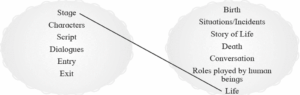
- Stage: Life
- Characters: Roles played by human beings
- Script: Story of Life
- Dialogues: Conversation
- Entry: Birth
- Exit: Death
The poem uses these theatrical metaphors to illustrate that the world is a theater where the "drama of human life is enacted" through various roles and stages.
Question 2. Read the poem carefully and complete the following table.
| Ages of Man | Role | Qualities / Actions |
| 1 | …………………………… | 1 ………………………………………………….
2 …………………………………………………. |
| 2 | …………………………… | 1 ………………………………………………….
2 …………………………………………………. |
| 3 | …………………………… | 1 ………………………………………………….
2 …………………………………………………. |
| 4 | …………………………… | 1 ………………………………………………….
2 …………………………………………………. |
| 5 | …………………………… | 1 ………………………………………………….
2 …………………………………………………. |
| 6 | …………………………… | 1 ………………………………………………….
2 …………………………………………………. |
| 7 | …………………………… | 1 ………………………………………………….
2 …………………………………………………. |
| Age | Role/Stage | Qualities | Actions |
| 1 | Infant (Babyhood) | Helpless and weak | Cries and vomits in the nurse's arms; |
| 2 | Schoolboy (Childhood) | Reluctant and unhappy | Whines, carries his satchel, has a shining but crawls unwillingly to school like a snail. |
| 3 | The Lover (Adolescence/Youth) | Romantic and emotional | Sighs like a furnace (burning with passion) and composes sad love songs/poems for his beloved. |
| 4 | Soldier (Adulthood) | Aggressive and honour-bound | Swears strange oaths, grows a beard like a leopard, is quick-tempered, and risks his life for fleeting fame ('the bubble reputation') even facing cannon fire. |
| 5 | Justice/Judge (Middle age) | Wise but pompous | Has a round belly from good living, looks stern, has a neatly trimmed beard, and is full of wise sayings and sound judgments. |
| 6 | Pantaloon (Old age) | Shrunken and comic | Becomes lean, wears slippers and spectacles, his clothes (hose) now look too big for his shrunken legs; his once-deep voice turns thin and childish again. |
| 7 | Second Childhood (Extreme old age) | Helpless, near death | Returns to a state like infancy — without teeth, eyesight, taste, or any other faculty ('sans everything'); the play of life ends. |
Question 3. Write down in your own words the differences between the following stages of a man’s life.
- 2nd stage and 4th stage
- 3rd stage and 5th stage
- 1st stage and 7th (last) stage
2nd Stage and 4th Stage:
- The 2nd stage (Schoolboy) is shy and unwilling. He goes to school slowly and does not want to be there.
- In contrast, the 4th stage (Soldier) is brave and eager. He is quick-tempered and ready to risk his life in battle to earn honour and fame.
- The schoolboy avoids responsibility, while the soldier willingly faces danger.
3rd Stage and 5th Stage:
- The 3rd stage (Lover) is emotional and romantic. He spends his time thinking about love and writing poems for his beloved.
- The 5th stage (Justice/Judge) is wise, practical, and respected. He makes decisions based on experience and good judgment.
- The lover is guided by emotions, while the judge is guided by wisdom and reason.
1st Stage and 7th (Last) Stage:
- Both stages show a person who depends completely on others.
- The 1st stage (Infant) is at the beginning of life, when a baby is helpless but has a whole life ahead.
- The 7th stage (Second Childhood) is at the end of life, when a person becomes helpless again after losing strength, memory, and senses.
- The infant has a future ahead, while the old person is nearing the end of life.
Question 4. Pick out lines that contain Imagery (a picture created in the mind by using words) of the following people.
(a)School boy (2nd stage)
(b)Soldier (4th stage)
(c)Judge (5th stage)
(d)Senior citizen (6th stage)
(a) School boy (2nd stage):
"Then the whining schoolboy, with his satchel
And shining morning face, creeping like snail
Unwillingly to school."
(b) Soldier (4th stage):
"Full of strange oaths and bearded like the pard,
Jealous in honour, sudden and quick in quarrel,
Seeking the bubble reputation
Even in the cannon’s mouth."
(c) Judge (5th stage):
"In fair round belly with good capon lined,
With eyes severe and beard of formal cut,
Full of wise saws and modern instances;"
(d) Senior citizen (6th stage):
"Into the lean and slippered pantaloon,
With spectacles on nose and pouch on side;
His youthful hose, well saved, a world too wide
For his shrunk shank..."
Question 5. You will notice that there is no Rhyme-scheme in the poem. It appears similar to the poem 1.1 ‘Where the Mind is Without Fear’ by Tagore.
However Tagore’s poem has no steady rhythm/meter either it is called Free Verse. Shakespeare uses lines with a steady rhythm of 5 beats in each. It is termed as Blank Verse. (No rhyme-scheme but uniformity in rhythm)
Copy the lines from “Ánd all the men and women merely players” to “sudden and quick in quarrel”. Put a stress mark on each of the syllables stressed in the lines as - for example, And all the men and women merely players;
Note : Student can discuss with their partners and do this activity by self.
Question 6. Think and write on your own.
(a)What is the theme/central idea of this poem ?
- The central theme of the poem is that life follows a natural cycle, and no one can escape growing old.
- Shakespeare compares the world to a stage and people to actors who play different roles at different stages of life.
- The poem shows how a person changes from a helpless baby to a helpless old person again, highlighting that change, aging, and the passage of time are a natural part of human life.
(b) Which two stages of man, described by Shakespeare sound humorous ? Say why.
Two stages that are often seen as humorous because of their exaggerated descriptions are:
- The Lover (3rd Stage): This stage is funny because the lover behaves very dramatically. He keeps sighing deeply and writes sad love poems about his beloved, even about something as small as her eyebrow.
- The Justice (5th Stage): This stage is humorous because the judge appears proud and self-important. He has a round belly from eating well and likes to show off his wisdom by quoting sayings and giving examples.
Both stages are amusing because Shakespeare exaggerates their behaviour to highlight their typical qualities.
(c) The last (7th) stage of life sounds very sad and miserable. How can you makeold age also cheerful and happy ?
While Shakespeare describes the final stage as a "second childishness" characterized by loss of senses and memory, old age can be made cheerful by:
- Maintaining social connections: Surrounding oneself with family and friends can help combat the feeling of "oblivion" and loneliness.
- Staying mentally active: Engaging in hobbies or storytelling (sharing "wise saws") can keep the mind sharp even as the body weakens.
- Focusing on legacy: Viewing this stage not as a loss of "everything," but as a time to reflect on the "eventful history" one has lived through.
Question 7. (A) The poem is entirely metaphorical. Pick out the comparisons from the poem.
(a) world
(b) actors
(c) birth and death
(d) school boy
(e) the lover’s sigh
(f) spotted leopard
(g) last stage (old age)
Here is how the poem matches human life to different objects or concepts,,,:
- (a) World: A stage.
- (b) Actors: All the men and women (referred to as players).
- (c) Birth and Death: Entrances and exits.
- (d) School boy: Compared to a snail (due to his slow movement).
- (e) The lover’s sigh: Compared to a furnace (due to the heat and intensity of passion).
- (f) Spotted leopard: The soldier's beard is compared to a pard (leopard).
- (g) Last stage (old age): Second childishness and mere oblivion.
(B)Pick out from the poem two examples of each.
| (a) Simile | (1) ………………………
(2) ……………………… |
| (b) Onomatopoeia | (1) ………………………
(2) ……………………… |
| (c) Alliteration | (1) ………………………
(2) ……………………… |
| (d) Metaphor | (1) ………………………
(2) ……………………… |
| (e) Inversion | (1) ………………………
(2) ……………………… |
| (f) Transferred Epithet | (1) ………………………
(2) ……………………… |
Here are two examples for each of the requested poetic devices found in the poem:
(a) Simile (Direct comparisons using "as" or "like"):
- "...creeping like snail..."
- "...sighing like furnace..." (Another example: "...bearded like the pard...")
(b) Onomatopoeia (Words that imitate sounds):
- "Mewling and puking..."
- "...whistles in his sound."
(c) Alliteration (Repetition of consonant sounds at the beginning of words):
- "...plays many parts..." (Repetition of 'p' sound in 'plays' and 'parts')
- "...shrunk shank..." (Repetition of 'sh' sound)
(d) Metaphor (Indirect comparisons without using "as" or "like"):
- "All the world’s a stage..."
- "...seeking the bubble reputation..."
(e) Inversion (Change in the normal word order for poetic effect):
- "Into the lean and slippered pantaloon" (Instead of: Shifts into the lean and slippered pantaloon).
- "His youthful hose, well saved, a world too wide" (Instead of: His youthful hose, which are well saved, are a world too wide).
(f) Transferred Epithet (An adjective that describes a person's feeling but is applied to an object):
- "Woeful ballad" (The ballad itself isn't sad; it's the lover who is woeful while writing it).
- "Youthful hose" (The stockings aren't young; they belong to the man's youthful days).
Question 8. Read the summary of the play ‘As You Like It’ by William Shakespeare using the Internet. Find out which character has narrated the above poem and on what occasion. Also, make a list of all the characters of the play.
This poem is actually a monologue taken from William Shakespeare's play "As You Like It".
Narrator and Occasion (Information from internet) :
- Character: The monologue is narrated by Jaques, a faithful lord who follows the exiled Duke Senior into the Forest of Arden. He is known for his melancholy and cynical outlook on life.
- Occasion: Jaques delivers this speech in Act II, Scene VII. The occasion arises after Duke Senior observes that they are not the only ones who are unhappy, noting that the "wide and universal theatre" of the world presents more woeful pageants than the scene they are currently living. Jaques responds to this by expanding on the idea that "all the world's a stage."
List of Characters in “As You Like It” (Information from internet) :
- Rosalind: The protagonist and daughter of Duke Senior.
- Orlando: The youngest son of Sir Rowland de Boys and Rosalind's love interest.
- Duke Senior: The rightful duke who has been exiled to the Forest of Arden by his brother.
- Jaques: The melancholy lord who narrates the "Seven Ages of Man" speech.
- Celia: Rosalind’s cousin and the daughter of Duke Frederick.
- Duke Frederick: The younger brother of Duke Senior who usurped his throne.
- Touchstone: The court fool or jester.
- Oliver: Orlando's older brother.
- Silvius and Phebe: A shepherd and shepherdess.
- Adam: An elderly, loyal servant to Orlando’s family.
- Audrey: A country wench.
- Corin: An elderly shepherd.
Question 9. Read the poem again and write an appreciation of the poem in a paragraph format. (Refer to page no. 5)
The poem "All the World’s a Stage" is a famous monologue written by the legendary playwright and poet William Shakespeare, taken from his play As You Like It.
The central theme of the poem is the inevitability of the human life cycle and the transience of our existence; it compares the world to a theater stage where every person is merely a "player" performing seven different roles throughout their life.
In terms of poetic structure, it is written in Blank Verse, which means it lacks a rhyme scheme but follows a steady rhythm of five beats per line. Shakespeare uses a rich variety of figures of speech to bring these stages to life, such as metaphors (comparing birth to "entrances"), similes (the schoolboy "creeping like snail"), and onomatopoeia ("mewling," "puking," and "whistles").
The tone of the poem ranges from humorous and satirical, particularly when describing the lover or the justice, to deeply somber in the final stage of "second childishness". This poem is widely appreciated for its universal appeal and vivid imagery, providing a philosophical reflection on how we all eventually end our "eventful history" in a state of "mere oblivion," without our senses or possessions.