
Solutions (Exercise + Intext)
Intext Question
Question 1. Why is Air Force Marshal Arjan Singh considered an outstanding military personality?
- Arjan Singh is considered an outstanding military personality because he was a war hero who successfully led the Indian Air Force (IAF) during the 1965 Indo-Pak war.
- He is the only officer to attain the highest post of Marshal of the Air Force (a five-star rank).
- Additionally, he was an exceptional pilot who flew more than 60 different types of aircraft and played a monumental role in transforming the IAF into the fourth largest and one of the most potent air forces in the world.
Question 2. What personality traits of Arjan Singh are mentioned here?
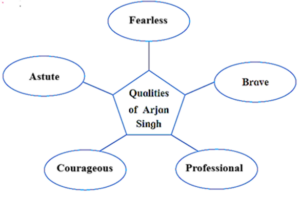
- The text describe Arjan Singh as fearless, a man of few words, and someone with profound knowledge about air power.
- Former Defence Minister Y.B. Chavan described him as a "jewel of a person" who was efficient, firm, unexcitable, and a very able leader.
- He was also known for his courage, determination, professional skill, and astute leadership.
Question 3. What enabled Arjan Singh to win the DFC award?
Arjan Singh was awarded the Distinguished Flying Cross (DFC) in 1944 for his role in successfully leading a squadron in combat against the Japanese during the Arakan Campaign. He flew crucial close air support missions during the Imphal Campaign and assisted the Allied Forces' advance to Yangon.
Question 4. At what age did Arjan Singh become a Squadron Leader?
Arjan Singh was born on April 15, 1919, and was promoted to the rank of Squadron Leader in 1944. Therefore, he became a Squadron Leader at the age of 25.
Question 5. For how long did Arjan Singh hold the post of AOC?
He held the distinction of having the longest tenure as Air Officer Commanding (AOC) of an operational command.
He served in this position for a total of seven years over two separate periods: first from 1949–1952 and again from 1957–1961.
Question 6. What uphill task did Singh face when he took over as Air Marshal?
When he took over the reins of the IAF as Air Marshal on August 1, 1964, he faced the uphill task of leading the force at a time when it was still rebuilding itself and gearing up to meet new challenges.
Question 7. What other important positions did Arjan Singh hold after his retirement?
After retiring from the IAF in August 1969, Arjan Singh served as the Ambassador to Switzerland.
Later, from December 1989 to December 1990, he held the position of Lieutenant Governor of Delhi.
English Workshop
Question 1. Read the text and fill in the flow chart of the promotions received by Arjan Singh.
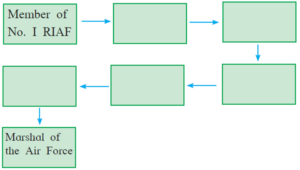
Promotions Received by Arjan Singh :
Commissioned as a Pilot
(member of the No.1 RIAF Squadron)
(Initial assignment flying Westland Wapiti biplanes)
↓
Flying Officer
(Moved to No. 1 Sqn to fly Hawker Hurricanes)
↓
Squadron Leader
(Promoted in 1944)
↓
Wing Commander
(Attended Royal Staff College, UK after this promotion)
↓
Group Captain
(Commanded Ambala immediately after Indian independence)
↓
Air Commodore
(Promoted in 1949; took over as AOC of an operational command)
↓
Air Vice Marshal
(Appointed as AOC-in-C of an operational command)
↓
Air Marshal
(Took over reins of the IAF on August 1, 1964)
↓
Air Chief Marshal
(Became the first Air Chief Marshal after the rank of CAS was upgraded)
↓
Marshal of the Air Force
(Conferred the highest five-star rank in January 2002)
Question 2. With the help of facts given in the text prepare a Fact file of Air Marshal Arjan Singh.
(a) Date of Birth ______________
(b) Place of Birth ______________
(c) Education ______________
(d) First Assignments ______________
(e) Important posts held (a) In Air Force ______________
(b) After retirement ______________
(f) Awards ______________
(g) Most outstanding contribution in IAF ______________
(h) Retirement ______________
(a) Date of Birth: April 15, 1919.
(b) Place of Birth: Lyalpur (now Faisalabad, Pakistan).
(c) Education: Completed his education at Montgomery (now Sahiwal, Pakistan) and later attended the Empire Pilot training course at RAF Cranwell in 1938 at the age of 19. He also attended the Royal Staff College in the UK.
(d) First Assignments: Flying Westland Wapiti biplanes in the North-Western Frontier Province as a member of the No. 1 RIAF Squadron.
(e) Important posts held:
- (a) In Air Force: Squadron Leader (1944); AOC of an operational command (Western Air Command); Deputy Chief of the Air Staff; Vice Chief of the Air Staff; Air Marshal (taking over reins of IAF in 1964); first Air Chief Marshal of the IAF; and finally, Marshal of the Air Force.
- (b) After retirement: Ambassador to Switzerland and Lieutenant Governor of Delhi (December 1989 to December 1990).
(f) Awards: Distinguished Flying Cross (DFC) in 1944 and the Padma Vibhushan.
(g) Most outstanding contribution in IAF: Successfully leading the Indian Air Force during the 1965 Indo-Pak war, where he denied success to the better-equipped Pakistani Air Force through his astute leadership, courage, and determination.
(h) Retirement: He retired from service in August 1969.
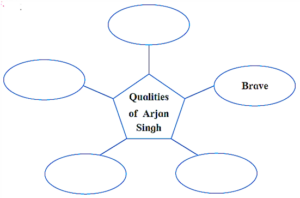
Question 3. Fill in the web.
Question 4. Say what actions preceded the following promotions of Arjan Singh in his career in the IAF.
(a) Selected for Empire Pilot training course at RAF
(b) Promoted to Squadron Leader
(c) Leader of a flypast of over 100 aircrafts at Red Fort, Delhi
(d) Awarded Padma Vibhushan
(e) First Air Chief Marshal of Indian Air Force
(a) Selected for Empire Pilot training course at RAF:
- Preceding this selection in 1938, Arjan Singh completed his education at Montgomery (now Sahiwal, Pakistan).
(b) Promoted to Squadron Leader:
- This promotion in 1944 followed a brief stint with the No. 2 RIAF Squadron, where he flew against tribal forces, and his subsequent move back to No. 1 Squadron as a Flying Officer to fly Hawker Hurricanes.
(c) Leader of a flypast of over 100 aircrafts at Red Fort, Delhi:
- Prior to this unique honor on August 15, 1947, Singh had successfully led a squadron in combat against the Japanese during the Arakan and Imphal campaigns and was awarded the Distinguished Flying Cross (DFC).
(d) Awarded Padma Vibhushan:
- This high civilian honor was given in recognition of his astute leadership of the Air Force during the 1965 Indo-Pak war, where he successfully inspired the IAF to victory despite significant constraints.
(e) First Air Chief Marshal of Indian Air Force:
- This promotion occurred because the rank of the Chief of the Air Staff (CAS) was upgraded in recognition of the Air Force’s overall contribution during the 1965 war.
Question 5. Replace the underlined words/phrases with the appropriate ones, to retain the proper meaning.
(be the epitome of, gear up, a brief stint, play a major role, in recognition of, takeover reins)
(a) He contributed notably in bringing up the school.
(b) Our school cricket team got ready for the final match against P. Q. R. High School.
(c) After a short period of working as a lecturer, Ravi took up an important posting a multi-national company.
(d) Our class monitor is a perfect symbol of duty and discipline.
(e) Accepting the great value of his research; they awarded him with a Ph.D. (degree)
(f) After the murder of King Duncan, Macbeth took over the control of Scotland.
Here are the sentences with the underlined words and phrases replaced by the appropriate expressions from the provided list:
- (a) He played a major role in bringing up the school.
- (b) Our school cricket team geared up for the final match against P. Q. R. High School.
- (c) After a brief stint as a lecturer, Ravi took up an important post in a multi-national company.
- (d) Our class monitor is the epitome of duty and discipline.
- (e) In recognition of his research; they awarded him with a Ph.D. (degree).
- (f) After the murder of King Duncan, Macbeth took over reins of Scotland.
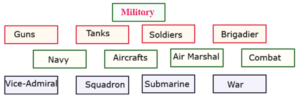
Question 6. Build the word wall with the words related to ‘Military’.

Question 7. (A) State the different meanings of the following pairs of Homophones and make sentences of your own with each of them.
Homophones: Meanings and Sentences
| Word | Meaning | Sentence |
| (a) led | Guided or showed the way (past tense of lead). | Arjan Singh led the IAF successfully during the 1965 Indo-Pak war. |
| lead | A heavy, bluish-grey metallic element. | Lead was commonly used in pipes before its toxicity was fully understood. |
| (b) role | A function or part played by a person in a particular situation. | He played a major role in transforming the IAF into a potent force. |
| roll | To move by turning over and over on an axis. | The children enjoyed watching the ball roll down the steep hill. |
| (c) air | The invisible gaseous substance surrounding the earth. | We need fresh air and exercise to stay healthy. |
| heir | A person legally entitled to the property or rank of another. | The young prince is the rightful heir to the throne. |
| (d) feat | An achievement that requires great courage, skill, or strength. | He was awarded the DFC on the spot in recognition of his feat. |
| feet | The plural form of "foot" (part of the body). | My feet were tired after the long hike through the mountains. |
| (e) reign | The period during which a sovereign rules. | The Great Ashoka's reign is known for the spread of peace and Buddhism. |
| rein | A long strap used to control a horse (often used figuratively as "control"). | Arjan Singh took over the reins of the IAF in 1964. |
| rain | Water falling in drops from the clouds. | The farmers were happy to see the rain after a long dry spell. |
(B) The following Homographs have the same spelling and pronunciation; but can have different meanings. Make sentences of your own to show the difference.
(a) firm
(b) train
(c) type
(d) post
(e) current
Homographs: Sentences Showing Different Meanings
- (a) firm
- Meaning 1 (Solid/Resolute): Arjan Singh was described by the Defence Minister as a person who was quite efficient and firm.
- Meaning 2 (A Business): My sister recently started working for a prestigious architecture firm in the city.
- (b) train
- Meaning 1 (Transport): We decided to take the overnight train to reach Delhi by morning.
- Meaning 2 (To Teach/Learn): Pilots must train for many hours in simulators before flying a real aircraft.
- (c) type
- Meaning 1 (Category): Arjan Singh flew more than 60 different types of aircraft during his career.
- Meaning 2 (To Write): You need to type your application clearly before submitting it.
- (d) post
- Meaning 1 (Job/Position): Singh attained the highest post of Marshal of the Air Force.
- Meaning 2 (To Mail): Please remember to post this birthday card on your way to work.
- (e) current
- Meaning 1 (Present Time): The current situation requires everyone to stay calm and follow instructions.
- Meaning 2 (Flow of Water/Air): It is dangerous to swim in the river because the current is very strong today.
Question 8. Glance through the text and prepare notes from the information that you get. Take only relevant points. Don’t use sentences. Arrange the points in the same order. You may use symbols or short forms. Present the points sequentially. Use highlighting techniques.
Marshal Arjan Singh: Career & Legacy Notes :
Personal Details:
- Born: 15 Apr 1919, Lyalpur (now Faisalabad, Pakistan)
- : Montgomery (now Sahiwal, Pakistan)
- Pilot training: RAF Cranwell, UK — 1938
Military Icon & War Hero :
- Successful leader of IAF during 1965 Indo-Pak war.
- 1st & only 5-star Marshal of the Indian Air Force.
- Fearless pilot; flew 60+ types of aircraft (biplanes to Gnats).
- Architect of IAF as 4th largest air force globally.
Personality & Leadership Traits :
- "Man of few words" with profound knowledge of air power.
- Efficient, firm, unexcitable, and astute.
- Epitome of military leadership.
Early Career Milestones :
- 1938: RAF Cranwell training @ age 19.
- 1st Assignment: Flying Westland Wapiti biplanes (NW Frontier Province).
- 1944: Promoted to Sqn Leader; fought Japanese in Arakan/Imphal.
- Gallantry: Awarded Distinguished Flying Cross (DFC).
Growth Post-Independence :
- Aug 15, 1947: Led fly-past (100+ aircraft) over Red Fort.
- 1949: Air Commodore; took over AOC of an operational command.
- Distinction: Longest tenure as AOC (7 years total).
Senior Commands & 1965 War :
- 1962-63: Deputy Chief & Vice Chief of the Air Staff.
- Aug 1, 1964: Took over reins of IAF as Air Marshal.
- 1965 War: Countered Pakistan's 'Operation Grand Slam'; led IAF to victory.
- Recognition: Rank upgraded to Air Chief Marshal.
Retirement & Civil Service :
- 1969: Retired in August.
- Diplomacy: Ambassador to Switzerland.
- Administration: Lt Governor of Delhi (1989-1990).
Ultimate Honor :
- Jan 2002: Conferred rank of Marshal of the Air Force.
Question 9. Develop a story suitable to the conclusion/end given below. Suggest a suitable title.
___________ (Title)
…………………………………………………………………………………………
…………………………………………………………………………………………
…………………………………………………………………………………………
……and so, with tears of joy and pride, the 10 year old Sanyogita More received the National Bravery Award from the Prime Minister.
The Little Savior of Sangli
Sanyogita was known in her small village as a girl of few words, possessing a quiet but firm nature that commanded respect even from those much older than her. She spent her afternoons reading about the fearless pilots and war heroes who had shaped India’s history, often dreaming of showing similar courage and determination one day.
That opportunity came unexpectedly during the peak of the monsoon season. The local river, usually a gentle stream, had turned into a roaring torrent. While the village was gearing up for a festival, a sudden flash flood hit, and the current became dangerously strong. Amidst the chaos, Sanyogita noticed two younger children trapped on a small wooden bridge that was beginning to crack under the pressure of the rising water.
While the adults panicked, Sanyogita remained unexcitable. Her astute mind quickly calculated a plan. Knowing she couldn't fight the water's force directly, she grabbed a thick coil of rope from a nearby shed. With the professional skill of someone twice her age, she tied one end to a sturdy tree and, despite the constraints of the muddy banks, managed to reach the bridge just as it started to give way.
She acted as the epitome of bravery, calmly guiding the terrified children along the rope to the safety of higher ground. Her monumental act of selfless service was soon reported to the authorities, who recognized that her presence of mind had saved two lives.
...and so, with tears of joy and pride, the 10 year old Sanyogita More received the National Bravery Award from the Prime Minister.