
Notes
|
Topics to be learn :
|
Area :
Area is the measure of the region enclosed by a closed polygon. It is measured in square units because the calculation is fundamentally based on the number of squares that can fit within the boundary.
Basic Shape Formulas
- Square: Area = side2
- Rectangle: Area = length × breadth
- Right-angled Triangle: Area = \(\frac{1}{2}\) × product of sides making the right angle
- Standard Triangle: Area = \(\frac{1}{2}\) × base × height
Area of Quadrilaterals :
Area of a parallelogram :
A quadrilateral is a parallelogram if both the pairs of its opposite sides are parallel and equal.
The area of a parallelogram is equivalent to the area of a rectangle with the same base and height.
Formula: Area = base × height
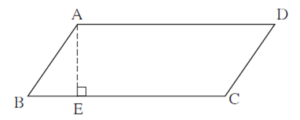
Key Insight:
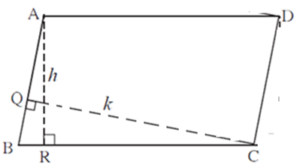
If one parallel side is considered the base, the height is the perpendicular distance between the two parallel sides.
Multiple bases can be used; for instance, in parallelogram ABCD, the area can be expressed as l(BC) × h or l(AB) × k, where h and k are heights corresponding to those specific bases.
Area of a rhombus :
The area of a rhombus is derived from the properties of its diagonals, which are perpendicular bisectors of each other. This divides the rhombus into four congruent right-angled triangles.
- Formula: Area = \(\frac{1}{2}\) × product of lengths of diagonals
- Side Calculation: If the diagonals and area are known, the side of the rhombus can be found using the Pythagoras theorem within one of the internal right-angled triangles (where sides are half the lengths of the diagonals).
Example :
□ ABCD is a rhombus. Its diagonals intersect in the point P. So we get four congruent right angled triangles. Sides of each right angled triangle are \(\frac{1}{2}\) l(AC) and \(\frac{1}{2}\) l(BD). Areas of all these four triangles are equal.
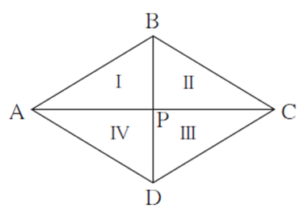
Area of rhombus ABCD = 4 × A(Δ APB)
= 4 × \(\frac{1}{2}\) × l(AP) × l(BP)
= 2 × \(\frac{l(AC}{2}×\frac{l(BD}{2}\)
= \(\frac{1}{2}\) × l(AC) × l(BD)
Area of a trapezium :
A trapezium's area is calculated by considering the distance between its parallel sides.
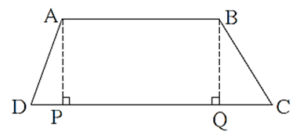
Formula: Area = \(\frac{1}{2}\) × sum of the lengths of parallel sides × height
Derivation: The area of a trapezium can be subdivided into two right-angled triangles and one rectangle. Summing these parts leads to the general formula.
Area of trapezium ABCD = \(\frac{1}{2}\) × h [l(DC) + l(AB)]
Area of a Triangle :
Advanced Triangle Measurement: Heron’s Formula
When the height of a triangle is unknown, but the lengths of all three sides (a, b, c) are provided, Heron’s Formula is employed.
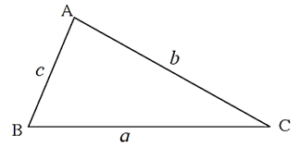
Calculate the Semiperimeter (s): s = \(\frac{a+b+c}{2}\)
Apply the Formula: Area = \(\sqrt{s(s-a)(s-b)(s-c)}\)
Area of figures having irregular shape :
In practical scenarios, such as measuring fields or plots, figures often have irregular shapes. Two primary methods are used for these calculations:
(i) Division into Known Polygons
Irregular polygons are divided into smaller, manageable shapes such as triangles and trapeziums. The total area is the sum of the areas of these sub-figures.
| Sub-figure Type | Required Data for Calculation |
| Right-angled Triangle | Base and perpendicular height |
| Trapezium | Lengths of parallel sides and height |
| General Triangle | Three side lengths (using Heron's Formula) |
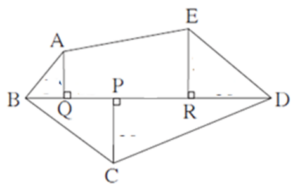
Area of polygon ABCDE = A(Δ AQB) + A(□ AQRE) + A(Δ ERD) + A(Δ BCD)
(ii) Graph Paper Approximation
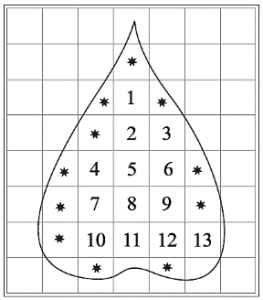
For closed figures with highly irregular boundaries, area can be estimated using graph paper:
Complete Squares: Counted as 1 sq cm each.
- Partial Squares (> \(\frac{1}{2}\) area): Counted as 1 sq cm.
- Half Squares (\(\frac{1}{2}\) area): Counted as 0.5 sq cm.
- Small Partial Squares (< \(\frac{1}{2}\) area): These are ignored (0 sq cm).
- Accuracy: The smaller the squares on the graph paper, the more accurate the approximation.
Area of a circle :
Suppose we have a circle of radius 'r' and diameter 'd' then
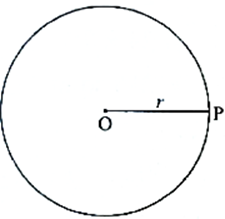
Area of the circle = πr2
Circumference of the circle = 2πr or πd
Land Measurement Units :
The revenue department utilizes a decimal system for recording land areas. The following table illustrates the conversions between various units:
| Unit | Metric Equivalent | Additional Notes |
| 1 Are | 100 sq m | Approximately 1 Guntha |
| 1 Hectare | 100 Are (10,000 sq m) | Standardized decimal unit |
| 1 Guntha | ≈ 100 sq m | Practical/traditional unit |
| 1 Acre | ≈ 0.4 Hectare | Practical/traditional unit |