
Solutions
Practice Set 8.1
Question 1.1. Construct the following quadrilaterals of given measures.
(1) In □ MORE, l(MO) = 5.8 cm, l(OR) = 4.4 cm, m∠ M = 58°, m∠ O = 105°, m∠ R = 90°.
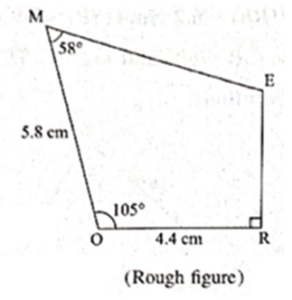
Steps of Construction:
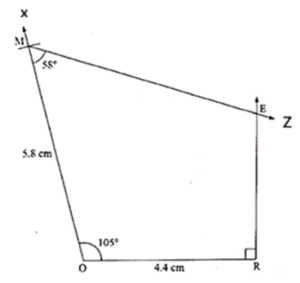
- Draw OR = 4.4 cm.
- Draw ∠ ROX = 105°.
- With O as the center and a radius of 5.8 cm, draw an arc-cutting ray OX at M.
- Draw ∠ ORE = 90°.
- Draw ∠ OMZ = 58°. Angle and extend the ray MZ. Let the rays MZ and RE intersect at point E.
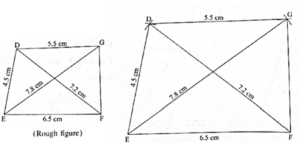
(2) Construct □ DEFG such that l(DE) = 4.5 cm, l(EF) = 6.5 cm, l(DG) = 5.5 cm, l(DF) = 7.2 cm, l(EG) = 7.8 cm.
Steps of Construction:
- Draw EF = 6.5 cm.
- With F as centre and radius 7.2 cm, draw an arc.
- With E as centre and radius 4.5 cm, draw an arc cutting the previous arc at D.
- Join ED.
- With D as centre and radius 5.5 cm, draw an arc.
- With E as centre and radius 7.8 cm, draw an arc cutting the previous arc at G.
- Join DG and GF.
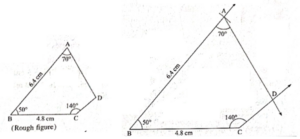
(3) In □ ABCD, l(AB) = 6.4 cm, l(BC) = 4.8 cm, m∠ A = 70°, m∠ B = 50°, m∠ C = 140°.
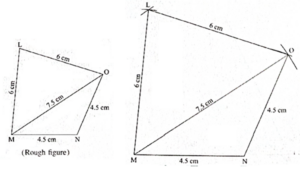
(4) Construct □ LMNO such that l(LM) = l(LO) = 6 cm, l(ON) = l(NM) = 4.5 cm, l(OM) = 7.5 cm.
Practice Set 8.2
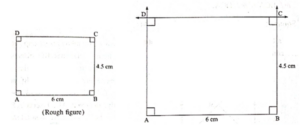
Question 2.1. Draw a rectangle ABCD such that l(AB) = 6.0 cm and l(BC) = 4.5 cm.
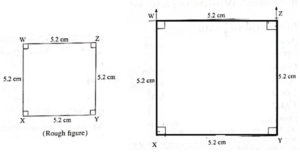
Question 2.2. Draw a square WXYZ with side 5.2 cm.
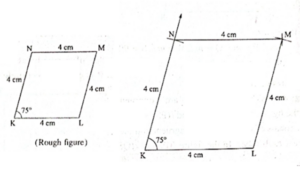
Question 2.3. Draw a rhombus KLMN such that its side is 4 cm and m∠ K = 75°.
Question 2.4. If diagonal of a rectangle is 26 cm and one side is 24 cm, find the other side.
Suppose ABCD is a rectangle.
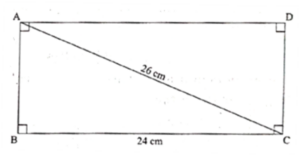
Here, segment AC is a diagonal and segment AD is one side of the rectangle ABCD.
l(AC) = 26 cm and l(AD) = 24 cm.
In right Δ ACD,
l(AC)2 = l(AD)2 + l(CD)2 ... (Pythagoras theorem)
= l(CD)2 = l(AC)2 - l(AD)2
= l(CD)2 = (26)2 - (24)2
l(CD)2 = 676 – 576 = 100
l(CD) = \(sqrt{100}\) = 10 cm
Thus, the other side of the rectangle is 10 cm.
Question 2.5. Lengths of diagonals of a rhombus ABCD are 16 cm and 12 cm. Find the side and perimeter of the rhombus.
Let ABCD be the required rhombus.
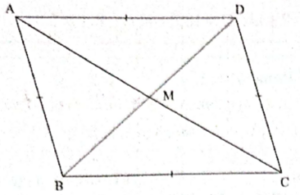
l(AC) = 16 cm and l(BD) = 12 cm
Diagonals of rhombus bisect each other
∴ l(AM) = \(\frac{1}{2}\) x l(AC) and l(BM) = \(\frac{1}{2}\) x l(BD)
∴ l(AM) = \(\frac{1}{2}\) x 16 and l(BM) = \(\frac{1}{2}\) x 12
∴ l(AM) = 8 cm and l(BM) = 6 cm
Diagonals of rhombus are perpendicular to each other
∴ m∠ AMB = 90°
In right angled Δ AMB,
by Pythagoras theorem,
l(AB)2 = l(AM)2 + l(MB)2
∴ l(AB)2 = 82 + 62
∴ l(AB)2 = 64 + 36
∴ /(AB)2 = 100
∴ l(AB) = \(\sqrt{100}\)
∴ l(AB) = 10 cm
Perimeter of rhombus ABCD = 4 x l(AB) = 4 × 10 = 40 cm
Answer is : Side of rhombus is 10 cm and perimeter of rhombus is 40 cm.
Question 2.6. Find the length of diagonal of a square with side 8 cm
Let ABCD be the required square.
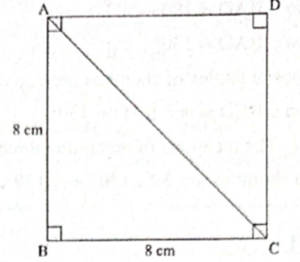
Here, segment AC is a diagonal of square ABCD.
In Δ ABC,
by Pythagoras theorem,
l(AC)2 = l(AB)2 + l(BC)2
∴ l(AC)2 = (8)2 + (8)2
∴ l(AC)2 = 64 + 64 = 128
l(AC) = \(\sqrt{128}\) cm ….[Taking square root of both sides]
∴ l(AC) = \(\sqrt{64×2}\) cm
∴ l(AC) = 8\(\sqrt{2}\) cm
Thus, the length of diagonal of square is 8\(\sqrt{2}\) cm.
Question 2.7. Measure of one angle of a rhombus is 50°, find the measures of remaining three angles.
Let ABCD be the required rhombus.
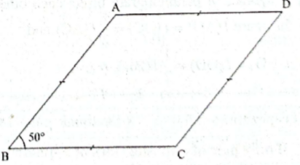
m∠ ABC = 50°
Opposite angles of rhombus are congruent.
∴ m∠ ADC = m∠ ABC = 50°
Side AD || side BC and line AB is the transversal,
m∠ BAD + m∠ ABC = 180° ... (Interior angles)
∴ m∠ BAD + 50° = 180°
∴ m∠ BAD = 180 - 50°
∴ m∠ BAD = 130°
Opposite angles of rhombus are equal
∴ m∠ BCD = m∠ BAD = 130°
Answer is : The measures of remaining three angles of a rhombus are 50°, 130° and 130°.
Practice Set 8.3
Question 3.1. Measures of opposite angles of a parallelogram are (3x - 2)° and (50 - x)°. Find the measure of its each angle.
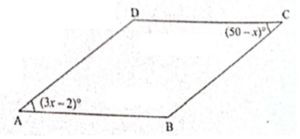
Let □ ABCD be given parallelogram and m∠ A = (3x - 2)° and m∠ C = (50 - x)°.
Opposite angles of parallelogram are of equal measures.
∴ m∠ A = m∠ C
∴ (3x - 2)° = (50 - x)°
∴ 3x – 2 = 50 - x
∴ 3x + x = 50 + 2
∴ 4x = 52
∴ x = 52/4
∴ x = 13
∴ m∠ A = m∠ C = (3x - 2)° = (3 × 13 - 2)° = 37°
side AB || side DC and line AD is the transversal,
m∠ A + m∠ D = 180° ….. [Interior angles]
∴ 37° + m∠ D = 180°
∴ m∠ D = 180° - 37°
∴ m∠ D = 143°
m∠ B = m∠ D = 143° ... [Opposite angles of parallelogram are of equal measures]
Answer is : The measure of each angle of a parallelogram are 37°, 143°, 37° and 143°.
Question 3.2. Referring the adjacent figure of a parallelogram, write the answers of questions given below.
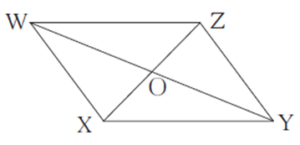
(1) If l(WZ) = 4.5 cm then l(XY) = ?
(2) If l(YZ) = 8.2 cm then l(XW) = ?
(3) If l(OX) = 2.5 cm then l(OZ) = ?
(4) If l(WO) = 3.3 cm then l(WY) = ?
(5) If m∠ WZY = 120° then m∠ WXY = ? and m∠ XWZ = ?
WXYZ is a parallelogram.
(1) l(XY) = l(WZ) = 4.5 cm ... (Opposite sides of a parallelogram are congruent)
(2) l(XW) = l(YZ) = 8.2 cm ... (Opposite sides of a parallelogram are congruent)
(3) l(OZ) = l(OX) = 2.5 cm ... (Diagonals of parallelogram bisect each other)
(4) l(WY) = 2 x l(WO) = 2 × 3.3 = 6.6 cm ... (Diagonals of parallelogram bisect each other)
(5) m∠ WXY = m∠ WZY = 120° ... (Opposite angles of a parallelogram are congruent)
Now,
m∠ WZY + m∠ XWZ = 180° ... (Adjacent angles of a parallelogram are supplementary)
∴ 120° + m∠ XWZ = 180°
m∠ XWZ = 180° - 120° = 60°
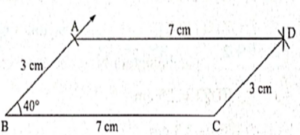
Question 3.3. Construct a parallelogram ABCD such that l(BC) = 7 cm, m∠ ABC = 40°, l(AB) = 3 cm.
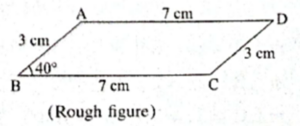
l(BC) of 7 cm can be drawn.
On drawing, ∠ ABC = 40°, we can locate point A on it such that l(AB) = 3 cm
Opposite sides of parallelogram are congruent.
∴ l(CD) = l (AB) = 3 cm
l(AD) = l(BC) = 7 cm.
Thus D can be obtained at a distance of 7 cm from A and 3 cm from C. □ ABCD can thus be constructed.
Question 3.4. Ratio of consecutive angles of a quadrilateral is 1:2:3:4. Find the measure of its each angle. Write, with reason, what type of a quadrilateral it is.
Let □ ABCD be the given quadrilateral.
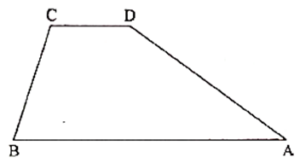
The ratio of consecutive angles is 1 : 2 : 3 : 4
Let the common multiple be x
∴ m∠ A =x°, m∠ B = 2x°, m∠ C = 3x° and m∠ D = 4x°
Sum of the measures of all angles of a quadrilateral is 360°
∴ m∠ A + m∠ B + m∠ C + m∠ D = 360°
∴ x° + 2x° + 3x° + 4x° = 360°
∴ 10x = 360
∴ x = 360/10 = 36
m∠ A = x = 36°
m∠ B = 2x = 2 x 36° = 72°
m∠ C = 3x = 3 x 36° = 108°
m∠ D = 4x = 4 x 36° = 144°
m∠ B + m∠ C = 72° + 108° = 180°
∴ side CD || side AB ... [. Interior angles are equal.]
m∠ A + m∠ B = 36 + 72 = 108
∴ m∠A + m∠B ≠ 180°
∴ Side BC is not parallel to side AD
∴ □ ABCD is a trapezium.
Question 3.5. Construct □ BARC such that l(BA) = l(BC) = 4.2 cm, l(AC) = 6.0 cm, l(AR) = l(CR) = 5.6 cm.
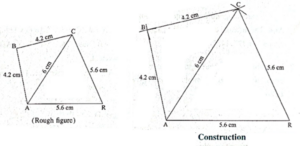
Question 3.6. Construct □ PQRS, such that l(PQ) = 3.5 cm, l(QR) = 5.6 cm, l(RS) = 3.5 cm, m∠ Q = 110°, m∠ R = 70°. If it is given that □ PQRS is a parallelogram, which of the given information is unnecessary ?
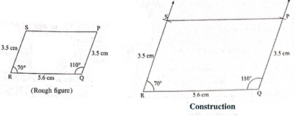
If □ PQRS is a parallelogram, then the information ∠ SRQ = 70° and SR = 3.5 cm or ∠ PQR = 110° and PQ =3.5 cm is unnecessary. …. [ ∵ It is possible to construct a parallelogram if its adjacent sides and the included angle are known.]