
Notes
|
Topics to be learn :
|
Recall :
Construct the triangles with given measures.
(1) Δ ABC : l (AB) = 5 cm, l (BC) = 5.5 cm, l (AC) = 6 cm
Steps of Construction :
- Draw base BC: Using a ruler, draw a straight line segment BC of length 5.5 cm.
- Construct side AB: Place the compass pointer at point B. Open the compass to 5 cm. Draw an arc above the line segment BC.
- Construct side AC: Place the compass pointer at point C. Open the compass to 6 cm. Draw another arc that intersects the previous arc.
- Mark intersection point A: The intersection of the two arcs is point A. Join AB and AC with a ruler.
- Triangle completed: The triangle ABC is now constructed with the required sides.
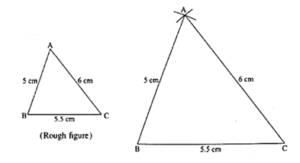
(2) Δ DEF : m ∠ D = 35°, m ∠ F = 100°, l(DF) = 4.8 cm
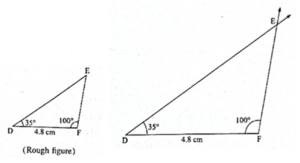
(3) Δ MNP : l(MP) = 6.2 cm, l(NP) = 4.5 cm, m ∠ P = 75°
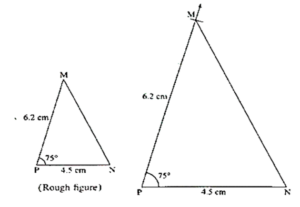
(4) Δ XYZ : m ∠ Y = 90°, l(XY) = 4.2 cm, l(XZ) = 7 cm
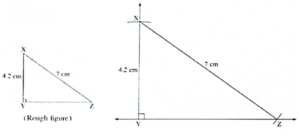
Construction of a quadrilateral :
- Every quadrilateral has 4 angles, 4 sides and 2 diagonals, so there are 10 elements of each quadrilateral.
- A quadrilateral can be constructed, if the measures of some specific 5 elements out of 10 are known.
Specific Construction Scenarios :
The following table outlines the four primary methods for constructing a quadrilateral :
| Scenario | Required Information |
| I | Lengths of four sides and one diagonal. |
| II | Lengths of three sides and two diagonals. |
| III | Two adjacent sides and three angles. |
| IV | Three sides and two angles included by those sides. |
(I) To construct a quadrilateral if the lengths of four sides and a diagonal is given :
Example : Construct □ PQRS such that , l(PQ) = 5.6 cm , l(QR) = 5 cm, l(PS) = 4.3 cm, l(RS) = 7 cm, l(QS) = 6.2 cm
Solution :
Let us draw a rough figure and show the given information in it. From the figure we see that the sides of Δ SPQ and Δ SRQ are known.
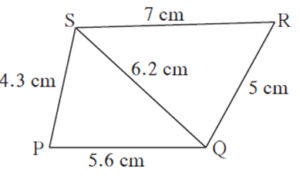
So if we construct Δ SPQ and Δ SRQ of given measures, we get □ PQRS.
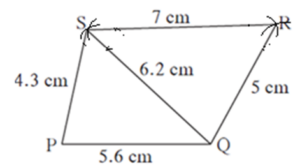
(II) To construct a quadrilateral if three sides and two diagonals are given.
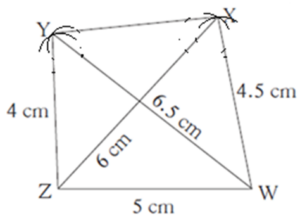
Example : Construct □ WXYZ such that, l(YZ) = 4 cm, l(ZX) = 6 cm, l(WX) = 4.5 cm, l(ZW) = 5 cm, l(YW) = 6.5 cm
Solution:
Rough figure:
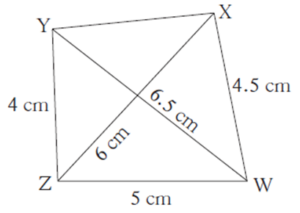
Let us draw a rough figure and show the given measures in it.
From the figure we see that all sides of Δ WXZ and Δ WZY are known.
So let us draw Δ WXZ and Δ WZY using given measures.
We will get □ WXYZ after drawing segment XY.
(III) To construct a quadrilateral if two adjacent sides and any three angles are given.
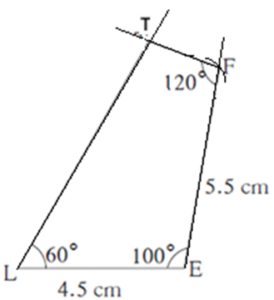
Example : Construct □ LEFT such that, l(EL) = 4.5 cm, l(EF) = 5.5 cm, m ∠ L = 60°, m ∠ E = 100°, m ∠ F = 120°
Solution:
We draw the rough figure and show all the given information in it.
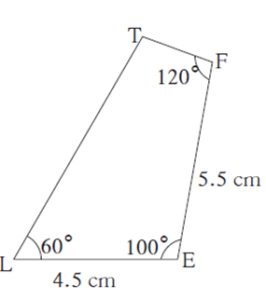
- Seg LE of given length can be drawn.
- Angles of measure 60° and 100° can be drawn with the help of the protractor at vertex L and E respectively.
- Point F can be located at the distance of 5.5 cm at the angle drawn at vertex E thus ∠ LEF = 100° and l(EF) = 5.5 cm.
- Angle of measure 120° can be drawn with the help of protractor at vertex F.
- Thus, the point of intersection of angle drawn at vertex L and vertex F is T. □ ABCD is thus constructed.
(IV) To construct a quadrilateral, if three sides and two angles included by them are given :
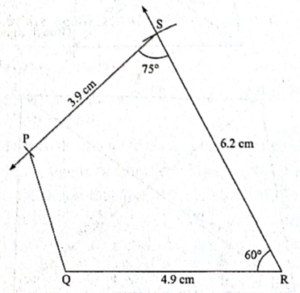
Example : Construct □ PQRS such that l(QR)= 4.9 cm, l(RS) = 6.2 cm, l(SP) = 3.9 cm, m∠ R = 60° and m∠ S = 75°.
Solution :
We draw the rough figure and show all the given information in it.
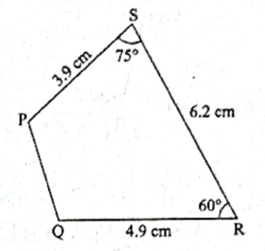
- Seg QR of length 4.9 cm can be drawn.
- At point R, an angle of measure 60° can be drawn with the help of a protractor.
- We can locate point S on the angle such that l(SR) = 6.2 cm.
- A point S, an angle of measure 75° can be drawn and point P can be located such
- that l(PS) = 3.9 cm.
- On joining P and Q, □ PQRS is thus obtained.
Rectangle :
If all angles of a quadrilateral are right angles, it is called a rectangle.
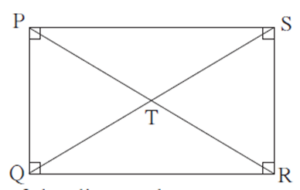
In the figure, m∠ P = m∠ Q = m∠ R = m∠ S = 90°
∴ □ PQRS is a rectangle.
Properties of rectangle :
- Opposite sides of rectangle are congruent.
[In the figure, l(PQ) = l(SR) and l(PS) = l(QR)]
- Diagonals of rectangle are congruent and they bisect each other.
[In the figure l(PR) = l(QS) and l(PT) = l(TR) = \(\frac{1}{2}\)l(PR) and l(TQ) = l(TS) = \(\frac{1}{2}\)l(QS).
[Note : Since l(PS) = l(QS) therefore, l(TP) = l(TR) = l(TS) = l(TQ)]
Square :
If all sides and all angles of a quadrilateral are congruent, it is called a square.
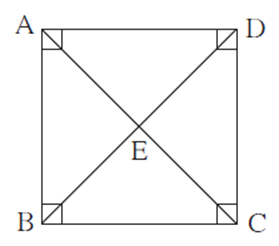
In the figure, l(AB) = l(BC) = l(CD) = l(AD) and m∠ A = m∠ B = m∠ C = m∠ D = 90° ∴ □ ABCD is a square.
Properties of square :
- Diagonals of square are congruent.
In the figure, l(AC) = l(BD)
- Diagonals of square bisect each other.
In the figure, l(AE) = l(EC) = \(\frac{1}{2}\)l(AC) and l(BE) = l(ED) = \(\frac{1}{2}\)l(BD)
[Note : Since l(AC) = l(BD) therefore l(AE) = l(EC) = l(BE) = l(ED)]
- Diagonals of square bisect opposite angles.
In the figure, diagonal AC bisects ∠ BAD and ∠ BCD and diagonal BD bisects ∠ ABC and ∠ ADC.
Rhombus :
If all sides of a quadrilateral are of equal length (congruent), it is called a rhombus.
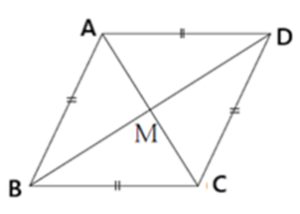
In the figure, l(AB) = l(BC) = l(CD) = l(AD) ∴ □ ABCD is a rhombus.
Properties of rhombus :
- Opposite angles of rhombus are congruent.
In the figure, ∠ ABC ≅ ∠ ADC and ∠ BAD ≅ ∠ BCD
Diagonals of rhombus are perpendicular to each other. In the figure, seg AC ⊥ seg BD at point M i.e. m∠ AMB = 90°.
Diagonals of rhombus bisect each other. In the figure, l(AM) = l(MC) = \(\frac{1}{2}\)l(AC) and l(BM) = l(MD) = \(\frac{1}{2}\)l(BD)
- Diagonals of rhombus bisect opposite angles.
In the figure, Diagonal BD bisects ABC i.e. it divides it into two angles of equal measures i.e. m∠ ABD = m∠ DBC and it also bisects ∠ ADC i.e. m∠ ADB = m∠ BDC.
Similarly, diagonal AC, bisects ∠ BAD and ∠ BCD i.e. m∠ BAC = m∠ DAC and m∠ BCA = m∠ DCA.
Solved Examples :
Q.1. P is the point of intersection of diagonals of rectangle ABCD.
(i) If l(AB) = 8 cm then l(DC) = ?,
(ii) If l(BP) = 8.5 cm then find l(BD) and l(BC)
Solution :
Let us draw a rough figure and show the given information in it.
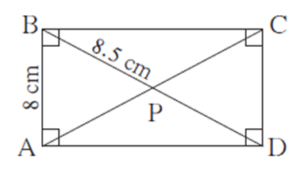
(i) Opposite sides of a rectangle are congruent.
∴ l(DC) = l(AB) = 8 cm
(ii) Diagonals of a rectangle bisect each other.
∴ l(BD) = 2 × l(BP) = 2 × 8.5 = 17 cm
Δ BCD is a right angled triangle. Using Pythagoras theorem we get,
l(BC)2 = l(BD)2 - l(CD)2 = 172 - 82 = 289 - 64 = 225
∴ l(BC) = = 15 cm
Parallelogram :
A quadrilateral is a parallelogram, if its opposite sides are parallel.
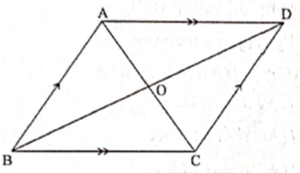
In the figure, side AB || side CD and side AD || side BC then □ ABCD is a parallelogram
Properties of parallelogram :
- Opposite sides of parallelogram are congruent.
In the figure, l(AB) = l(CD) and l(AD) = l(BC).
- Opposite angles of parallelogram are congruent.
In the figure, m∠ ABC = m∠ ADC and m∠ BAD = m∠ BCD.
- Diagonals of parallelogram bisect each other.
In figure l(AO) = l(OC) = \(\frac{1}{2}\)l(AC) and l(BO) = l(OD) = \(\frac{1}{2}\)l(BD).
Trapezium :
If only one pair of opposite sides of a quadrilateral is parallel then it is called a trapezium.
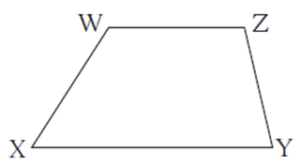
In □ WXYZ, only one pair of opposite sides, seg WZ and seg XY is parallel. So by definition □ WXYZ is a trapezium.
With the property of interior angles formed by two parallel lines and their transversal we get m∠ W + m∠ X = 180° and m∠ Y + m∠ Z = 180°.
- In a trapezium, out of four pairs of adjacent angles, two are supplementary.
Kite :
If one diagonal is the perpendicular bisector of the other diagonal then the quadrilateral is called a kite.
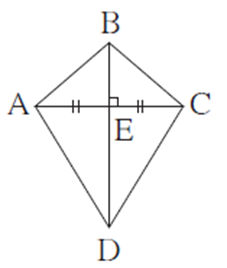
In the figure, diagonal BD is the perpendicular bisector of diagonal AC. ∴ □ ABCD is a kite.
Properties of Kite :
- Two pairs of adjacent sides are congruent.
In the figure, l(AB) = l(BC) and l(AD) = l(DC).
- One pair of opposite angles is congruent.
In the figure, m∠ BAD = m∠ BCD.
Solved Example :
Q.1. Ratio of measures of angles of □ CWPR is 7:9:3:5 then find the measures of its angles and write the type of the quadrilateral.
Solution:
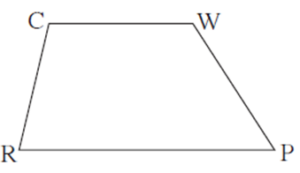
Suppose, m∠ C : m∠ W : m∠ P: m∠ R = 7:9:3:5
let the measures of ∠C, ∠W, ∠P and ∠R be 7x, 9x, 3x and 5x respectively.
∴ 7x + 9x + 3x + 5x = 360°
∴ 24 x = 360° ∴ x = 15
∴ m∠ C = 7 × 15 = 105°, m∠ W = 9 × 15 = 135°
m∠ P = 3 × 15 = 45°and m∠ R = 5 × 15 = 75°
∴ m∠ C + m∠ R = 105°+75°= 180° ∴ side CW || side RP
m∠ C + m∠ W = 105°+ 135°= 240° ≠ 180°
∴ side CR is not parallel to side WP.
∴ only one pair of opposite sides of □ CWPR is parallel.
∴ □ CWPR is a trapezium.