
Solutions- Practice Set and Problem Sets
Practice set 6.1 :
Question 1.1. Distance of chord AB from the centre of a circle is 8 cm. Length of the chord AB is 12 cm. Find the diameter of the circle.
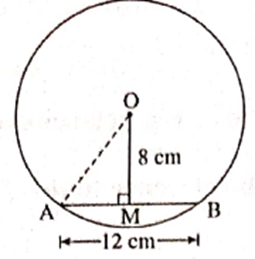
Let point O be the center of the circle.
seg OM ⊥ chord AB such that, A-M-B
AM = \(\frac{1}{2}\) AB .. (The perpendicular drawn from the center of the circle to the chord bisects the chord.)
∴ AM = \(\frac{1}{2}\) x 12
∴ AM = 6 cm
Draw line OA.
In Δ OMA, From Pythagoras theorem,
OA2 = OM2 + AM2
∴ OA2 = 82 + 62
∴ OA2 = 64 + 36
∴ OA2 = 100
∴ OA = 10 cm
∴ Diameter of circle = 2 x 10 = 20
∴ Diameter of circle is 20 cm
Question 1.2. Diameter of a circle is 26 cm and length of a chord of the circle is 24 cm. Find the distance of the chord from the centre.
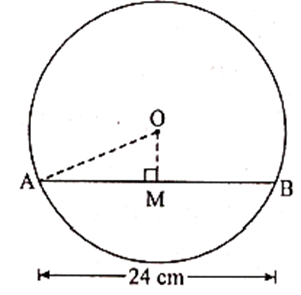
Let the centre of the circle be O and AB be the given chord.
Let seg OM ⊥ chord AB such that A-M-B.
AB = 24 cm
Diameter of the circle = 26 cm
∴ its radius (r) = \(\frac{1}{2}\) x 26 = 13 cm
Draw seg OA. ∴ OA = 13 cm
Now, the perpendicular drawn from the centre of the circle to its chord bisects the chord.
∴ AM = \(\frac{1}{2}\) AB
∴ AM = \(\frac{1}{2}\) x 24
∴ AM = 12 cm
In right angled Δ OMA, by Pythagoras theorem,
OA2 = OM2 + AM2
∴ 132 = OM2 + 122
∴ OM2 = 132 - 122
∴ OM2 = 169 - 144
∴ OM2 = 25 ∴ OM = \(\sqrt{25}\)
∴ OM = 5 cm
Distance of the chord from the centre is 5 cm.
Question 1.3. Radius of a circle is 34 cm and the distance of the chord from the centre is 30 cm, find the length of the chord.
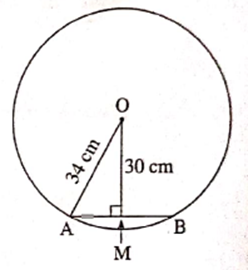
Let O be the center of the circle and seg AB is its chord.
seg OM ⊥ chord AB such that, A-M-B
OA = 34 cm
OC = 30 cm
In Δ OMA, From Pythagoras theorem,
OA2 = OC2 + AM2
∴ 342= 302 + AM2
∴ 1156 = 900 + AM2
∴ AM2 = 1156 - 900
∴ AM2 = 256
∴ AM = \(\sqrt{256}\)
∴ AM = 16 cm
∴ AM = AB ... (The perpendicular drawn from the center of the circle to the chord bisects the chord.)
∴ 16 = AB
∴ AB = 16 × 2
∴ AB = 32 cm
The length of the chord is 32 cm.
Question 1.4. Radius of a circle with centre O is 41 units. Length of a chord PQ is 80 units, find the distance of the chord from the centre of the circle.
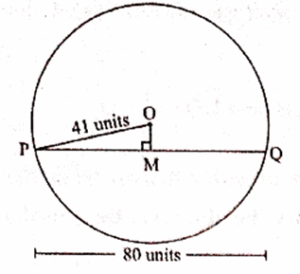
Let seg OM ⊥ chord PQ such that P-M-Q.
PQ = 80 units, OP = 41 units.
PM = \(\frac{1}{2}\) PQ ... (The perpendicular drawn from the centre of the circle to its chord bisects the chord.)
∴ PM = \(\frac{1}{2}\) × 80
∴ PM = 40 units
In right angled Δ OMP, by Pythagoras theorem,
OP2 = OM2 + PM2
∴ 412 = OM2 + 402
1681 = OM2 + 1600
∴ OM2 = 1681 - 1600
∴ OM2 = 81
∴ OM = \(\sqrt{81}\)
∴ OM = 9 units
Distance of the chord from the centre is 9 units.
Question 1.5. In figure, centre of two circles is O. Chord AB of bigger circle intersects the smaller circle in points P and Q. Show that AP = BQ
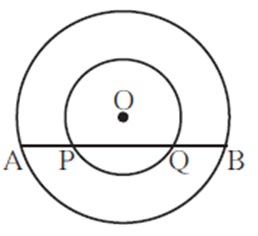
Construction : Draw seg OM ⊥ chord AB such that A-M-B.
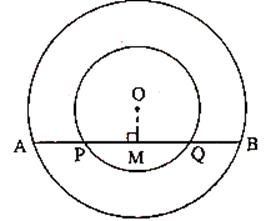
Proof : With respect to smaller circle,
seg OM ⊥ chord PQ.
∴ PM = MQ ... (The perpendicular drawn from the centre of the circle to its chord bisects the chord.) ... (1)
Similarly, with respect to larger circle,
seg OM ⊥ chord AB
∴ AM = MB ... (2)
AM = AP + PM ... (A-P-M) ... (3)
MB = MQ + QB ... (M-Q-B) ... (4)
∴ AP + PM = MQ + QB ... [From (2), (3) and (4) ] ... (5)
∴ AP = BQ ... [From (5) and (1)]
Question 1.6. Prove that, if a diameter of a circle bisects two chords of the circle then those two chords are parallel to each other.
Given :
(1) A circle with centre O.
(2) seg PQ is the diameter.
(3) Diameter PQ bisects chord AB and chord CD at points M and N respectively.
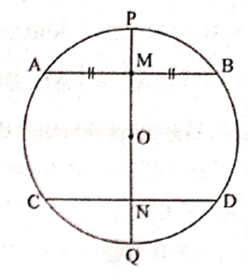
To prove : Chord AB || Chord CD
Proof :
M is the midpoint of chord AB ... (Given)
∴ seg OM ⊥ chord AB ... (The segment joining the centre of the circle and the
midpoint of its chord is perpendicular to the chord.)
∴ ∠OMA = 90° ... (1)
N is the midpoint of chord CD ... (Given)
∴ seg ON ⊥ chord CD ... (The segment joining the centre of the circle and the
midpoint of its chord is perpendicular to the chord.)
∴ ∠ONC = 90° ... (2)
Adding (1) and (2), we get,
∴ ∠OMA + ∠ONC= 90° + 90°
∴ ∠OMA + ∠ONC = 180°
i.e. ∠NMA + ∠MNC = 180° ... (M-O-N)
∴ chord AB || chord CD ... (Interior angles test for parallel lines)
Practice set 6.2 :
Question 2.1. Radius of circle is 10 cm. There are two chords of length 16 cm each. What will be the distance of these chords from the centre of the circle ?
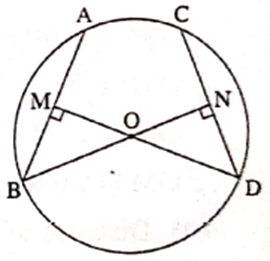
Let, O be the center of the circle and seg AB and seg CD are its congruent chords.
seg OM ⊥ seg AB such that, A-M-B and seg ON ⊥ seg CD such that, C-N-D.
OB = OD = 10 cm .. (Radius of the circle is 10 cm.)
AB = CD = 16 cm ... (Given)
∴ MB = \(\frac{1}{2}\) AB ...(The perpendicular drawn from the center of the circle to the chord bisects the chord.)
∴ MB = \(\frac{1}{2}\) x 16
∴ MB = 8 cm
In Δ OMB, by Pythagoras theorem,
OB2 = OM2 + MB2
∴ 102 = OM2 + 82
∴ OM2 = 100 - 64
∴ OM2 = 36
Taking the square root on both sides,
∴ OM = \(\sqrt{36}\)
∴ OM = 6 cm
∴ ON = OM .. (Congruent chords of a circle are the same distance from the centre.)
∴ ON = 6 cm
The distance of the given chords from the centre of the circle is 6 cm.
Question 2.2. In a circle with radius 13 cm, two equal chords are at a distance of 5 cm from the centre. Find the lengths of the chords.
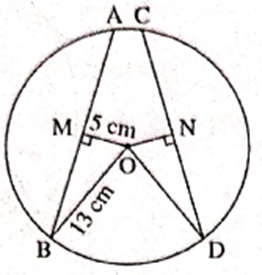
Let the centre of the circle be O and let seg AB and seg CD be the given congruent chords. seg OM ⊥ seg AB such that A-M-B and seg ON ⊥ seg CD such that C-N-D.
Radius of the circle is 13 cm.
∴ OB = OD = 13 cm
In right angled Δ OMB,
by Pythagoras theorem, OB2 = OM2 + MB2
∴ 132 = 52 + MB2
∴ 169 = 25 + MB2
∴ MB2 =169 - 25 = 144
∴ MB = \(\sqrt{144}\)
∴ MB = 12 cm.
Now, the perpendicular drawn from the centre of the circle to its chord bisects the chord.
MB = \(\frac{1}{2}\) AB
∴ 12 = \(\frac{1}{2}\) AB
∴ AB = 12 x 2
∴ AB = 24 cm
chord AB ≅ chord CD ... (Given)
∴ CD = 24 cm.
Length of each of the two equal chords of the circle is 24 cm.
Question 2.3. Seg PM and seg PN are congruent chords of a circle with centre C. Show that the ray PC is the bisector of ∠NPM.
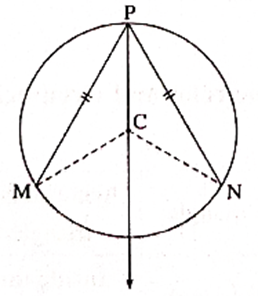
Proof : Draw seg CM and seg CN.
In Δ CPM and Δ CPN,
seg PM ≅ seg PN ... (Given)
seg PC ≅ seg PC ... (Common side)
seg CM = seg CN ... (Radii of the same circle)
∴ Δ CPM ≅ Δ CPN ... (SSS test of congruence)
∴ ∠CPM ≅ ∠CPN ... (c.a.c.t.)
∴ ray PC is the bisector of ∠NPM.
Practice set 6.3 :
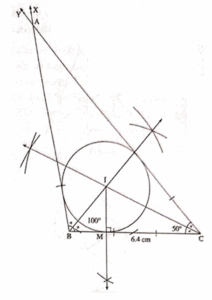
Question 3.1. Construct Δ ABC such that ∠B = 100°, BC = 6.4 cm, ∠C = 50° and construct its incircle.
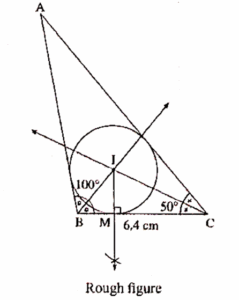
Steps of construction:
- Construct AABC of given measures.
- Draw bisectors of two angles, ∠C and ∠B.
- Name the point of intersection of angle bisectors as I.
- Draw a perpendicular IM on side BC. Point M is the foot of the perpendicular.
- Draw a circle that touches all sides of the triangle with I as centre and IM as radius.
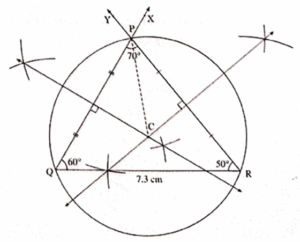
Question 3.2. Construct Δ PQR such that ∠P = 70°, ∠R = 50°, QR = 7.3 cm. and construct its circumcircle.
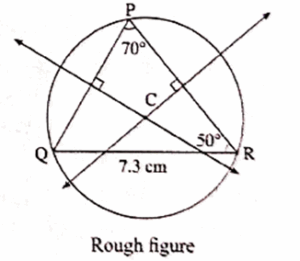
In Δ PQR,
∠P + ∠Q + ∠R =180°
70° + ∠Q + 50° = 180°
∴ 120° + ∠Q = 180°
∴ ∠Q = 180° - 120° = 60°
Steps of construction:
- Construct Δ PQR of the given measurement.
- Draw the perpendicular bisectors of side PQ and side QR of the triangle.
- Name the point of intersection of the perpendicular bisectors as point C.
- Join seg CP.
- Draw circle with centre C and radius CP.
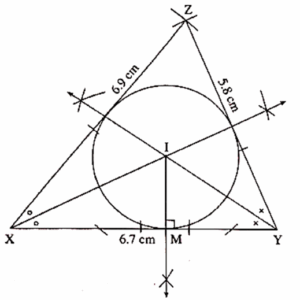
Question 3.3. Construct Δ XYZ such that XY = 6.7 cm, YZ = 5.8 cm, XZ = 6.9 cm. Construct its incircle.
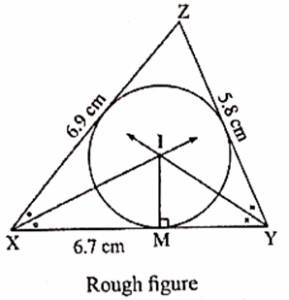
Steps of construction:
- Construct AXYZ of given measures.
- Draw bisectors of two angles, 2X and ZZ.
- Name the point of intersection of angle bisectors as I.
- Draw a perpendicular IM on side XZ. Point M is the foot of the perpendicular.
- Draw a circle that touches all sides of the triangle with I as centre and IM as radius.
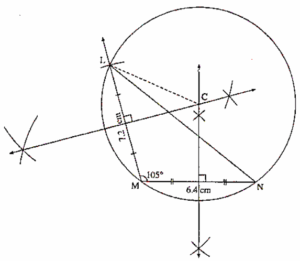
Question 3.4. In Δ LMN, LM = 7.2 cm, ∠M = 105°, MN = 6.4 cm, then draw Δ LMN and construct its circumcircle.
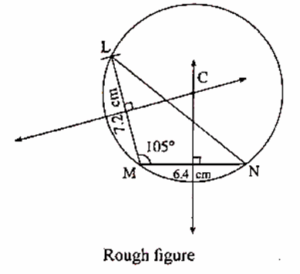
Steps of construction:
- Construct ALMN of the given measurement.
- Draw the perpendicular bisectors of side MN and side ML of the triangle.
- Name the point of intersection of perpendicular bisectors as C.
- Join seg CL.
- Draw circle with centre C and radius CL.
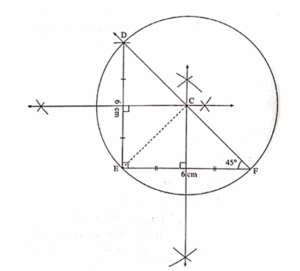
Question 3.5. Construct Δ DEF such that DE = EF = 6 cm, ∠F = 45° and construct its circumcircle
DE = EF
∴ ∠DFE = ∠EDF = 45°
∴ ∠DEF = 90°
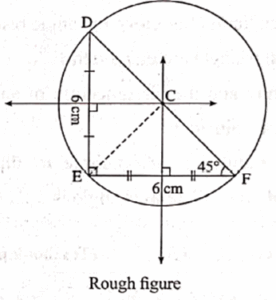
Steps of construction:
- Construct ADEF of the given measurement.
- Draw the perpendicular bisectors of side DE and side EF of the triangle.
- Name the point of intersection of perpendicular bisectors as C.
- Join seg CE.
- Draw circle with centre C and radius CE.
Problem set 6 :
Question 1. Choose correct alternative answer and fill in the blanks.
(i) Radius of a circle is 10 cm and distance of a chord from the centre is 6 cm. Hence the length of the chord is .........
(A) 16 cm (B) 8 cm (C) 12 cm (D) 32 cm
(A) 16 cm
Explanation :
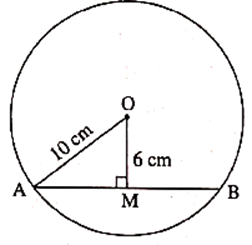
OM = 6 cm
OA = 10 cm
By Pythagoras theorem,
102 = AM2 + 62
AM = 8 cm
AB = 2 x AM
AM = 2 x 8 = 16 cm.
(ii) The point of concurrence of all angle bisectors of a triangle is called the ......
(A) centroid (B) circumcentre (C) incentre (D) orthocentre
(C) incentre
(iii) The circle which passes through all the vertices of a triangle is called .....
(A) circumcircle (B) incircle
(C) congruent circle (D) concentric circle
(A) circumcircle
(iv) Length of a chord of a circle is 24 cm. If distance of the chord from the centre is 5 cm, then the radius of that circle is ....
(A) 12 cm (B) 13 cm (C) 14 cm (D) 15 cm
(B) 13 cm
Explanation :
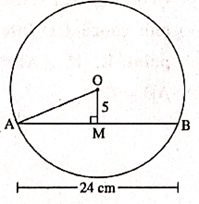
AM = \(\frac{1}{2}\) AB = \(\frac{1}{2}\) × 24 = 12 cm
by Pythagoras theorem,
OA = 13 cm.
(v) The length of the longest chord of the circle with radius 2.9 cm is .....
(A) 3.5 cm (B) 7 cm (C) 10 cm (D) 5.8 cm
(D) 5.8 cm
(vi) Radius of a circle with centre O is 4 cm. If l(OP) = 4.2 cm, say where point P will lie.
(A) on the centre (B) Inside the circle
(C) outside the circle (D) on the circle
(C) outside the circle
(vii) The lengths of parallel chords which are on opposite sides of the centre of a circle are 6 cm and 8 cm. If radius of the circle is 5 cm, then the distance between these chords is .....
(A) 2 cm (B) 1 cm (C) 8 cm (D) 7 cm
(D) 7 cm
Explanation :
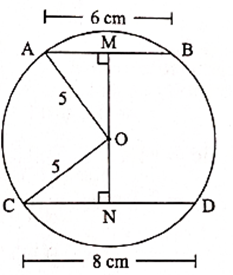
AM = \(\frac{1}{2}\) AB = 3 cm also CN = 4 cm.
By applying Pythagoras theorem in A OMA and A ONC,
we get, OM = 4 and ON = 3
MN = MO + ON = 4 + 3 = 7cm.
Question 2. Construct incircle and circumcircle of an equilateral Δ DSP with side 7.5 cm. Measure the radii of both the circles and find the ratio of radius of circumcircle to the radius of incircle.
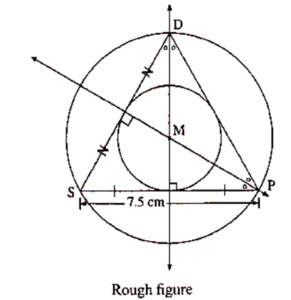
Radius of circumcircle = DM = 4.2 cm
Radius of incircle = MN = 2.1 cm
\(\frac{DM}{MN}=\frac{4.2}{2.1}=\frac{2}{1}\)
∴ DM : MN = 2: 1
Ratio of the radius of circumcircle to the radius of incircle is 2 : 1.
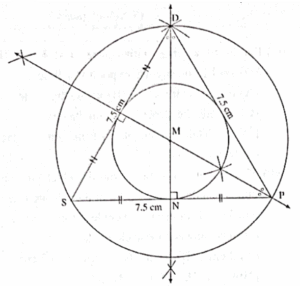
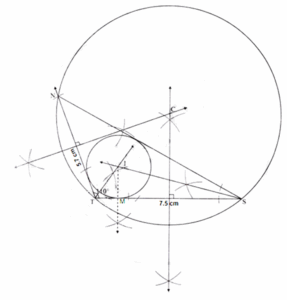
Question 3. Construct Δ NTS where NT = 5.7 cm, TS = 7.5 cm and ∠NTS = 110° and draw incircle and circumcircle of it.
Steps of construction:
For incircle:
- Construct Δ NTS of given measures.
- Draw bisectors of two angles, ∠T and ∠S.
- Name the point of intersection of angle bisectors as I.
- Draw a perpendicular IM on side TS. Point M is the foot of the perpendicular.
- Draw a circle that touches all sides of the triangle with I as centre and IM as radius.
For circumcircle:
- Draw the perpendicular bisectors of side NT and side TS of the triangle.
- Name the point of intersection of the perpendicular bisectors as point C.
- Join seg CN.
- Draw circle with centre C and radius CN.
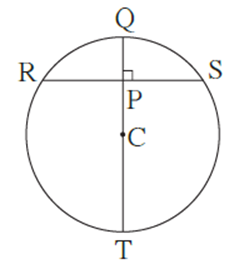
Question 4. In the figure, C is the centre of the circle. seg QT is a diameter CT = 13, CP = 5, find the length of chord RS.
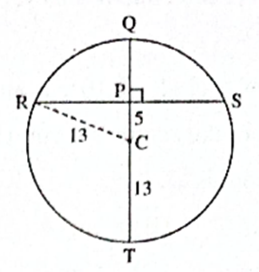
Draw seg CR.
CR = CT = 13 ... (Radii of the same circle)
In Δ CPR,
∠CPR = 90°
By Pythagoras theorem,
CR2 = CP2 + PR2
∴ 132 = 52 + PR2
∴ 169 = 25 + PR2
∴ PR2 = 169 - 25
∴ PR2 = 144
∴ PR = \(\sqrt{144}\)
∴ PR = 12
The perpendicular drawn from the centre of the circle to its chord bisects the chord.
∴ PR = RS
12 = RS
∴ RS = 12 x 2
∴ RS = 24
Length of chord RS is 24.
Question 5. In the figure, P is the centre of the circle. chord AB and chord CD intersect on the diameter at the point E If Δ AEP ≅ Δ DEP then prove that AB = CD.
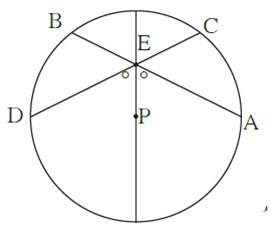
Construction : Draw seg PM ⊥ chord AB such that A-M-B. Draw seg PN ⊥ chord CD such that C-N-D.
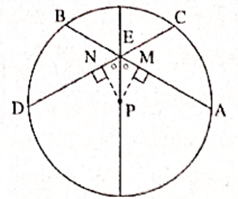
∠AEP ≅ ∠DEP ... (Given)
∴ ray EP is the bisector of ∠AED
∴ PM = PN ... (Angle bisector theorem)
∴ chord AB ≅ chord CD ... (The chords of a circle equidistant from the centre of
a circle are congruent)
∴ AB = CD
Question 6. In the figure, CD is a diameter of the circle with centre O. Diameter CD is perpendicular to chord AB at point E. Show that D ABC is an isosceles triangle.
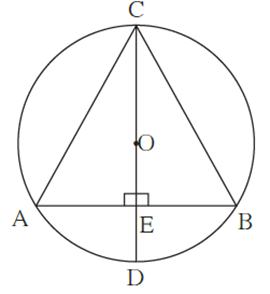
Proof :
Diameter CD is perpendicular to chord AB at point E
∴ seg OE ⊥ chord AB
∴ AE = BE ... (The perpendicular drawn from the centre of the circle to its chord
bisects the chord.) ... (1)
In Δ CEA and Δ CEB,
seg CE ≅ seg CE ... (Common side)
∠CEA ≅ ∠CEB ... (Each measures 90°)
seg AE ≅ seg BE ... [From (1)]
∴ Δ CEA ≅ Δ CEB ... (By SAS test of congruence)
∴ seg AC ≅ seg BC ... (c.s.c.t.)
∴ Δ ABC is an isosceles triangle. ... (By definition)