
Solutions
Practice set 2.1 :
Question 1.1. In figure line RP || line MS and line DK is their transversal. ∠DHP = 85°. Find the measures of following angles.
(i) ∠RHD (ii) ∠PHG (iii) ∠HGS (iv) ∠MGK
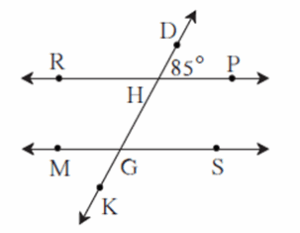
(i) Since, RP is a straight line and ray HD stands on it, then
∠RHD + ∠DHP = 180° ... (angles in a linear pair)
∴ ∠RHD + 85° = 180°
∴ ∠RHD = 180° -85°
∴ ∠RHD = 95°
(ii) Since the straight lines RP and DK intersect at H, then
∠PHG = ∠RHD ... (Vertically opposite angles)
∴ ∠PHG = 95°
(iii) Since, the line RP || line MS and line DK is their transversal intersecting them at H and G, then
∴ ∠HGS = ∠DHP ... (Corresponding angles)
∴ ∠HGS = 85°
(iv) Since, the straight lines MS and DK intersect at G, then
∠MGK = ∠HGS ... (Vertically opposite angles)
∠MG K= 85°
Question 1.2. In figure line p || line q and line l and line m are transversals. Measures of some angles are shown. Hence find the measures of ∠a, ∠b, ∠c, ∠d.
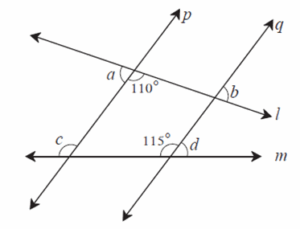
∠a + 110° = 180° ... (Angles in a linear pair)
∴ ∠a = 180° - 110°
∴ ∠a = 70° ... (1)
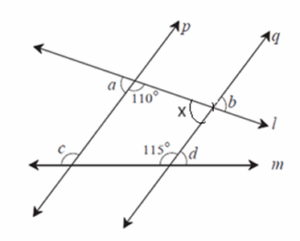
Consider ∠x as shown in the figure.
line p || line q and line l is its transversal.
∴ ∠x ≅ ∠a ... (Corresponding angles)
∴ ∠x = 70° ... [From (1)]
∠b ≥ ∠x ... (Vertically opposite angles)
∴ ∠b = 70°
line p || line q ... (Given)
and line m is the transversal.
∴ ∠c = 115° ... (Corresponding angles)
∠d + 115° = 180° ... (Angles in a linear pair)
∴ ∠d = 180° - 115°
∴ ∠d = 65°
Answers is : ∠a = 70°, ∠b = 70°, ∠c = 115°, ∠d = 65°.
Question 1.3. In figure line l || line m and line n || line p. Find ∠a, ∠b, ∠c from the given measure of an angle.
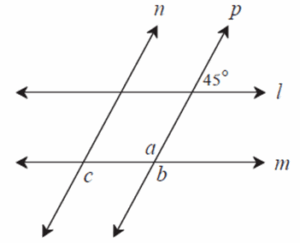
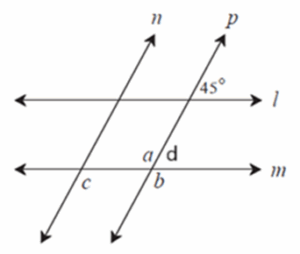
Consider d as shown in the figure.
line l || line m ... (Given)
and line p is the transversal.
∠d = 45° ... (Corresponding angles)
∠a + ∠d=180° ... (Angles in a linear pair)
∴ ∠a + 45° = 180°
∴ ∠a = 180° - 45° .. 4a= 135°
∴ ∠b ≅ ∠a ... (Vertically opposite angles)
v ∠b = 135°
line n || line p ... (Given)
and line m is the transversal.
v ∠c ≅ ∠a ... (Alternate angles)
∴ ∠c = 135°
Answers is : ∠a = 135°, ∠b = 135°, ∠c = 135°.
Question 1.4. In figure sides of ∠PQR and ∠XYZ are parallel to each other. Prove that, ∠PQR ≅ ∠XYZ
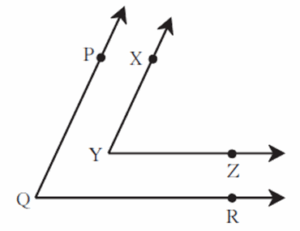
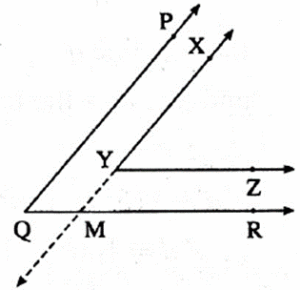
Let ray XY intersect ray QR at point M such that, X-Y-M and Q-M-R.
Ray YZ || Ray QR .... (Given)
And line MX is their transversal.
∴ ∠XYZ ≅ ∠YMR ... (Corresponding angle)
ray XY || ray QP . ... (Given)
ray MX || ray QP ... (X-Y-M)
And line QR is their transversal.
∴ ∠YMR ≅ ∠PQM ... (Corresponding angle)
∴ ∠PQM ≅ ∠XYZ
∴ ∠PQR ≅ ∠XYZ .... (Q-M-R)
Question 1.5. In figure, line AB || line CD and line PQ is transversal. Measure of one of the angles is given. Hence find the measures of the following angles.
(i) ∠ART (ii) ∠CTQ (iii) ∠DTQ (iv) ∠PRB
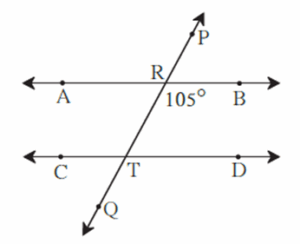
∠BRT = 105° ... (Given)
(i) ∠ART + ∠BRT = 180° ... (Angles in a linear pair)
∴ ∠ART + 105° = 180°
∴ ∠ART = 180° - 105°
∴ ∠ART = 75°
(ii) line AB || line CD ... (Given)
and line PQ is the transversal.
∴ ∠CTQ ≅ ∠ART ... (Corresponding angles)
∴ ∠CTQ = ∠ART
∴ ∠CTQ = 75°
(iii) ∠CTQ + ∠DTQ = 180° ... (Angles in a linear pair)
∴ 75° + ∠DTQ = 180°
∴ ∠DTQ = 180° - 75°
∴ ∠DTQ = 105°
(iv) ∠PRB + ∠BRT = 180° ... (Angles in a linear pair)
∴ ∠PRB + 105° = 180°
∴ ∠PRB = 180° - 105°
∠PRB = 75°.
Answer is : ∠ART = 75°, ∠CTQ = 75°, ∠DTQ = 105°, ∠PRB = 75°.
Practice set 2.2 :
Question 2.1. In figure, y = 108° and x = 71° Are the lines m and n parallel ? Justify ?
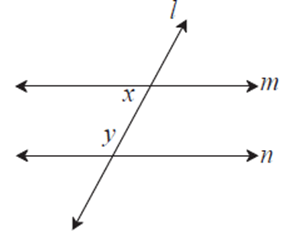
We have, x = 71° and y = 108°
x + y = 71° + 108°
∴ x + y = 179°
So, x + y ≠ 180°
∴ The angles x and y are not supplementary.
∴ The angles do not satisfy the interior angles test for parallel lines.
∴ Line m and line n are not parallel lines.
Question 2.2. In figure, if ∠a ≅ ∠b then prove that line l || line m.
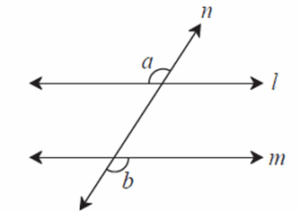
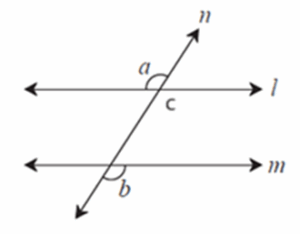
Consider ∠c as shown in the figure.
∠a ≅ ∠b ... (Given) ... (1)
∠a ≅ ∠c ... (Vertically opposite angles) ... (2)
∴ ∠b ≅ ∠c ... [From (1) and (2)]
∴ line l || line m ... (Corresponding angles test for parallel lines)
Question 2.3. In figure, if ∠a ≅ ∠b and ∠x ≅ ∠y then prove that line l || line n.
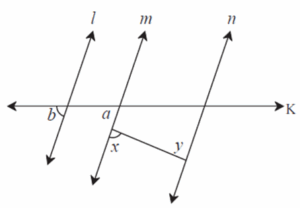
We have ∠a ≅ ∠b
∴ m∠a = m∠b
But ∠a and ∠b are corresponding angles formed by a transversal k of line m and line l.
∴ line m || line l ... (corresponding angles test)
Also, we have ∠x ≅ ∠y
∴ m∠x = m∠y
But ∠x and ∠y are alternate interior angles formed by a transversal k of line m and line n.
∴ line m || line n .(alternate angles test)
So, we have line m || line l and line m || line n.
It is known that if two lines in a plane are parallel to a third line in the plane, then those two lines are parallel to each other.
∴ line l || line n
Question 2.4. In figure, if ray BA || ray DE, ∠C = 50° and ∠D = 100°. Find the measure of ∠ABC.
(Hint : Draw a line passing through point C and parallel to line AB.)
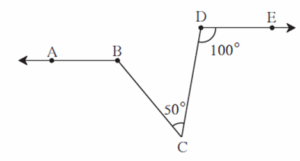
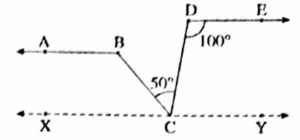
Draw a line XY passing through point C and parallel to line AB.
ray DE || ray BA ... (Given)
ray BA || line XY ... (Construction)
ray DE || ray BA || line XY ... (1)
∠EDC = 100° ... (Given)
ray DE || line XY ... [From (1)]
and line DC is the transversal.
∴ ∠EDC = ∠DCX ... (Alternate angles)
∴ ∠EDC = ∠DCX
∴ ∠DCX = 100° ... (Given : ∠EDC = 100°)
∠DCB + ∠BCX = ∠DCX ... (Angles addition postulate)
∴ 50° + ∠BCX = 100°
∴ ∠BCX = 100° - 50°
∴ ∠BCX = 50° ... (2)
Ray BA || line XY ... [From (1)]
and line BC is the transversal.
∴ ∠ABC + ∠BCX = 180° ... (Interior angles)
∴ ∠ABC + 50° = 180° ... [From (2)]
∴ ∠ABC = 180° - 50°
∴ ∠ABC = 130°
Answer is : ∠ABC = 130°.
Question 2.5. In figure, ray AE || ray BD, ray AF is the bisector of ∠EAB and ray BC is the bisector of ∠ABD. Prove that line AF || line BC.
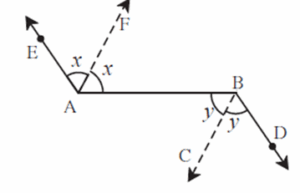
Proof : Ray AE || ray BD ... (Given)
and line AB is the transversal.
∴ ∠EAB ≅ ∠ABD ... (Alternate angles)
∴ ∠EAB = ∠ABD
Multiplying both the sides by \(\frac{1}{2}\) we get,
\(\frac{1}{2}\)∠EAB = \(\frac{1}{2}\)∠ABD ... (1)
\(\frac{1}{2}\)∠FAB = \(\frac{1}{2}\)∠EAB ... [Ray AF bisects ∠EAB] ... (2)
\(\frac{1}{2}\)∠ABC = \(\frac{1}{2}\)∠ABD ... [Ray BC bisects ∠ABD] ... (3)
∴ ∠FAB = ∠ABC ... [From (1), (2) and (3)]
∴ ∠FAB ≅ ∠ABC
∴ line AF || line BC ... (Alternate angles test for parallel lines)
Question 2.6. A transversal EF of line AB and line CD intersects the lines at point P and Q respectively. Ray PR and ray QS are parallel and bisectors of ∠BPQ and ∠PQC respectively. Prove that line AB || line CD.
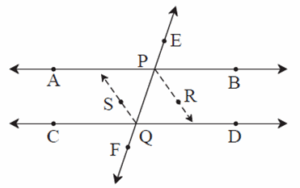
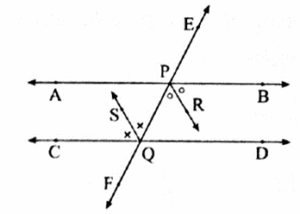
Proof : Ray PR || ray QS ... (Given)
and line PQ is the transversal.
∴ ∠RPQ ≅ ∠PQS ... (Alternate angles)
∴ ∠RPQ = ∠PQS ... (1)
∠RPQ = \(\frac{1}{2}\)∠BPQ ... [Ray PR bisects ∠BPQ] ... (2)
∠PQS = \(\frac{1}{2}\)∠PQC ... [Ray QS bisects ∠PQC] ... (3)
∴ \(\frac{1}{2}\)∠BPQ = \(\frac{1}{2}\)∠PQC ... [From (1), (2) and (3)]
∴ ∠BPQ = ∠PQC
∴ ∠BPQ ≅ ∠PQC
∴ line AB || line CD ... (Alternate angles test for parallel lines)