
Solutions- Practice Set and Problem Sets
Practice set 5.1 :
Question 1.1. Diagonals of a parallelogram WXYZ intersect each other at point O. If ∠XYZ = 135° then what is the measure of ∠XWZ and ∠YZW ? If l(OY) = 5 cm then l(WY) = ?
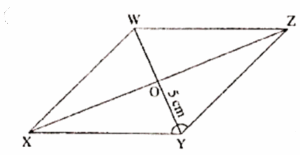
(i) ∠XYZ = 135° ... [Given]
WXYZ is a parallelogram.
∠XWZ = ∠XYZ
∴ ∠XWZ = 135° ... (1)
(ii) ∠YZW + ∠XYZ = 180° ... [Adjacent angles of a parallelogram are supplementary]
∴ ∠YZW + 135° = 180° ... [From (1)]
∴ ∠YZW = 180° - 135°
∴ ∠YZW = 45°
(iii) l(OY) = 5 cm ... [Given]
l(OY) – \(\frac{1}{2}\)l(WY) ... [Diagonals of a parallelogram bisect each other]
∴ l(WY) = 2 × l(OY)
∴ l(WY) = 2 × 5
∴ l(WY) = 10 cm
Answer is : ∠XWZ = 135°, ∠YZW = 45°, l(WY) = 10 cm
Question 1.2. In a parallelogram ABCD, If ∠A = (3x + 12)°, ∠ B = (2x - 32)° then find the value of x and then find the measures of ∠C and ∠D.
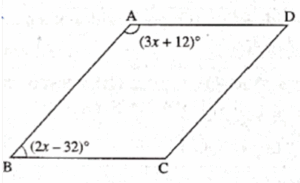
□ ABCD is a parallelogram.
∴ ∠A + ∠B = 180° ... (Adjacent angles of parallelogram are supplementary)
∴ (3x + 12)° + (2x - 32)° = 180°
∴ 3x + 12 + 2x – 32 = 180
∴ 5x - 20 = 180
∴ 5x = 180 + 20
∴ 5x = 200
∴ x = 200/5
∴ x = 40
∠C = ∠A ... (Opposite angles of a parallelogram)
∴ ∠C = (3x + 12)°
∴ ∠C = [3(40) + 12]°
∴ ∠C = (120 + 12)°
∴ ∠C = 132°
∠D = ∠B ... (Opposite angles of a parallelogram)
∴ ∠D = (2x - 32)°
∴ ∠D = [2(40) - 32]°
∴ ∠D = (80 - 32)°
∴ ∠D = 48°
Answer is : The value of x is 40, ∠C = 132°, ∠D = 48°.
Question 1.3. Perimeter of a parallelogram is 150 cm. One of its sides is greater than the other side by 25 cm. Find the lengths of all sides.
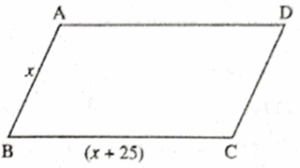
Let □ ABCD be the given parallelogram.
Let AB = x cm
According to the given condition,
BC = (x + 25) cm
CD = AB = x cm ... (Opposite sides of a parallelogram are congruent)
AD = BC = (x+25) cm ... (Opposite sides of a parallelogram are congruent)
The perimeter of parallelogram ABCD = 150 cm ... (Given)
∴ AB + BC + CD + AD = 150
∴ x + (x + 25) + x + (x + 25) = 150
∴ 4x + 50 = 150
∴ 4x = 150 - 50
∴ 4x = 100
∴ x = 100/4
∴ x = 25 ∴ CD = AB = x = 25 cm.
AD = BC = x + 25 = 25 + 25 = 50 cm
Answer is : The lengths of the sides of the parallelogram are 25 cm, 50 cm, 25 em and 50 cm.
Question 1.4. If the ratio of measures of two adjacent angles of a parallelogram is 1 : 2, find the measures of all angles of the parallelogram.
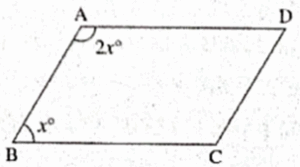
Let □ ABCD be the parallelogram.
The ratio of measures of two adjacent angles of a parallelogram is 1 : 2.
Let the common multiple be x.
∴ ∠A = x° and ∠B = 2x°
∠A + ∠B = 180°
∴ X + 2x = 180 ... [Adjacent angles of a parallelogram are supplementary]
∴ 3x = 180
x = 180/3 = 60
∠A = x° = 60°
∠B = 2x° = 2×60° = 120°
∠A = ∠C = 60°
∠B = ∠D = 120° ... [Opposite angles of a parallelogram]
Answer is : The angles of parallelogram are 60°, 120°, 60° and 120°.
Question 1.5. Diagonals of a parallelogram intersect each other at point O. If AO = 5, BO = 12 and AB = 13 then show that ABCD is a rhombus.
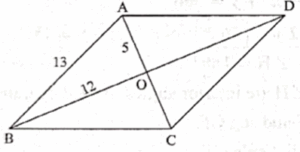
AO = 5, BO = 12, AB = 13 ... (Given)
AB2 = 132 = 169
AO2 + OB2 = 52 + 122
∴ AO2 + OB2 = 25 + 144
∴ AO2 + OB2 = 169
∴ AO2 + OB2 = AB2
By converse of Pythagoras theorem,
∠AOB = 90° ... (1)
In parallelogram ABCD, diagonal AC ⊥ diagonal BD ... [From (1)]
Also, diagonals AC and BD bisect each other. ... (Property of a parallelogram)
ABCD is a rhombus ... (A parallelogram is a rhombus if its diagonals are perpendicular bisector of each other.)
Question 1.6. In the figure, PQRS and ABCR are two parallelograms. If ∠P = 110° then find the measures of all angles of ABCR.
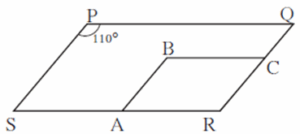
PQRS is a parallelogram .... [Given]
∴ ∠R = ZP ... [Opposite angles of a parallelogram]
∴ ∠R = 110° ... (i)
ABCR is a parallelogram. ... [Given]
∴ ∠A + ∠R = 180° ... [Adjacent angles of a parallelogram are supplementary]
∴ ∠A + 110° = 180° ... [From (i)]
∴ ∠A = 180° - 110°
∴ ∠A = 70°
∴ ∠C = ∠A = 70°
∴ ∠B = ∠R = 110° ... [Opposite angles of a parallelogram]
Answer is : ∠R = 110°, ∠B = 110°, ∠A = 70°, ∠C =70°.
Question 1.7. In figure ABCD is a parallelogram. Point E is on the ray AB such that BE = AB then prove that line ED bisects seg BC at point F.
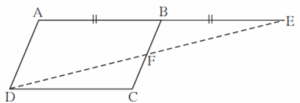
seg AB || seg DC ... (Opposite sides of a parallelogram)
∴ seg AE || seg DC ... (A-B-E)
and line BC is the transversal,
∴ ∠EBC ≅ ∠DCB ... (Alternate angles)
i.e. ∠EBF ≅ ∠DCF ... (B-F-C) ... (1)
seg AB ≅ seg CD ... (Opposite sides of a parallelogram) ... (2)
also seg AB ≅ seg BE ... (Given) ... (3)
∴ seg BE ≅ seg CD [From (2) and (3)] ... (4)
seg AE || seg DC and line DE is the transversal.
∴ ∠BED ≅ ∠EDC ... (Alternate angles)
i.e. ∠BEF ≅ ∠FDC ... (5)
In Δ EBF and Δ DCF,
seg BE ≅ seg CD ... [From (4)]
∠EBF ≅ ∠DCF ... [From (1)]
∠BEF ≅ ∠FDC ... [From (5)]
∴ Δ EBF ≅ Δ DCF ... (ASA test of congruence)
∴ seg BF ≅ seg CF ... (c.s.c.t)
∴ line ED bisects seg BC at point F.
Practice set 5.2 :
Question 2.1. In figure, ABCD is a parallelogram, P and Q are midpoints of side AB and DC respectively, then prove APCQ is a parallelogram.
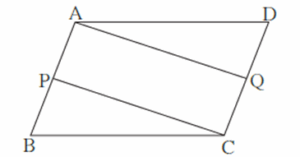
Given : ABCD is a parallelogram. P and Q are the midpoints of sides AB and DC respectively.
To Prove : APCQ is a parallelogram.
Proof:
AP = \(\frac{1}{2}\)AB ... (i) [P is the midpoint of side AB]
QC = \(\frac{1}{2}\)DC ... (ii) [Q is the midpoint of side CD]
ABCD is a parallelogram. ... [Given]
∴ AB = DC ... [Opposite sides of a parallelogram]
\(\frac{1}{2}\)AB = \(\frac{1}{2}\)DC ... [Multiplying both sides by \(\frac{1}{2}\) ]
∴ AP = QC ... (iii) [From (i) and (ii)]
Also, AB || DC ... [Opposite angles of a parallelogram]
i.e. AP || QC ... (iv) [A-P-B, D-Q-C]
From (iii) and (iv),
AP = QC
AP || QC
A quadrilateral is a parallelogram if its opposite sides is parallel and congruent.
∴ APCQ is a parallelogram.
Question 2.2. Using opposite angles test for parallelogram, prove that every rectangle is a parallelogram.
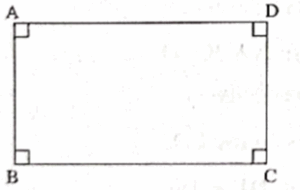
Let ABCD be a rectangle.
All angles are right angles: ∠A = ∠B = ∠C = ∠D = 90∘
Thus, ∠A =∠C and ∠B =∠D.
The opposite angles test states: If both pairs of opposite angles are equal, the quadrilateral is a parallelogram.
Therefore, every rectangle is a parallelogram by this test.
Question 2.3. In figure, G is the point of concurrence of medians of D DEF. Take point H on ray DG such that D-G-H and DG = GH, then prove that GEHF is a parallelogram.
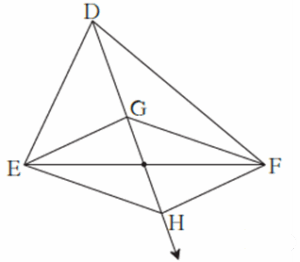
Proof : Let the median from vertex D intersect side EF at M.
G is the centroid ... (Given)
Centroid divides each median in the ratio 2 : 1
∴ DG : GM = 2 : 1
∴ \(\frac{DG}{GM}=\frac{2}{1}\)
∴ DG = 2GM ... (1)
DG = GH ... (Given)
∴ DG = GM + MH ... (G-M-H)
∴ 2GM = GM + MH ... [From (1)]
∴ 2GM - GM = MH
∴ GM = MH ... (2)
In GEHF,
seg GM ≅ seg MH ... [From (2)]
seg EM ≅ seg MF ... (M is the midpoint of seg EF)
A quadrilateral is a parallelogram, if its diagonals bisect each other.
∴ GEHF is a parallelogram.
Question 2.4. Prove that quadrilateral formed by the intersection of angle bisectors of all angles of a parallelogram is a rectangle. (Figure)
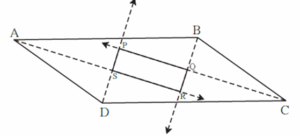
Proof :
□ ABCD is a parallelogram ... (Given)
∠ADC + ∠BCD = 180° ... (Adjacent angles of a parallelogram are supplementary)
Multiplying each term by \(\frac{1}{2}\), we get,
\(\frac{1}{2}\)∠ADC + \(\frac{1}{2}\)∠BCD = \(\frac{1}{2}\) × 180°
But, \(\frac{1}{2}\)∠ADC = ∠PDC ... (Ray DP bisects ∠ADC) ... (2)
And ∠BCD = ∠PCD ... (Ray CP bisects ∠BCD) ... (3)
∴ ∠PDC + ∠PCD = 90° ... [From (1), (2) and (3)] ... (4)
In Δ PDC,
∠PDC + ∠PCD + ∠DPC = 180° ... (The sum of the measures of all angles of a triangle is 180°)
∴ 90° + ∠DPC = 180° ... [From (4)]
∴ ∠DPC=180° - 90°
∴ ∠DPC = 90°
i.e. ∠SPQ = 90° ... (D-S-P, P-Q-C) ... (5)
Similarly, we can prove SRQ = 90° ... (6)
also ∠ASD = 90° and ∠BQC = 90° ... (7)
∠PSR = ∠ASD ... (Vertically opposite angles)
∴ ∠PSR = 90° (From 7) ... (8)
Similarly, ∠PQR = 90° ... (9)
In □ PQRS,
∠SPQ = ∠SRQ = ∠PSR = ∠PQR = 90° ... (From 5, 6, 8 and 9)
∴ □ PQRS is a rectangle ... (By definition)
Question 2.5. In figure, if points P, Q, R, S are on the sides of parallelogram such that AP = BQ = CR = DS then prove that PQRS is a parallelogram.
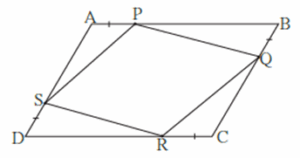
Proof : AP = CR ... (Given) ... (1)
□ ABCD is a parallelogram ... (Given)
∴ AB = CD ... (Opposite sides of a parallelogram)
∴ AP + PB = CR + RD ... (A-P-B, C-R-D) ... (2)
∴ PB = RD ... [From (1) and (2)] ... (3)
∠ABC ≅ ∠ADC ... (Opposite angles of a parallelogram)
i.e. ∠PBQ ≅ ∠RDS ... (A-P-B, B-Q-C, C-R-D and A-S-D) ... (4)
In Δ PBQ and Δ RDS,
seg PB ≅ seg RD ... [From (3)]
PBQ ≅ ZRDS ... [From (4)]
seg BQ ≅ seg SD ... (Given)
∴ Δ PBQ ≅ Δ RDS ... (SAS test of congruence)
∴ seg PQ ≅ seg RS ... (c.s.c.t) ... (5)
Similarly, by proving Δ PAS ≅ Δ RCQ, we get, ... (6)
seg PS ≅ seg RQ
In □ PQRS,
seg PQ ≅ seg RS ... [From (5)]
seg PS ≅ seg RQ ... [From (6)]
A quadrilateral is a parallelogram if its opposite sides are congruent.
∴ □ PQRS is a parallelogram.
Practice set 5.3 :
Question 3.1. Diagonals of a rectangle ABCD intersect at point O. If AC = 8 cm then find the length of BO and if ∠CAD = 35° then find the measure of ∠ACB.
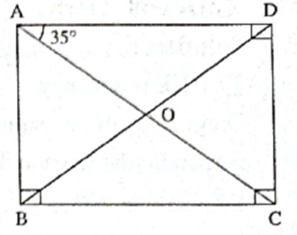
□ ABCD is a rectangle ... [Given]
∴ BD = AC ... [Diagonals of a rectangle are congruent]
∴ BD = 8 cm ... [From (i)]
BO = \(\frac{1}{2}\)BD ... [Diagonals of a rectangle bisect each other]
∴ BO = \(\frac{1}{2}\) × 8
∴ BO = 4 cm
side AD || side BC and seg AC is their transversal. ... [Opposite sides of a rectangle are parallel]
∴ ∠ACB = ∠CAD ... [Alternate angles]
∠ACB = 35° ...[ ∵ ∠CAD = 35°]
∴ BO = 4 cm, ∠ACB = 35°
Question 3.2. In a rhombus PQRS if PQ = 7.5 then find the length of QR. If ∠QPS = 75° then find the measure of ∠PQR and ∠SRQ.
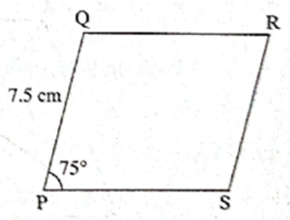
PQ= 7.5 cm ... (Given)
PQ = QR ... (Sides of a rhombus)
∴ QR = 7.5 cm
∠QPS = 75° ... (Given)
∠QPS + ∠PQR = 180° ... (Adjacent angles of a rhombus are supplementary)
∴ 75° + ∠PQR = 180°
∴ ∠PQR = 180° - 75°
∴ ∠PQR = 105°
∠SRQ = ∠QPS ... (Opposite angles of a rhombus)
∴ ∠SRQ = 75°
Answer is : QR = 7.5 cm, ∠PQR = 105°, ∠SRQ = 75°.
Question 3.3. Diagonals of a square IJKL intersects at point M, Find the measures of ∠IMJ, ∠JIK and ∠LJK .
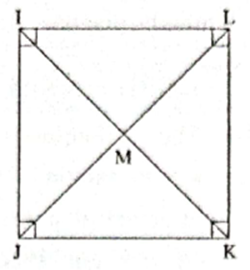
□ IJKL is a square.
Diagonals of a square are perpendicular to each other
∴ ∠IMJ = 90°
Diagonals of a square bisects opposite angles.
∴ ∠JIK = \(\frac{1}{2}\)∠JIL
∴ ∠JIK = \(\frac{1}{2}\) x 90°
∴ ∠JIK = 45°
Also, ∠LJK = \(\frac{1}{2}\)∠IJK
∴ ∠LJK = \(\frac{1}{2}\) × 90°
∴ ∠LJK = 45°
Answer is : ∠IMJ = 90°, ∠JIK = 45° and ∠LJK = 45°.
Question 3.4. Diagonals of a rhombus are 20 cm and 21 cm respectively, then find the side of rhombus and its perimeter.
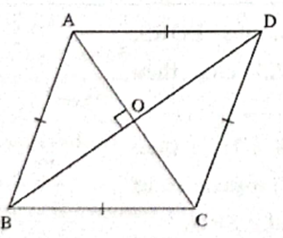
Let □ ABCD be given rhombus.
AC = 20 cm, BD = 21 cm.
Let diagonals AC and BD intersect at point O.
AO = \(\frac{1}{2}\)AC and BO = \(\frac{1}{2}\)BD ... (Diagonals of a rhombus bisect each other)
∴ AO = \(\frac{1}{2}\) × 20 ∴ AO = 10 cm
and BO = \(\frac{1}{2}\) x 21 = 10.5 cm
Ιη ΔΑΟΒ,
∴ ∠AOB = 90° ... (Diagonals of a rhombus are perpendicular to each other)
By Pythagoras theorem,
AB2 = AO2 + OB2
∴ AB2 = 102 + 10.52
∴ AB2 = 100 + 110.25
∴ AB2 = 210.25
∴ AB = 210.25
∴ AB = 14.5 cm
Side of the rhombus = AB = 14.5 cm
Perimeter of the rhombus = 4 x side =4 × 14.5 = 58cm
Answer is : Side of the rhombus is 14.5 cm Perimeter of the rhombus is 58 cm.
Question 3.5. State with reasons whether the following statements are ‘true’ or ‘false’.
(i) Every parallelogram is a rhombus.
False.
- In a rhombus all sides are congruent. Whereas in a parallelogram only opposite sides are congruent. Hence every parallelogram is not a rhombus.
(ii) Every rhombus is a rectangle.
False.
In a rectangle all angles are of measure 90°. Whereas in a rhombus it is not necessary that all angles are of measure 90°.
(iii) Every rectangle is a parallelogram.
True.
- A quadrilateral is a parallelogram, if its opposite sides are parallel. In a rectangle, opposite sides are parallel. Hence every rectangle is a parallelogram.
(iv) Every squre is a rectangle.
True.
- A quadrilateral is a rectangle, if all its angles are right angles. A square has all of its angles right angles. Hence every square is a rectangle.
(v) Every square is a rhombus.
True.
A quadrilateral is a rhombus, if all of its sides are congruent. In a square, all sides are congruent. Hence, every square is a rhombus.
(vi) Every parallelogram is a rectangle.
False.
- A quadrilateral is a rectangle, if all of its angles are right angles. In a parallelogram it is not necessary that all angles are right angles. Hence every parallelogram is not a rectangle.
Practice set 5.4 :
Question 4.1. In IJKL, side IJ || side KL ∠I = 108° ∠K = 53° then find the measures of ∠J and ∠L.
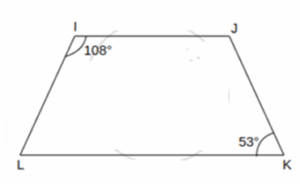
seg LK || seg IJ and line LI is the transversal,
∠L + ∠I = 180° …..(Interior angles)
∴ ∠L + 108° = 180°
∴ ∠L = 180° - 108°
∴ ∠L = 72°
seg LK || seg IJ and line KJ is the transversal,
∠K + ∠J = 180° …..(Interior angles)
∴ 53° + ∠J = 180°
∴ ∠J = 180° - 53°
∴ ∠J = 127°
Answer is : ∠L = 72° and ∠J = 127°.
Question 4.2. In ABCD, side BC || side AD, side AB ≅ side DC If ∠A = 72° then find the measures of ∠B, and ∠D.
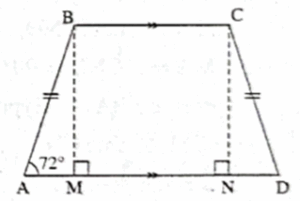
Draw seg BM ⊥ side AD such that A-M-D and seg CN ⊥ side AD such that A-N-D.
seg BC || seg AD ... (Given)
∴ BM = CN ... (Distance between two parallel lines is constant) ... (1)
In A BMA and ACND,
∠BMA = ∠CND = 90° ... (Construction)
Hypotenuse BA ≅ Hypotenuse CD ... (Given)
side BM side CN ... [From (1)]
∴ ∠BMA = ∠CND ... (Hypotenuse side test of congruence)
∴ ∠BAM ≅ ∠CDN ... (c.a.c.t.)
i.e. ∠BAD ≅ ∠CDA ... (A-M-D, A-N-D)
∠BAD = 72° ... (Given)
∠CDA = 72° i.e. ∠D = 72°
side BC || side AD ... (Given)
and line BA is the transversal,
∠BAD + ∠ABC = 180° …..(Interior angles)
∴ 72° + ∠ABC = 180°
∴ ∠ABC = 180° - 72°
∴ ∠ABC = 108° i.e. ∠B = 108°
Answer is : ∠D = 72° and ∠B = 108°.
Question 4.3. In ABCD, side BC < side AD (Figure) side BC || side AD and if side BA ≅ side CD then prove that ∠ABC ≅ ∠DCB.
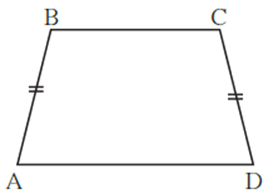
Proof :
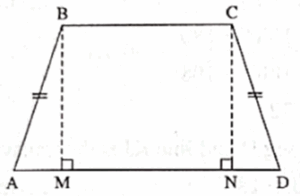
Draw seg BM ⊥ side AD such that A-M-D and seg CN ⊥ side AD such that A-N-D.
side BC || side AD ... (Given)
∴ BM = CN ... (Distance between two parallel lines is constant) ... (1)
In ABMA and A CND,
∠BMA = ∠CND = 90° ….(Construction)
Hypotenuse BA ≅ Hypotenuse CD ... (Given)
side BM ≅ side CN ... [From (1)]
∴ Δ BMA ≅ Δ CND ... (By hypotenuse side test of congruence)
∴ ∠BAM ≅ ∠CDN ... (c.a.c.t.)
i.e. ∠BAD ≅ ∠CDA ... (A-M-D, A-N-D) ... (2)
side BC || ≅ side AD ... (Given)
and line AB is the transversal,
∴ ∠ABC + ∠BAD = 180° ... (Interior angles) ... (3)
side BC || side AD ... (Given)
and line CD is the transversal,
∴ ∠DCB + ∠CDA = 180° ... (Interior angles) ... (4)
∴ ∠ABC + ∠BAD = ∠DCB + ∠CDA ... [From (3) and (4)]
∴ ∠ABC + ∠CDA = ∠DCB + ∠CDA ... [From (2)]
∴ ∠ABC = ∠DCB
∴ ∠ABC ≅ ∠DCB.
Practice set 5.5 :
Question 5.1. In figure, points X, Y, Z are the midpoints of side AB, side BC and side AC of Δ ABC respectively. AB = 5 cm, AC = 9 cm and BC = 11 cm. Find the length of XY, YZ, XZ.
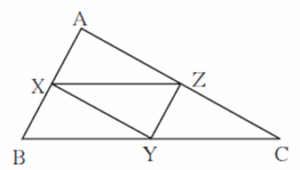
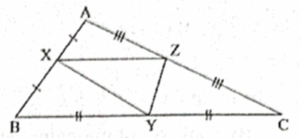
AB = 5 cm, AC = 9 cm and BC = 11 cm ... (Given)
In Δ ABC, X and Y are the midpoints of sides AB and BC respectively. ... (Given)
∴ XY = \(\frac{1}{2}\)AC ... (Midpoint theorem)
∴ XY = \(\frac{1}{2}\) x 9
∴ XY = 4.5 cm
In Δ ABC, Y and Z are the midpoints of sides BC and AC respectively. ... (Given)
∴ YZ = \(\frac{1}{2}\)AB ... (Midpoint theorem)
∴ YZ = \(\frac{1}{2}\) x 5
∴ YZ = 2.5 cm
In Δ ABC, X and Z are the midpoints of sides AB and AC respectively ... (Given)
∴ XZ = \(\frac{1}{2}\)BC ... (Midpoint theorem)
∴ XZ = \(\frac{1}{2}\) x 11
∴ XZ = 5.5 cm
Answer is : XY = 4.5 cm, YZ = 2.5 cm, XZ = 5.5 cm.
Question 5.2. In figure, PQRS and MNRL are rectangles. If point M is the midpoint of side PR then prove that, (i) SL = LR, (ii) LN = \(\frac{1}{2}\)SQ.
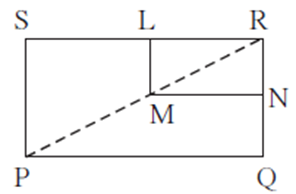
Proof :
(i) LMNR is a rectangle.
∴ seg LM || seg RN ... (Opposite sides of a rectangle)
i.e. seg LM || seg RQ ... (R -N - Q) ... (1)
seg RQ || seg SP ... (Opposite sides of a rectangle) ... (2)
From (1) and (2),
seg LM || seg SP ... (3)
In Δ RSP, M is the midpoint of seg PR ... (Given)
seg LM || seg SP ... [From (3)]
∴ L is the midpoint of side SR ... (By converse of midpoint theorem) ... (4)
∴ SL = LR
(ii) Diagonals of a rectangle are congruent.
∴ SQ = PR and LN = MR
Now, MR = \(\frac{1}{2}\)PR ... (M is the midpoint of seg PR) ... (7)
∴ LN = \(\frac{1}{2}\) PR ... [From (6) and (7)] ... (8)
∴ LN = \(\frac{1}{2}\) SQ. ... [From (5) and (8)]
Question 5.3. In figure, Δ ABC is an equilateral traingle. Points F,D and E are midpoints of side AB, side BC, side AC respectively. Show that Δ FED is an equilateral traingle.
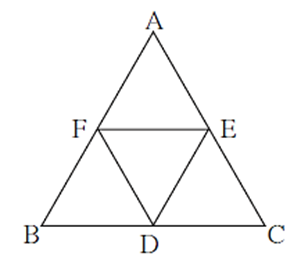
Proof :
In Δ ABC, F and E are the midpoints of sides AB and AC respectively. ... (Given)
∴ FE = \(\frac{1}{2}\)BC ... (Midpoint theorem) ... (1)
In Δ ABC, D and E are the midpoints of sides BC and AC respectively.
∴ DE = \(\frac{1}{2}\)AB ... (Midpoint theorem) ... (2)
In Δ ABC, D and F are the midpoints of sides BC and AB respectively.
DF = \(\frac{1}{2}\)AC ... (Midpoint theorem) ... (3)
Δ ABC is a equilateral.
∴ BC = AB = AC ... (Sides of an equilateral triangle)
Multiplying each term by \(\frac{1}{2}\), we get,
\(\frac{1}{2}\)BC = \(\frac{1}{2}\)AB = \(\frac{1}{2}\)AC ... (4)
∴ FE = DE = DF ... [From (1), (2), (3) and (4)]
∴ Δ DEF is an equilateral triangle. ... (By definition)
Question 5.4. In figure, seg PD is a median of Δ PQR. Point T is the mid point of seg PD. Produced QT intersects PR at M. Show that \(\frac{PR}{PM}\) = \(\frac{3}{1}\)
[Hint : draw DN || QM.]
Proof:
Draw seg DN || seg QM such that P-M-N and M-N-R.
In Δ PDN,
Point T is the mid-point of seg PD. ... (Given)
seg TM || seg DN ... (Construction)
∴ Point M is the mid-point of seg PN. ... (Converse of mid-point theorem) [P-M-N]
∴ PM = MN
In Δ QMR,
Point D is the mid-point of seg QR. ... (Given)
seg DN || seg QM. ... (Construction)
∴ Point N is the mid-point of seg MR. ... (Converse of mid-point theorem)[M-N-R]
∴ RN = MN ... (ii)
PM = MN = RN ….[From (i) and (ii)] ... (iii)
Now,
PR = PM + MN + RN
∴ PR = PM + PM + PM ……[From (iii)]
∴ PR = 3PM
∴ \(\frac{PR}{PM}\) = \(\frac{3}{1}\)
Hence proved.
Problem set 5 :
Question 1. Choose the correct alternative answer and fill in the blanks.
(i) If all pairs of adjacent sides of a quadrilateral are congruent then it is called ....
(A) rectangle
(B) parallelogram
(C) trapezium
(D) rhombus
(D) rhombus
- When all the pairs of the adjacent sides of a quadrilateral are congruent then it is a rhombus.
(ii) If the diagonal of a square is 12\(\sqrt{2}\) cm then the perimeter of square is ......
(A) 24 cm
(B) 24\(\sqrt{2}\) cm
(C) 48 cm
(D) 48\(\sqrt{2}\) cm
(C) 48 cm
Explanation :
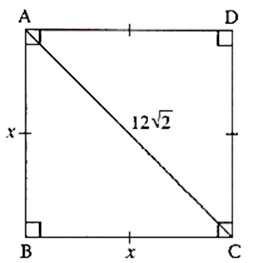
In Δ ABC, we apply the Pythagoras theorem,
AB2 + BC2 = AC2
x2 + x2 = AC2 (□ABCD is a square.)
2x2 = AC2
2x2 = (12\(\sqrt{2}\) )2
2x2 = 144(2)
x2 = 144
x = 12 cm
∴ x = AB = BC = CD = AD = 12 cm
Perimeter of □ABCD = 4 x 12 = 48 cm
(iii) If opposite angles of a rhombus are (2x)° and (3x - 40)° then value of x is ...
(A) 100 °
(B) 80 °
(C) 160 °
(D) 40 °
(D) 40 °
A rhombus is also a parallelogram so, the opposite angles will be congruent.
Thus, (2x)° =(3x - 40)°
3x - 2x = 40°
x = 40°
Question 2. Adjacent sides of a rectangle are 7 cm and 24 cm. Find the length of its diagonal.
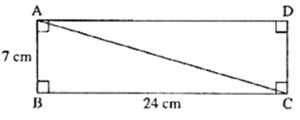
Let □ ABCD be a given rectangle.
AB = 7 cm, BC = 24 cm
In Δ ABC,
∠ABC = 90° ... (Angle of a rectangle)
By Pythagoras theorem,
AC2 = AB2 + BC2
∴ AC2 = 72 + 242
∴ AC2 = 49 + 576
AC2 = 625
∴ AC = \(\sqrt{625}\)
∴ AC = 25 cm
∴ The length of the diagonal is 25 cm.
Question 3. If diagonal of a square is 13 cm then find its side.
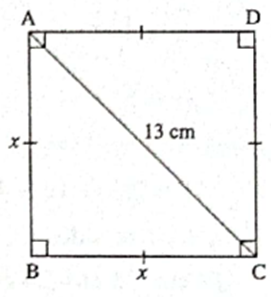
Let □ ABCD be a given square.
AC = 13 cm
Let the side of the square be x cm.
In Δ ABC,
∠ABC = 90°
By Pythagoras theorem,
AC2 = AB2 + BC2
∴ 132 = x2 + x2
∴ 2x2 = 169
∴ x2 = 169/2
∴ x = \(\sqrt{169/2}\) = \(\frac{13}{\sqrt{2}}\) = \(\frac{13}{\sqrt{2}}×\frac{\sqrt{2}}{\sqrt{2}}\) = 6.5\(\sqrt{2}\)
Side of a square is 6.5\(\sqrt{2}\)
Question 4. Ratio of two adjacent sides of a parallelogram is 3 : 4, and its perimeter is 112 cm. Find the length of its each side.
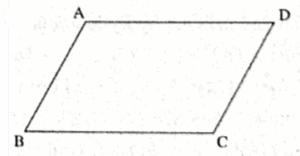
Let □ ABCD be a given parallelogram.
AB : BC = 3 : 4
Let the common multiple of the given ratio be x.
Then AB = 3x cm,
BC = 4x
CD = AB = 3x cm ... (Opposite sides of a parallelogram)
AD = BC = 4x cm ... (Opposite sides of a parallelogram)
Perimeter of □ ABCD = 112 cm
∴ AB + BC + CD + AD = 112
∴ 3x + 4x + 3x + 4x = 112
∴ 14x = 112
∴ 4x = 112/14
∴ x = 8.
∴ CD =AB = 3x = 3 × 8 = 24 cm
AD = BC = 4x = 4 x 8 = 32 cm.
∴ The sides of the parallelogram are of lengths 24 cm, 32 cm, 24 cm and 32 cm.
Question 5. Diagonals PR and QS of a rhombus PQRS are 20 cm and 48 cm respectively. Find the length of side PQ.
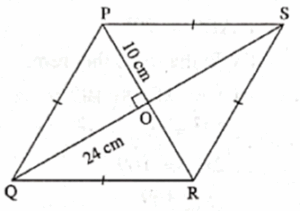
Let the diagonals PR and QS intersect at point O.
PR = 20 cm, QS = 48 cm
The diagonals of a rhombus bisect each other at right angles ... (1)
∴ OP = \(\frac{1}{2}\)PR = \(\frac{1}{2}\) × 20 cm
∴ OP = 10 cm ... (2)
OQ = \(\frac{1}{2}\) QS = \(\frac{1}{2}\) × 48 cm
∴ OQ = 24 cm ... (3)
∠POQ = 90° ... [From (1)]
In right angled Δ POQ, by Pythagoras theorem,
PQ2 = OP2 + OQ2
= (10)2 + (24)2 ... [From (2) and (3)]
= 100 + 576 = 676
∴ PQ2 = (26)2
∴ PQ = 26 cm
∴ The length of side PQ is 26 cm.
Question 6. Diagonals of a rectangle PQRS are intersecting in point M. If ∠QMR = 50° then find the measure of ∠MPS.
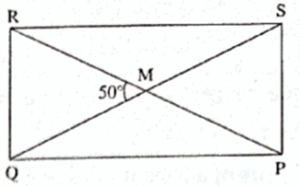
□ PQRS is rectangle
Diagonals of a rectangle are equal.
.. ∴ PR = QS.
Multiplying both the sides by \(\frac{1}{2}\)
\(\frac{1}{2}\)PR = \(\frac{1}{2}\)QS
Now, PM = \(\frac{1}{2}\)PR ... (2) ... (Diagonals of rectangle bisect each other)
MS = \(\frac{1}{2}\)QS ... (Diagonals of rectangle bisect each other)
∴ PM = MS ... [From (1), (2) and (3)]
∴ ∠MPS ≅ ∠MSP ... (Isosceles triangle theorem)
Let ∠MPS = ∠MSP = x ... (4)
∠PMS = ∠QMR ... (Vertically opposite angles)
∠QMR = 50° ... (Given)
∴ ∠PMS = 50° ... (5)
In Δ MPS,
∠PMS + ∠MPS + ∠MSP = 180° ... (The sum of the measures of all angles of a triangle is 180°)
∴ 50° + x + x = 180° ... [From (5) and (4)]
∴ 2x = 180°- 50°
∴ 2x = 130°
∴ x = 130°/2
∴ x = 65°
∴ ∠MPS = x = 65°
∴ The measure of MPS is 65°.
Question 7. In the adjacent Figure, if seg AB || seg PQ , seg AB ≅ seg PQ, seg AC || seg PR, seg AC ≅ seg PR then prove that, seg BC || seg QR and seg BC ≅ seg QR.
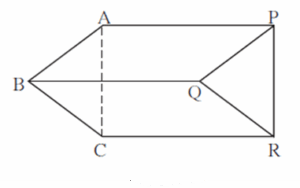
In □ ABQP,
seg AB || seg PQ ... (Given)
seg AB seg PQ ... (Given)
A quadrilateral is a parallelogram, if a pair of opposite sides is parallel and congruent.
□ ABQP is a parallelogram
∴ seg AP || seg BQ ... (1)
and seg AP ≅ seg BQ ... (2) ... (Opposite sides of a parallelogram are parallel and congruent)
In □ ACRP,
seg AC || seg PR, seg AC ≅ seg PR ... (Given)
A quadrilateral is a parallelogram, if a pair of opposite sides is parallel and congruent.
□ ACRP is a parallelogram
∴ seg AP || seg CR ... (3)
seg AP ≅ seg CR ... (4) ... (Opposite sides of a parallelogram are parallel and congruent)
In □ BQRC,
seg BQ || seg CR ... [From (1) and (3)]
seg BQ ≅ seg CR ... [From (2) and (4)]
A quadrilateral is a parallelogram, if a pair of opposite sides is parallel and congruent.
□ BQRC is a parallelogram
seg BC || seg QR,
seg BC ≅ seg QR ... (Opposite sides of a parallelogram are parallel and congruent)
Question 8. In the Figure, ABCD is a trapezium. AB || DC. Points P and Q are midpoints of seg AD and seg BC respectively. Then prove that, PQ || AB and PQ = \(\frac{1}{2}\)(AB + DC).
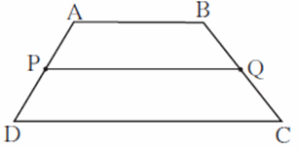
Construction : Draw seg AQ and extend it to intersect side DC produce at R.
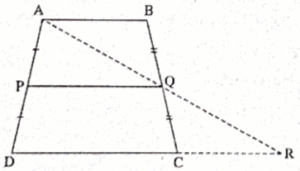
Proof : line AB | line DC and line BC is the transversal ... (Given)
∴ ∠ABC = ∠RCB ... (Alternate angles)
i.e. ∠ABQ = ∠RCQ ... (B-Q-C) ... (1)
In Δ ABQ and Δ RCQ,
∠ABQ ≅ ∠RCQ
seg BQ ≅ seg CQ ... (Q is the midpoint of seg BC)
∠BQA ≅ ∠CQR ... (Vertically opposite angles)
∴ Δ ABQ ≅ Δ RCQ ... (ASA test of congruence)
∴ seg AB ≅ seg RC ... (c.s.c.t.) ... (2)
∴ seg AQ ≅ seg QR ... (c.s.c.t.) ... (3)
In Δ ADR,
P is the midpoint of seg AD ... (Given)
Q is the midpoint of seg AR ... (From 3)
∴ seg PQ || side DR ... (Midpoint theorem)
∴ seg PQ || side DC ... (D-C-R) ... (4)
side DC || side AB ... (Given) ... (5)
∴ seg PQ || side AB ... [From (4) and (5)]
also, PQ = \(\frac{1}{2}\) DR ... (Midpoint theorem)
∴ PQ = \(\frac{1}{2}\)(DC + CR) ... (D-C-R)
∴ PQ = \(\frac{1}{2}\)(DC + AB) ... [From (2)]
i.e. PQ = \(\frac{1}{2}\)(AB + DC).
Question 9. In the adjacent figure, ABCD is a trapezium. AB || DC. Points M and N are midpoints of diagonal AC and DB respectively then prove that MN || AB.
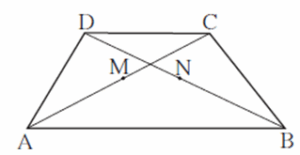
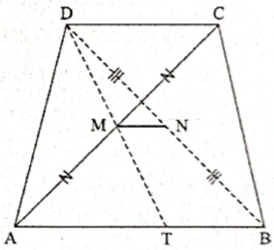
Proof : Draw seg DM and extend it to intersect side AB at point T. ... (A-T-B) ... (Given)
side DC || side AB and line AC is the transversal
∴ ∠DCA ≅ ∠BAC ... (Alternate angles)
i.e. ∠DCM ≅ ∠TAM ... (A-M-C and A-T-B) ... (1)
In Δ DCM and Δ TAM,
∠DCM ≅ ∠TAM
seg MC ≅ seg MA ... (M is the midpoint of side AC)
∠DMC ≅ ∠TMA ... (Vertically opposite angles)
∴ Δ DCM ≅ Δ TAM ... [From (1)] ... (ASA test of congruence)