
Solutions
Practice set 4.1 :
Question 1.1. Construct Δ PQR, in which QR = 4.2 cm, m∠Q = 40° and PQ + PR = 8.5 cm
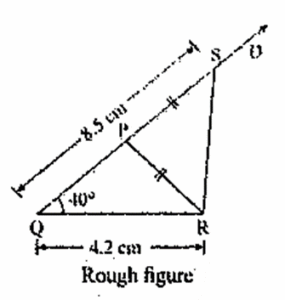
As shown in the rough figure, first we draw seg QR = 4.2 cm of length.
Draw a ray QD making an angle of 40° with seg QR.
Mark point S on QD such that QS = 8.5 cm
Now, PQ + PS = QS ... [Q-P-S]
∴ PQ + PS = 8.5 cm ... (i)
Given PQ + PR =8.5 cm ... (ii)
∴ PQ + PS = PQ+ PR ... [From (i) and (ii)]
∴ PS = PR
∴ P is on the perpendicular bisector of SR. ... (Perpendicular bisector theorem)
∴ The point of intersection of ray QD and perpendicular bisector of seg SR is point P.
Steps of constructions:
- Draw seg QR of length 4.2 cm.
- Draw ray QD such that ∠RQD = 40°.
- Mark point S on ray QD such that QS = 8.5 cm
- Draw seg RS.
- Construct the perpendicular bisector of seg RS.
- Draw perpendicular bisector of SR which intersects ray QD. Mark the point as P.
- Draw seg PR.
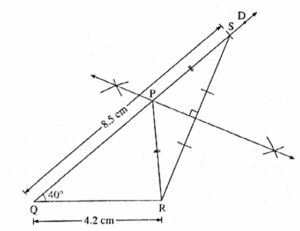
Therefore, Δ PQR is the required triangle.
Question1.2. Construct Δ XYZ, in which YZ = 6 cm, XY + XZ = 9 cm. ∠XYZ = 50°
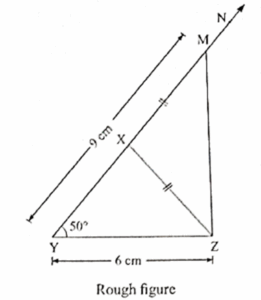
As shown in the rough figure, first we draw seg YZ = 6 cm of length.
Draw a ray YN making an angle of 50° with seg YZ.
Mark point M on YN such that YM = 9 cm
Now, YX + XM = YM ... [Y-X-M]
∴ YX + XM = 9 cm ... (i)
Given XY + XZ = 9 cm ... (i) Given
∴ YX + XM = XY + XZ ... [From (i) and (ii)]
∴ XM = XZ
∴ X is on the perpendicular bisector of MZ. ... (Perpendicular bisector theorem)
∴ The point of intersection of ray YN and perpendicular bisector of seg MZ is point X.
Steps of construction:
- Draw seg YZ of length 6 cm.
- Draw ray YN such that ∠ZYN = 50°.
- Mark point M on ray YN such that YM = 9 cm
- Draw seg MZ.
- Construct the perpendicular bisector of seg MZ.
- Name the point of intersection of ray YM and the perpendicular bisector of MZ as X.
- Draw seg XZ.
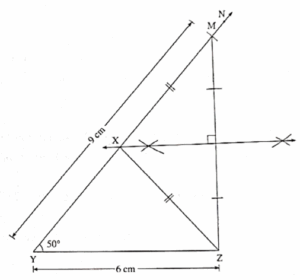
Therefore, Δ XYZ is the required triangle.
Question 1.3. Construct Δ ABC, in which BC = 6.2 cm, ∠ACB = 50°, AB + AC = 9.8 cm
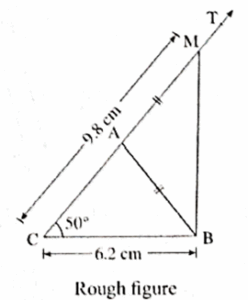
As shown in the rough figure draw seg CB = 6.2 cm
Draw a ray CT making an angle of 50° with CB
Take a point D on ray CT, such that
CM = 9.8 cm
Now, AC + AM = CM ... [C-A-M]
∴ AC + AM = 9.8 cm ... (i)
Also, AB + AC = 9.8 cm ... (ii) [Given]
∴ AC + AM = AB + AC ... [From (i) and (ii)]
∴ AM = AB
∴ Point A is on the perpendicular bisector of seg MB. ... (Perpendicular bisector
theorem)
∴ The point of intersection of ray CT and perpendicular bisector of seg MB is point A.
Steps of constructions:
- Draw seg BC of length 6.2 cm.
- Draw ray CT, such that ∠BCT = 50°.
- Mark point M on ray CT such that l(CM) = 9.8 cm.
- Join points M and B.
- Draw perpendicular bisector of seg MB intersecting ray CT. Name the point as A.
- Join the points A and B.
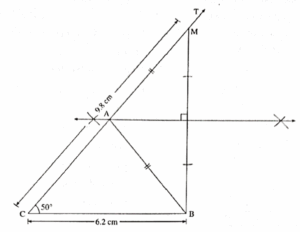
Therefore, Δ ABC is the required triangle.
Question 1.4. Construct Δ ABC, in which BC = 3.2 cm, ∠ACB = 45° and perimeter of Δ ABC is 10 cm.
BC = 3.2 cm
Perimeter of A ACB = 10 cm
∴ AB + AC + BC = 10
∴ AB + BC + 3.2 = 10
∴ AB + AC = 10-3.2
∴ AB + AC = 6.8 cm
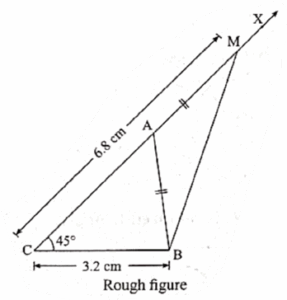
Now, In Δ ABC
BC= 3.2 cm, ∠ACB = 45° and AB + AC = 6.8 cm ... (i)
As shown in the rough figure draw seg BC = 3.2 cm
Draw a ray CX making an angle of 45° with CB
Take a point M on ray CX, such that
CM = 6.8 cm
Now, CA + AM = CM ... [C-A-M]
∴ CA + AM = 6.8 cm .(ii)
Also, AB + CA = 6.8 cm ... (iii) [From (i)]
∴ CA + AM = AB + CA ….[From (ii) and (iii)]
∴ AM = AB
∴ Point A is on the perpendicular bisector of seg MB. ... (Perpendicular bisector
theorem)
∴ The point of intersection of ray CX and perpendicular bisector of seg MB is point A.
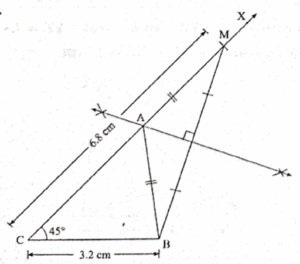
Therefore, Δ ABC is the required triangle.
Practice set 4.2 :
Question 2.1. Construct Δ XYZ, such that YZ = 7.4 cm, ∠XYZ = 45° and XY - XZ = 2.7 cm.
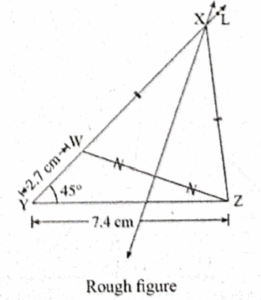
Explanation and steps of construction :
As shown in the rough figure, first we draw seg YZ of length 7.4 cm. We draw ray YL such that ∠LYZ = 45°.
Now, we have to locate point X on ray YL.
Take a point W on ray YL such that YW = 2.7 cm
XY = XW + YW
∴ XY = XW + 2.7 cm
∴ XY - XW = 2.7 cm
Now, XY - XZ = 2.7 cm
∴ XY - XW = XY - XZ
∴ XW = XZ
∴ X is equidistant from the points W and Z of seg WZ.
∴ X lies on the perpendicular bisector of seg WZ ... (Perpendicular bisector theorem)
∴ point X is the point of intersection of ray YL and perpendicular bisector of seg WZ.
Steps of construction :
(1) Draw seg YZ of length 7.4 cm.
(2) Draw ray YL such that ∠LYZ = 45°.
(3) Take a point W on ray YL such that YW = 2.7 cm.
(4) Construct the perpendicular bisector of seg WZ.
(5) Name the point of intersection of ray YL and the perpendicular bisector of seg WZ as X.
(6) Draw seg XZ.
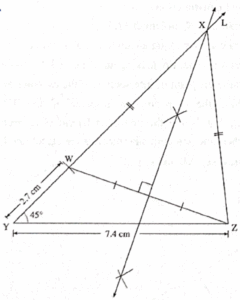
Therefore, Δ XYZ is the required triangle.
Question 2.2. Construct Δ PQR, such that QR = 6.5 cm, ∠PQR = 40° and PQ - PR = 2.5 cm.
[ Note : Considering ∠PQR = 60° as given in the textbook, the triangle formed is very large. Hence, ∠PQR = 40° is considered to make it small. There will not be any difference in conceptual understanding of the construction for the student.]
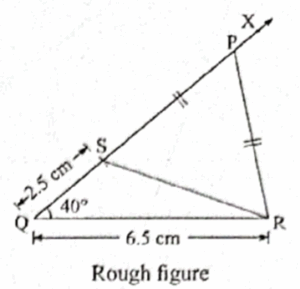
Here, PQ - PR = 2.5 cm
∴ PQ > PR
As shown in the rough figure draw seg QR = 6.5 cm
Draw a ray QX making on angle of 40° with QR
Take a point S on ray QX, such that QS = 2.5 cm
Now, PQ - PS = QS ... [Q-S-P]
∴ PQ - PS = 2.5 cm ... (i) [Given]
Also, PQ - PR = 2.5 cm ... (ii) [From (i) and (ii)]
∴ PQ – PS = PQ - PR
∴ PS = PR
∴ Point P is on the perpendicular bisector of seg RS.
∴ Point P is the intersection of ray QX and the perpendicular bisector of seg RS
Steps of construction:
- Draw seg QR of length 6.5 cm.
- Draw ray QX such that ∠RQX = 40°
- Take point S on ray QX such that QS = 2.5 cm.
- Join points S and R.
- Draw perpendicular bisector of seg SR intersecting ray QX. Name the point as P.
- Draw seg PR.
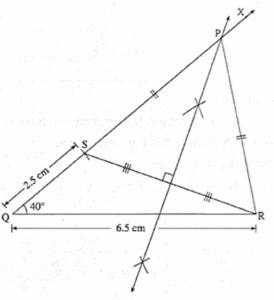
Therefore, Δ PQR is required triangle.
Question 2.3. Construct Δ ABC, such that BC = 6 cm, ∠ABC = 100° and AC - AB = 2.5 cm.
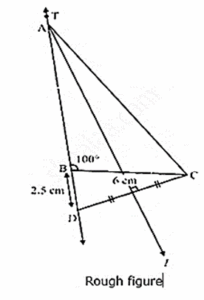
Here, AC - AB = 2.5 cm
∴ AC > AB
As shown in the rough figure draw seg BC = 6 cm
Draw a ray BT making an angle of 100° with BC.
Take a point D on opposite ray of BT, such that BD 2.5 cm.
Now, AD - AB = BD ... [A-B-D]
∴ AD – AB = 2.5 cm ... (i)
Also, AC - AB = 2.5 cm ... (ii) [Given]
∴ AD - AB = AC – AB ...[From (i) and (ii)]
∴ AD = AC
∴ Point A is on the perpendicular bisector of seg DC.
∴ Point A is the intersection of ray BT and the perpendicular bisector of seg DC.
Steps of construction:
- Draw seg BC of length 6 cm.
- Draw ray BT, such that ∠CBT = 100°.
- Take point D on opposite ray of BT such that l(BD) = 2.5 cm.
- Join the points D and C.
- Draw the perpendicular bisector of seg DC intersecting ray BT. Name the point as A.
- Join the points A and C.
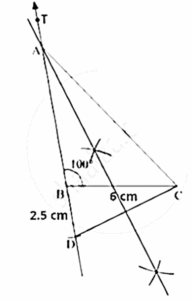
Therefore, Δ ABC is required triangle.
Practice set 4.3 :
Question 3.1. Construct Δ PQR, in which ∠Q = 70°, ∠R = 80° and PQ + QR + PR = 9.5 cm.
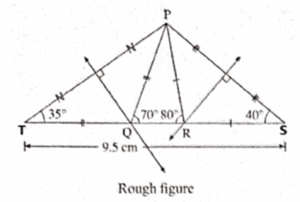
(i) As shown in the figure, take point T and S on line QR, such that
QT = PQ and RS = PR ... (i)
QT + QR + RS = TS ... [T-Q-R, Q-R-S]
∴ PQ + QR + PR = TS ... (ii) [From (i)]
Also,
PQ + QR + PR = 9.5 cm ... (iii) [Given]
∴ TS = 9.5 cm
(ii) In Δ PQT
PQ = QT ... [From (i)]
∴ ∠QPT = ∠QTP = x° ... (iv) [Isosceles triangle theorem]
In Δ PQT, PQR is the exterior angle.
∴ ∠QPT + ∠QTP = ∠PQR ..[Remote interior angles theorem]
∴ x + x = 70° ... [From (iv)]
∴ 2x = 70° ∴ x = 35°
∴ ∠PTQ = 35°
∴ ∠T = 35°
Similarly, ∠S = 40°
(iii) Now, in Δ PTS
∠T = 35°, ∠S = 40° and TS = 9.5 cm
Hence, Δ PTS can be drawn.
(iv) Since, PQ = TQ,
: Point Q lies on perpendicular bisector of seg PT.
Also, RP = RS
∴ Point R lies on perpendicular bisector of seg PS.
Points Q and R can be located by drawing the perpendicular bisector of PT and PS respectively.
∴ Δ PQR can be drawn.
Steps of construction:
- Draw seg TS of length 9.5 cm.
- From point T draw ray making angle of 35°.
- From point S draw ray making angle of 40°.
- Name the point of intersection of two rays as P.
- Draw the perpendicular bisector of seg PT and seg PS intersecting seg TS in Q and R respectively.
- Join PQ and PR.
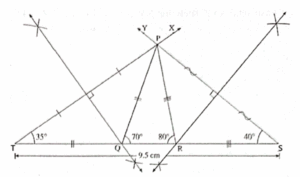
Therefore, Δ PQR is the required triangle.
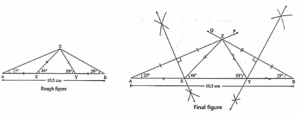
Question 3.2. Construct Δ XYZ, in which ∠Y = 58°, ∠X = 46° and perimeter of triangle is 10.5 cm.
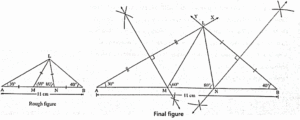
Question 3.3. Construct Δ LMN, in which ∠M = 60°, ∠N = 80° and LM + MN + NL = 11 cm.
Problem set 4 :
Question 1. Construct Δ XYZ, such that XY + XZ = 10.3 cm, YZ = 4.9 cm, ∠XYZ = 45°.
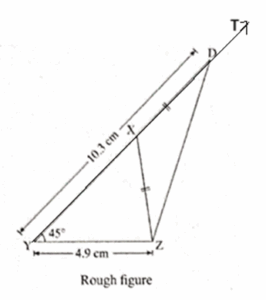
As shown in the rough figure draw seg YZ = 4.9 cm
Draw a ray YT making an angle of 45° with YZ
Take a point D on ray YT, such that YD = 10.3 cm
Now, YX + XD =YD ... [Y-X-D]
∴ YX + XD = 10.3 cm ... (i)
Also, XY + YZ = 10.3 cm ... (ii) [Given]
∴ YX + XD = XY + XZ .. [From (i) and (ii)]
∴ XD = XZ
Point X is on the perpendicular bisector of seg DZ
∴ The point of intersection of ray YT and perpendicular bisector of seg DZ is point X.
Steps of construction:
- Draw seg YZ of length 4.9 cm.
- Draw ray YT, such that ∠ZYT = 75°.
- Mark point D on ray YT such that l(YD) = 10.3 cm.
- Join points D and Z.
- Draw perpendicular bisector of seg DZ intersecting ray YT. Name the point as X.
- Join the points X and Z.
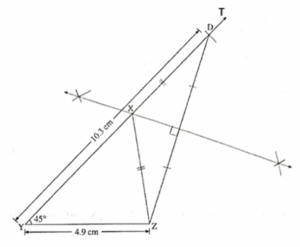
Therefore, Δ XYZ is the required triangle.
Question 2. Construct Δ ABC, in which ∠B = 70°, ∠C = 60°, AB + BC + AC = 11.2 cm.
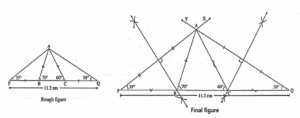
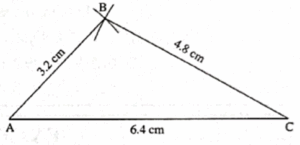
Question 3. The perimeter of a triangle is 14.4 cm and the ratio of lengths of its side is 2 : 3 : 4. Construct the triangle.
Let the given triangle be ABC.
AB : BC : AC =2 : 3 : 4
Let the common multiple of the given ratio be x.
Then AB = 2x cm, BC = 3x cm, AC = 4x cm.
Perimeter of A ABC = 14.4 cm
∴ AB + BC + AC = 14.4
∴ 2x + 3x + 4x =14.4
∴ 9x = 14.4
∴ x = 14.4/9 = 1.6
AB = 2x = 2 x 1.6 = 3.2 cm;
BC = 3x = 3 x 1.6 = 4.8 cm;
AC = 4x = 4 x 1.6 = 6.4 cm
Question 4. Construct Δ PQR, in which PQ - PR = 2.4 cm, QR = 6.4 cm and ∠PQR = 55°.
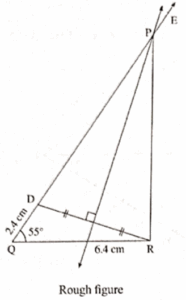
Here, PQ - PR = 2.4 cm
∴ PQ > PR
As shown in the rough figure, draw seg QR = 6.4 cm
Draw a ray QT making on angle of 55° with QR
Take a point D on ray QE, such that QD = 2.4 cm.
Now, PQ - PD = QD ... [Q-D-P]
∴ PQ – PD = 2.4 cm .(i)
Also, PQ-PR = 2.4 cm ... (ii) [Given]
∴ PQ – PD = PQ – PR ... [From (i) and (ii)]
∴ PD = PR
∴ Point P is on the perpendicular bisector of seg RD.
∴ Point P is the intersection of ray QE and the perpendicular bisector of seg RD.
Steps of construction:
- Draw seg QR of length 6.4 cm.
- Draw ray QE, such that ∠RQE = 55°.
- Take point D on ray QE such that l(QD) = 2.4 cm.
- Join the points D and R.
- Draw perpendicular bisector of seg SR intersecting ray QE. Name that point as P.
- Join the points P and R.
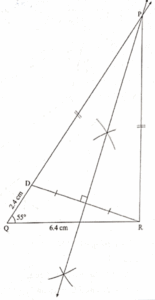
Therefore, Δ PQR is required triangle.