
Solutions
Practice set 3.1 :
Question 1.1. In figure ∠ACD is an exterior angle of Δ ABC. ∠B = 40°, ∠A = 70°. Find the measure of ∠ACD.
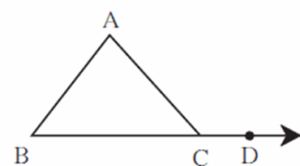
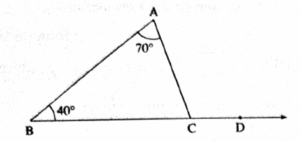
∠B = 40°, ∠A = 70° ... (Given)
In Δ ABC,
∠ACD = ∠A + ∠B ….(Remote interior angle theorem)
= 70° + 40° = 110°
Hence, the measure of ∠ACD is 110°.
Question 1.2. In Δ PQR, ∠P = 70°, ∠Q = 65° then find ∠R.
In Δ PQR,
∠P + ∠Q + ∠R = 180° ... (The sum of all angles of a triangle is 180°.)
70° + 65° + ∠R = 180°
∴ 135° + ∠R = 180°
∴ ∠R = 180° - 135° = 45°
Hence, the measure of ∠R is 45°.
Question 1.3. The measures of angles of a triangle are x°, (x-20)°, (x-40)°. Find the measure of each angle.
The measures of the angles of a triangle are x°, (x - 20)°, (x - 40)°.
x° + (x - 20)° + (x - 40)° = 180° ... .(The sum of the angles of a triangle is 180°.)
∴ 3x – 60 = 180
∴ 3x = 180 + 60
∴ 3x = 240
∴ x = 240/3
∴ x = 80
Now, x° = 80°
(x - 20)° = (80 - 20)° = 60°
(x - 40)° = (80 - 40)° = 40°
Hence, the measures of the angles of the triangle are 80°, 60° and 40°.
Question 1.4. The measure of one of the angles of a triangle is twice the measure of its smallest angle and the measure of the other is thrice the measure of the smallest angle. Find the measures of the three angles.
Let us suppose the angles of a Δ PQR such that ∠P < ∠Q < ∠R.
∴ ∠Q = 2∠P,
∴ ∠R = 3∠P
Now, ∠P + ∠Q + ∠R= 180° ... (The sum of the angles of a triangle is 180°.)
∠P + 2∠P + 3∠P = 180°
∴ 6∠P = 180°
∠P = 180°/6 = 30°
∴ P = 30°
∠Q = 2∠P = 2 x 30° = 60°
∠R = 3∠P = 3 × 30° = 90°
Hence, the measure of each angle is 30°, 60° and 90° respectively. P = 30°
Question 1.5. In figure, measures of some angles are given. Using the measures find the values of x, y, z.
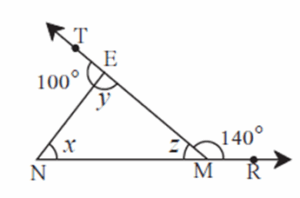
∠NEM + ∠NET = 180° ... (Linear angle property)
∴ y + 100° = 180°
∴ y = 80°
Also, ∠NME + ∠EMR = 180° ... (Linear angle property)
∴ z + 140° = 180°
∴ z = 40°
Now, In Δ NEM
∠N + ∠E + ∠M = 180° ... (Angle sum property)
∴ x + y + z = 180°
∴ x + 80° + 40° = 180°
∴ x + 120° = 180°
∴ x = 60°
Hence, the values of x, y and z are 60°, 80° and 40° respectively.
Question 1.6. In figure, line AB || line DE. Find the measures of ∠DRE and ∠ARE using given measures of some angles.
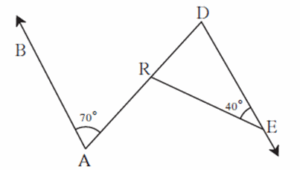
AB || DE and AD is a transversal line.
∠BAR = ∠RDE = 70° .... (Alternate angles)
And line AD is their transversal
∴ ∠BAD ≅ ∠EDA ... (Alternate angles)
∠BAD = 70° .. (Given)
:. ∠EDA = 70°
In other words ∠EDR = 70° ... (A-R-D)
∠ARE, ∠RDE exterior angle
∴ ∠ARE = ∠EDR + ∠DER ... (remote interior angle theorem)
∴ ∠ARE = 70° + 40°
∴ ∠ARE = 110°
∠ARE + ∠DRE = 180° ... (angles in linear pair)
∴ 110° + ∠DRE= 180°
∴ ∠DRE = 180° - 110°
∴ ∠DRE = 70°
Question 1.7. In Δ ABC, bisectors of ∠A and ∠B intersect at point O. If ∠C = 70°. Find measure of ∠AOB.
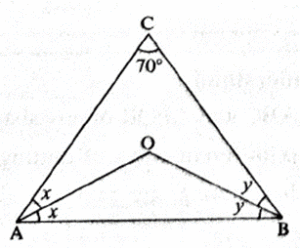
∠OAB ≅ ∠OAC ... (Seg AO bisects 4BAC) ... (i)
∠OBA ≅ ∠OBC ... (Seg RO bisects ZABC) ... (ii)
In Δ ABC,
∠BAC + ∠ABC + ∠ACB = 180° ... (The sum of the angles of a triangle is 180°.)
∴ ∠BAC + ∠ABC + 70° =1 80°
∴ ∠BAC + ∠ABC = 180° - 70°
∴ ∠BAC + ∠ABC = 110°
\(\frac{1}{2}\)(∠BAC) + \(\frac{1}{2}\)(∠ABC) = \(\frac{1}{2}\) x 110° ... [Multiplying both sides by \(\frac{1}{2}\) ]
∴ ∠OAB + ∠OBA = 55° ... (iii) ... [From (i) and (ii)]
In Δ OAB,
∠OAB + ∠OBA + ∠AOB = 180° ... (The sum of the angles of a triangle is 180°.)
∴ 55° + ∠AOB = 180° ….[From (iii)]
∴ ∠AOB = 180° -55°
∴ ∠AOB = 125°
Question 1.8. In Figure 3.11, line AB || line CD and line PQ is the transversal. Ray PT and ray QT are bisectors of ∠BPQ and ∠PQD respectively. Prove that m∠PTQ = 90°.
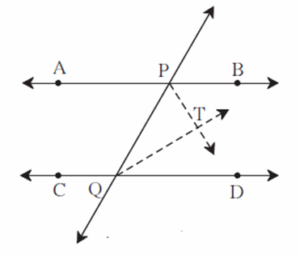
Given: line AB || line CD and line PQ is the transversal. Ray PT and ray QT are bisectors of ∠BPQ and ∠PQD respectively.
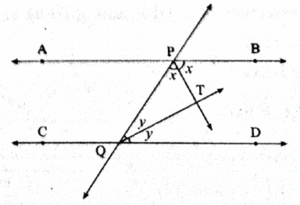
To prove: m∠PTQ = 90°
Proof:
∠TPB = ∠TPQ = \(\frac{1}{2}\)∠BPQ ... (i) ….[Ray PT bisects ∠BPQ]
∠TQD = ∠TQP = \(\frac{1}{2}\)∠PQD ... (ii) …[Ray QT bisects ∠PQD]
line AB || line CD and line PQ is their transversal. ... (Given)
∴ ∠BPQ + ∠PQD = 180° ... [Interior angles]
\(\frac{1}{2}\)(∠BPQ) + \(\frac{1}{2}\)(∠PQD) = \(\frac{1}{2}\) x 180° ... [Multiplying both sides by \(\frac{1}{2}\) ]
∴ ∠TPQ + ∠TQP = 90° ... (iii)
In Δ PTQ,
∠TPQ + ∠TQP + ∠PTQ = 180° ... (The sum of the angles of a triangle is 180°.)
∴ 90° + ∠PTQ = 180° ... [From (iii)]
∴ ∠PTQ = 180° - 90°
∴ ∠PTQ = 90°
∴ m∠PTQ = 90°
Hence proved.
Question 1.9. Using the information in figure, find the measures of ∠a, ∠b and ∠c.
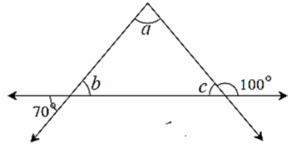
∠b = 70° ... (Vertically opposite angles)
∠c + 100° =180° ... (Angles in a linear pair)
∴ ∠c = 180° - 100°
∴ ∠c = 80°
∠a + ∠b + ∠c = 180° ... (The sum of the angles of a triangle is 180°.)
∴ ∠a + 70° + 80° = 180°
∴ ∠a + 150° = 180°
∴ ∠a = 180° - 150°
∴ ∠a = 30°
Hence ∠a = 30°, ∠b = 70°, ∠c = 80°.
Question 1.10. In figure, line DE || line GF ray EG and ray FG are bisectors of ∠DEF and ∠DFM respectively. Prove that, (i) ∠DEG = \(\frac{1}{2}\)∠EDF (ii) EF = FG.
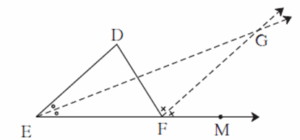
Proof :
∠DEG ≅ ∠GEF ... (Ray EG bisects ZDEF)
Let ∠DEG = ∠GEF = x° ... (1)
∠DEF = ∠DEG + ∠GEF ... (Angles addition postulate)
∴ ∠DEF = x° + x° ... [From (1)]
∴ ∠DEF = 2x° ... (2)
Line DE || line GF and line EF is the transversal.
∠DEF ≅ ∠GFM ... (Corresponding angles)
∴ ∠GFM = 2x° ... [From (2)] ... (3)
∠DFG ≅ ∠GFM ... (Ray FG bisects 4DFM)
∴ ∠DFG = 2x° ... [From (3)] ... (4)
∠DFM = ∠DFG + ∠GFM ... (Angles addition postulate)
∴ ∠DFM = 2x° + 2x° ... [From (3) and (4)]
∴ 4DFM = 4x° ... (5)
∠DFM is an exterior angle of Δ DEF.
∴ ∠DFM = ∠EDF + ∠DEF ... (Theorem of remote interior angles)
∴ 4x° = ∠EDF + 2x°
∴ ∠EDF = 4x° - 2x°
∴ ∠EDF = 2x°
∴ ∠EDF = 2∠DEG ... [From (1)]
∴ ∠DEG = \(\frac{1}{2}\)∠EDF
Line DE || line GF ... (Given)
and line EG is the transversal.
∠DEG ≅ ∠FGE ... (Alternate angles)
∴ ∠FGE = x° ... (6)
In Δ FEG,
∠FGE ≅ ∠GEF ... [From (6) and (1)]
∴ EF = FG ... (Isosceles triangle theorem)
Practice set 3.2 :
Question 2.1. In each of the examples given below, a pair of triangles is shown. Equal parts of triangles in each pair are marked with the same signs. Observe the figures and state the test by which the triangles in each pair are congruent.
(i)
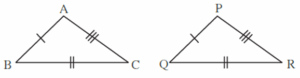
By . . . . . . . . . . test Δ ABC ≅ Δ PQR
By SSS test Δ ABC ≅ Δ PQR
(ii)
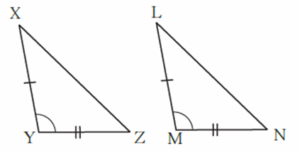
By . . . . . . . . . . test Δ XYZ ≅ Δ LMN
By SAS test Δ XYZ ≅ Δ LMN
(iii)
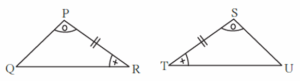
By . . . . . . . . . . test Δ PRQ ≅ Δ STU
By ASA test Δ PRQ ≅ Δ STU
(iv)
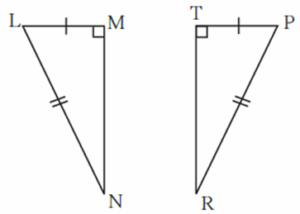
By . . . . . . . . . . test Δ LMN ≅ Δ PTR
By hypotenuse side test Δ LMN ≅ Δ PTR
Question 2.2. Observe the information shown in pairs of triangles given below. State the test by which the two triangles are congruent. Write the remaining congruent parts of the triangles.
(i)
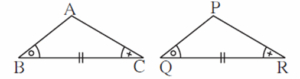
From the information shown in the figure,
in Δ ABC and Δ PQR
∠ABC ≅ ∠PQR
seg BC ≅ seg QR
∠ACB ≅ ∠PRQ
∴ Δ ABC ≅ Δ PQR .......[ASA] test
∴ ∠BAC ≅ [∠QPR ] .......corresponding angles of congruent triangles.
seg AB ≅ [seg PQ] and [seg AC ] ≅ seg PR ….. corresponding sides of congruent triangles
(ii)
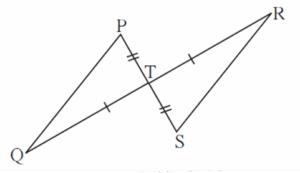
From the information shown in the figure,,
In Δ PTQ and Δ STR
seg PT ≅ seg ST
∠PTQ ≅ ∠STR ....vertically opposite angles
seg TQ ≅ seg TR
∴ Δ PTQ ≅ Δ STR ....... [SAS] test
∴ ∠TPQ ≅ [∠TSR] and [∠TQP] ≅ ∠TRS ….. corresponding sides of congruent triangles
seg PQ ≅ [seg SR] ….corresponding sides of congruent triangles.
Question 2.3. From the information shown in the figure, state the test assuring the congruence of Δ ABC and Δ PQR. Write the remaining congruent parts of the triangles.
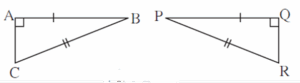
In Δ ABC and Δ QPR
AB = PQ, BC= PR ... (Given)
∠BAC = ∠PQR = 90° ... (Given)
∴ Δ BAC ≅ Δ PQR ... [Hypotenuse side test]
∴ seg AC ≅ seg QR ... [c.s.c.t.]
∠ABC ≅ ∠QPR and ∠ACB ≅ ∠QRP ... [c.a.c.t.]
Question 2.4. As shown in the following figure, in Δ LMN and Δ PNM, LM = PN, LN = PM. Write the test which assures the congruence of the two triangles. Write their remaining congruent parts.
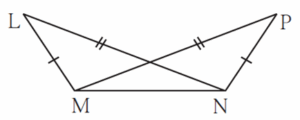
Δ LMN ≅ Δ PNM ... (SSS test of congruence)
∠MLN ≅ ∠NPM ... [c.a.c.t.]
∠LMN ≅ ∠PNM ... [c.a.c.t.]
∠LNM ≅ ∠PMN ... [c.a.c.t.]
Question 2.5. In figure, seg AB ≅ seg CB and seg AD ≅ seg CD. Prove that Δ ABD ≅ Δ CBD
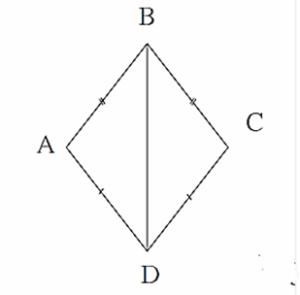
In Δ ABD and Δ CBD,
seg BA ≅ seg BC ...(Given)
seg AD ≅ seg CD ...(Given)
seg BD ≅ seg BD ... (Common side)
∴ Δ ABD ≅ Δ CBD ... (SSS test of congruence)
Please note : corresponding sides of congruent triangles in short we write c.s.c.t. and corresponding angles of congruent triangles in short we write c.a.c.t.
Question 2.6. In figure, ∠P ≅ ∠R seg PQ ≅ seg RQ Prove that, Δ PQT ≅ Δ RQS
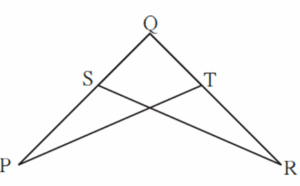
Proof : In Δ PQT and Δ RQS,
∠PQT ≅ ∠RQS ... (Common angle)
seg PQ ≅ seg RQ ...(Given)
∠QPT ≅ ∠QRS ...(Given)
∴ Δ PQT ≅ Δ RQS ... (ASA test of congruence)
Practice set 3.3 :
Question 3.1. Find the values of x and y using the information shown in figure. Find the measure of ∠ABD and m∠ACD.
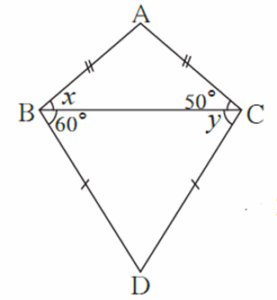
In Δ ABC, AB = AC
∴ ∠ABC = ∠ACB ... (Isosceles triangle theorem)
∴ ∠ACB = 50° ... (given)
∴ ∠ABC = 50° i.e. x = 50°
In Δ BDC, DB = DC
∴ ∠DBC = ∠DCB ... (Isosceles triangle theorem)
∠DBC = 60° ... (given)
∠DCB = 60° i.e. y = 60°
Now, ∠ABD = ∠ABC + ∠DBC ... (Angle addition property)
= 50° + 60°
∴ ∠ABD = 110°
Also, ∠ACD = ∠ACB + ∠DCB ... (Angle addition property)
= 50° + 60°
= 110°
∴ ∠ACD = 110°
Hence, the values of x = 50° and y = 60°, ∠ABD = 110° and ∠ACD = 110° respectively.
Question 3.2. The length of hypotenuse of a right angled triangle is 15. Find the length of median of its hypotenuse.
In a right angled triangle, the length of the median on the hypotenuse is half the length of the hypotenuse.
∴ length of median of its hypotenuse = \(\frac{1}{2}) x 15 = 7.5
Hence, the length of median of its hypotenuse is 7.5 units.
Question 3.3. In Δ PQR, ∠Q = 90°, PQ = 12, QR = 5 and QS is a median. Find l(QS).
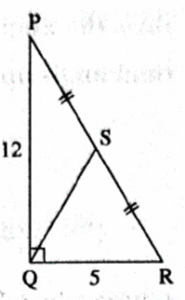
In Δ PQR,
∠PQR = 90° ... (Given)
By Pythagoras theorem,
PR2 = PQ2 + QR2
∴ PR2 = 122 + 52
∴ PR2 = 144 + 25
∴ PR2 = 169
∴ PR = \(\sqrt{169}\)
PR = 13
In a right angled triangle, the length of the median on the hypotenuse is half the length of the hypotenuse.
∴ QS = \(\frac{1}{2}) x PR
∴ QS = \(\frac{1}{2}) x 13
∴ QS = 6.5
Hence, l(QS) = 6.5 units.
Question 3.4. In figure, point G is the point of concurrence of the medians of Δ PQR. If GT = 2.5, find the lengths of PG and PT.
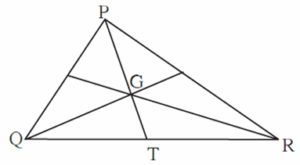
GT = 2.5 ... (Given)
PG : GT = 2 : 1 ….(The centroid divides each median in the ratio 2:1)
∴ \(\frac{PG}{GT}) = \(\frac{2}{1})
∴ \(\frac{PG}{2.5}) = \(\frac{2}{1})
∴ PG = 2 x 2.5
∴ PG = 5
Now, PT = PG + GT = 5 + 2.5
∴ PT = 7.5 units
Hence, the length of PG and PT is 5 and 7.5 units respectively.
Practice set 3.4 :
Question 4.1. In figure, point A is on the bisector of ∠XYZ. If AX = 2 cm then find AZ.
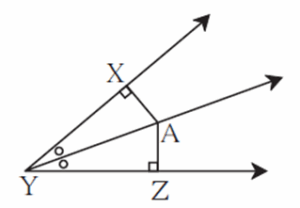
Here, AX = 2 cm ... (Given)
Point A lies on the bisector of XYZ. ... [Given]
Point A is equidistant from the sides of ∠XYZ. ... [Every point on the bisector of an angle is equidistant from the sides of the angle]
∴ AZ = AX
∴ AZ = 2 cm
Hence, the length of AZ is 2 cm.
Question 4.2. In figure, ∠RST = 56°, seg PT ⊥ ray ST, seg PR ⊥ ray SR and seg PR ≅ seg PT Find the measure of ∠RSP. State the reason for your answer.
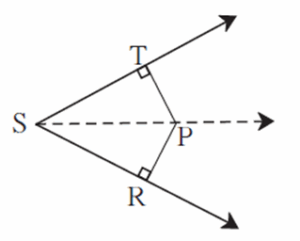
seg PT ⊥ ray ST ... (Given)
seg PR ⊥ ray SR ... (Given)
seg PR ≅ seg PT ... (Given)
i.e. PR = PT
∴ point P is equidistant from the sides of ∠TSR
∴ point P lies on the bisector of ∠TSR ... (Angle bisector theorem) ... (1)
∠RST = 56°
∴ ∠RSP = \(\frac{1}{2}\) ∠RST ... [From (1)]
∴ ∠RSP = \(\frac{1}{2}\) x 56°
Hence, ∠RSP = 28°.
Question 4.3. In Δ PQR, PQ = 10 cm, QR = 12 cm, PR = 8 cm. Find out the greatest and the smallest angle of the triangle.
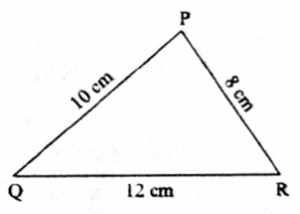
PQ = 10 cm, QR = 12 cm, PR = 8 cm ... (Given)
∴ QR > PQ > PR
∴ ∠QPR > ∠PRQ > ∠PQR ... (Angle opposite to greater side is greater)
Hence, ∠QPR is the greatest angle and ∠PQR is the smallest angle.
Question 4.4. In Δ FAN, ∠F = 80°, ∠A = 40° . Find out the greatest and the smallest side of the triangle. State the reason.
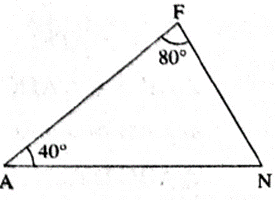
In Δ FΑΝ,
∠F + ∠A + ∠N = 180° ... (sum of measures of angles of a triangle is 180°)
80° + 40° + ∠N = 180°
120° + ∠N = 180°
∴ ∠N = 180° - 120° = 60°
Now, in Δ FAN, ∠F and ∠A are the largest and smallest angles.
The side opposite to the largest angle is the greatest side and the side opposite to the smallest angle is the smallest side.
Hence, AN is the greatest side of the triangle and FN is the smallest side of the triangle.
Question 4.5. Prove that an equilateral triangle is equiangular.
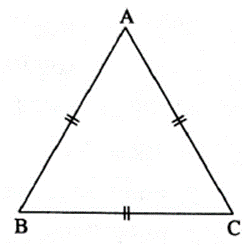
Consider an equilateral triangle ABC.
In Δ ABC,
AB ≅ BC
∴ ∠ACB = ∠BAC ... (1) ... (Angles opposite to equal sides)
In Δ ABC,
AB ≅ CA
∴ ∠ACB = ∠ABC ... (2) ... (Angles opposite to equal sides)
From (1) and (2), we get
∠BAC ≅ ∠ABC ≅ ∠ACB
Hence, an equilateral triangle is equiangular.
Question 4.6. Prove that, if the bisector of ∠BAC of Δ ABC is perpendicular to side BC, then Δ ABC is an isosceles triangle.
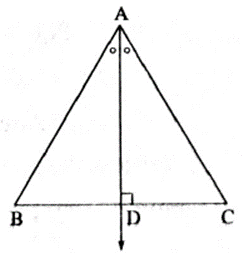
Proof : In Δ ADB and Δ ADC.
∠BAD ≅ ∠CAD ... (Given)
seg AD ≅ seg AD ... (Common side)
∠ADB ≅ ∠ADC ... (Each measures 90°)
∴ Δ ABD ≅ Δ ADC ... (ASA test of congruence)
∴ seg AB ≅ seg AC ... (c.s.c.t.)
∴ Δ ABC is isosceles.
Question 4.7. In figure, if seg PR ≅ seg PQ, show that seg PS > seg PQ.
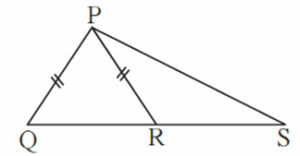
In Δ PQR,
seg PR ≅ seg PQ ... [Given]
∴ ∠PQR ≅ ∠PRQ ... (i) [Isosceles triangle theorem]
∠PRQ is the exterior angle of APRS.
∴ ∠PRQ > ∠PSR ... (ii) [Property of exterior angle]
∴ ∠PQR > ∠PSR ... [From (i) and (ii)]
i.e. ∠Q > ∠S ... (iii)
In Δ PQS,
∠Q > ∠S ... [From (iii)]
∴ PS > PQ ... [Side opposite to greater angle is greater]
∴ seg PS > seg PQ
Question 4.8. In figure, in Δ ABC, seg AD and seg BE are altitudes and AE = BD. Prove that seg AD ≅ seg BE
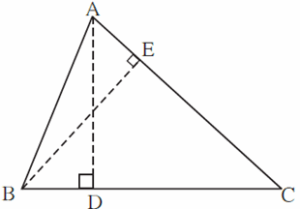
Given: In Δ ABC, seg AD and seg BE are altitudes, and AE = BD.
To prove: seg AD ≅ seg BE.
Proof:
In Δ ADB and Δ BEA,
∠ADB = ∠BEA = 90° ... [Given]
seg BD ≅ seg AE ... [Given]
seg AB ≅ seg BA ... [Common side]
By hypotenuse side test,
∴ Δ ADB ≅ Δ BEA
∴ seg AD = seg BE ... [c.s.c.t.]
Hence proved.
Practice set 3.5 :
Question 5.1. If Δ XYZ ~ Δ LMN, write the corresponding angles of the two triangles and also write the ratios of corresponding sides.
Consider, Δ XYZ ≅ Δ LMN
∴ ∠X ≅ ∠L, ∠Y ≅ ∠M and ∠Z ≅ ∠N ... (Corresponding angles of similar triangles)
\(\frac{XY}{LM}\) = \(\frac{YZ}{MN}\) = \(\frac{XZ}{LN}\) ... (Corresponding sides of similar triangle)
Question 5.2. In Δ XYZ, XY = 4 cm, YZ = 6 cm, XZ = 5 cm, If Δ XYZ ~ Δ PQR and PQ = 8 cm then find the lengths of remaining sides of Δ PQR.
Consider, Δ XYZ ~ Δ PQR
\(\frac{XY}{PQ}\) = \(\frac{YZ}{QR}\) = \(\frac{XZ}{PR}\) ... (Corresponding sides of similar triangle)
∴ \(\frac{4}{8}\) = \(\frac{6}{QR}\) = \(\frac{5}{PR}\)
∴ \(\frac{4}{8}\) = \(\frac{6}{QR}\)
∴ QR = \(\frac{6×8}{4}\) = 12 cm
\(\frac{6}{QR}\) = \(\frac{5}{PR}\)
∴ PR = \(\frac{5×8}{4}\) = 10 cm
Hence, the lengths of remaining sides of Δ PQR are QR= 12 cm and PR = 10 cm.
Question 5.3. Draw a sketch of a pair of similar triangles. Label them. Show their corresponding angles by the same signs. Show the lengths of corresponding sides by numbers in proportion.
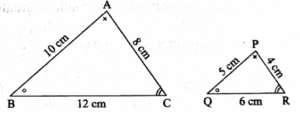
Δ ABC ~ Δ PQR
Then, the corresponding angles are
∠A = ∠P
∠B = ∠Q
∠C = ∠R
Also, the corresponding sides are in proportion.
\(\frac{AB}{PQ}\) = \(\frac{BC}{QR}\) = \(\frac{AC}{PR}\)
\(\frac{10}{5}\) = \(\frac{12}{6}\) = \(\frac{8}{4}\) = \(\frac{2}{1}\)