
Solutions
Practice set 5.1
Question 1.1. By using variables x and y form any five linear equations in two variables.
Here are five linear equations in two variables x and y:
(i) 2x + 3y = 7
(ii) x − 4y = 5
(iii) 5x + 2y = 13
(iv) 3x – y = 4
(v) x + y = 8
Each of these equations is linear because both variables have degree 1 and their graphs will be straight lines in the coordinate plane.
Question 1.2. Write five solutions of the equation x + y = 7.
Here are five possible solutions to the equation x + y = 7. Each solution is a pair (x, y) where the sum is 7:
(i) x = 0, y = 7 → (0, 7)
(ii) x = 1, y = 6 → (1, 6)
(iii) x = 2, y = 5 → (2, 5)
(iv) x = 3, y = 4 → (3, 4)
(v0 x = −1, y = 8 → (-1, 8)
These are just a few examples; there are infinitely many possible solutions!
Question 1.3. Solve the following sets of simultaneous equations.
(i) x + y = 4 ; 2x – 5y = 1
x +y = 4 ……(i)
2x - 5y = 1 ……(ii)
Multiplying equation (i) by 5,
5x + 5y = 20 ……(iii)
Adding equations (iii) and (ii),
5x + 5y = 20
2x − 5y = 1
---------------
7x = 21
∴ x = 21/7 = 3
Substituting x = 3 in equation (i),
3 + y = 4
∴ y = 4 - 3
∴ y = 1
The solution of the given equations is (3, 1).
(ii) 2x + y = 5; 3x - y = 5
2x + y = 5
∴ y = 5 - 2x ... (I)
3x - y = 5 ... (II)
Substituting (I) in (II)
3x - y = 5
∴ 3x - (5 - 2x) = 5
∴ 3x – 5 + 2x = 5
∴ 5x = 5 + 5
5x = 10
∴ x = 10/5 = 2
Putting x = 2 in (I) we have,
2 x 2 + y = 5
∴ 4 + y = 5
∴ y = 5 - 4
∴ y = 1
The solution of the given equations is (2, 1)
(iii) 3x - 5y = 16; x - 3y = 8
3x - 5y = 16 ... (1)
x - 3y = 8 ... (2)
x = 8 + 3y …..From (2) ... (3)
substituting equation (3) in equation (1), we get
3(8 + 3y) - 5y = 16
24 + 9y - 5y = 16
9y - 5y = 16 - 24
4y = - 8
∴ y = - 8/4
∴ y = - 2
substituting y =- 2 in equation (3), we get
x = 8 + 3y
x = 8 + 3 × (-2)
x = 8 - 6
x = 2
The solution of the given equations is (2, -2)
(iv) 2y – x = 0; 10x + 15y = 105
2y – x = 0
2y = x
∴ x = 2y ... (I)
10x + 15y = 105 ... (II)
Putting x = 2y in equation (II)
∴ 10(2y) + 15y = 105
20y + 15y = 105
35y = 105
∴ y = 105/35
∴ y = 3
Putting y = 3 in equation (I)
x = 2 x 3 = 6
∴ (x, y) = (6, 3)
The solution of the given equations is (6, 3)
(v) 2x + 3y + 4 = 0; x - 5y = 11
2x + 3y + 4 = 0
∴ 2x + 3y = - 4 ... (1)
x - 5y = 11 ... (2)
On multiplying both sides of equation (2) by 2, we get
2x - 10y = 22 ... (3)
By subtracting equation (1) from equation (3), we get
2x - 10y = 22
2x + 3y = - 4
- - +
---------------
0 - 13y = 26
∴ 13y = - 26
∴ y = - 26/13 = -2
Substituting y = - 2 in equation (2), we get
∴ x - 5y = 11
∴ x - 5(-2) = 11
∴ x + 10 = 11
∴ x = 11 - 10
∴ x = 1
∴ (x, y) = (1, -2)
The solution of the given equations is (1, -2)
(vi) 2x - 7y = 7; 3x + y = 22
2x - 7y = 7 ... (I)
3x +y = 22 ... (II)
y = 22 - 3x ... (III)
Putting y = 22 - 3x in equation (I)
∴ 2x - 7(22 - 3x) = 7
∴ 2x – 154 + 21x = 7
∴ 23x = 7 + 154
∴ 23x = 161
∴ x = 161/23
∴ x = 7
Putting x = 7 in equation (III)
∴ y = 22 – 3(7)
∴ y = 22 – 21 = 1
∴ (x, y) = (7, 1)
The solution of the given equations is (7, 1)
Practice set 5.2
Question 2.1. In an envelope there are some 5 rupee notes and some 10 rupee notes. Total amount of these notes together is 350 rupees. Number of 5 rupee notes are less by 10 than number of 10 rupee notes. Then find the number of 5 rupee and 10 rupee notes. (wrong question in text book)
Corrected question : In an envelope there are some 5 rupee notes and some 10 rupee notes. Total amount of these notes together is 350 rupees. Number of 5 rupee notes are less by 10 than twice number of 10 rupee notes. Then find the number of 5 rupee and 10 rupee notes.
Let the number of 5 rupee notes be x and that of 10 rupee notes be y.
The value of x notes of 5 rupee = ₹ 5x.
The value of y notes of 10 rupee = ₹ 10y.
The total amount of these notes is given to be ₹ 350,
∴ 5x + 10y = 350
∴ x + 2y = 70 ... (Dividing both the sides by 5) ... (1)
From the second condition,
2y – x = 10 i.e. -x + 2y = 10 ... (2)
Adding equations (1) and (2),
x + 2y = 70
-x + 2y = 10
---------------
4y = 80
∴ y = 80/4 = 20
Substituting y = 20 in equation (1),
x + 2(20) = 70
∴ x = 70 - 40
∴ x = 30
There are 30 notes of 5 rupee each and 20 notes of 10 rupee each.
Question 2.2. The denominator of a fraction is 1 more than twice its numerator. If 1 is added to numerator and denominator respectively, the ratio of numerator to denominator is 1 : 2. Find the fraction. (wrong question)
Corrected question : The denominator of a fraction is 1 less than twice its numerator. If 1 is added to numerator and denominator respectively, the ratio of numerator to denominator is 1 : 2. Find the fraction.
Let the numerator of the fraction be x and the denominator be y.
Then the required fraction is \(\frac{x}{y}\)
Twice the numerator - 1 = 2x - 1.
From the first condition, y = 2x - 1
∴ 2x – y = 1 …..(i)
1 is added to the numerator and the denominator.
∴ the new numerator is x + 1, and the new denominator is y + 1.
From the second condition, \(\frac{x+1}{y=1}=\frac{3}{5}\)
∴ 5x + 5 = 3y + 3
∴ 5x - 3y = 3 - 5 …..(ii)
∴ 5x - 3y = - 2
Multiplying equation (1) by 3,
6x - 3y = 3 …..(iii)
Subtracting equation (ii) from equation (iii),
6x - 3y = 3
5x - 3y = - 2
.- + +
------------------
x = 5
Substituting x = 5 in equation (i),
10 – y = 1 ∴ - y = 1 - 10
∴ - y = - 9
∴ y = 9
The required fraction is \(\frac{5}{9}\)
Question 2.3. The sum of ages of Priyanka and Deepika is 34 years. Priyanka is elder to Deepika by 6 years. Then find their today's ages.
Let Priyanka's present age be x years and Deepika's present age be y years.
From the problem, we form the equations:
x + y = 34 ….(1) …(sum of ages)
x = y + 6 …..(2) ….(Priyanka is 6 years older)
Now, substitute equation (2) into equation (1):
x + y = 34
∴ (y + 6) + y = 34
∴ 2y + 6 = 34
∴ 2y = 34 - 6
∴ 2y = 28
∴ y = 14
Now substitute y = 14 into equation (2):
x = y + 6 = 14 + 6 = 20
Therefore:
Priyanka's age = 20 years
Deepika's age = 14 years
Question 2.4. The total number of lions and peacocks in a certain zoo is 50. The total number of their legs is 140. Then find the number of lions and peacocks in the zoo.
Let the number of lions be x and the number of peacocks be y.
From the problem, we have two equations:
The total number of lions and peacocks is 50:
∴ x + y = 50 ….(1)
Lions have 4 legs each and peacocks have 2 legs each.
The total number of legs is 140
∴ 4x + 2y = 140 .…(2)
We can simplify the second equation by dividing everything by 2:
∴ 2x + y = 70 …..(3)
Now, subtract the equation (1) from (3)
(2x + y) − (x + y) = 70 – 50
2x + y − x - y = 20
∴ x = 20
Substitute x = 20 into the equation (1) :
∴ 20 + y = 50
∴ y = 30
Therefore, there are 20 lions and 30 peacocks in the zoo.
Question 2.5. Sanjay gets fixed monthly income. Every year there is a certain increment in his salary. After 4 years, his monthly salary was Rs. 4500 and after 10 years his monthly salary became 5400 rupees, then find his original salary and yearly increment.
Let Sanjay's fixed monthly salary be ₹ x and the yearly increment be ₹y.
Then after 4 years his salary was x + 4y = 4500 ... (1)
and after 10 years it was x + 10y = 5400. ... (2)
Subtracting equation (1) from equation (2),
x + 10y = 5400
x + 4y = 4500
.- - -
--------------------
6y = 900
∴ y = 900/6 = 150
Substituting y = 150 in equation (1),
x + 4(150) = 4500,
∴ x + 600 = 4500
∴ x = 4500 – 600 = 3900
Therefore, Sanjay's monthly salary is ₹ 3900; yearly increment is ₹ 150.
Question 2.6. The price of 3 chairs and 2 tables is 4500 rupees and price of 5 chairs and 3 tables is 7000 rupees, then find the price of 2 chairs and 2 tables.
Let the price of a chair be ₹ .r and that of a table be ₹ y. Then from the first condition,
3x +2y = 4500 ….(1)
From the second condition,
5x + 3y = 7000 ….(2)
Multiplying the equation (1) by 3 and the equation (2) by 2,
9x + 6y = 13500 ….(3)
10x + 6y = 14000 ….(4)
Subtracting equation (3) from equation (4),
10x + 6y = 14000
9x + 6y = 13500
.- - -
---------------------
x = 500
∴ The price of 2 chairs = 2x = 2 × 500 = 1000
Substituting x = 500 in equation (1),
3(500) + 2y = 4500
∴ 1500 + 2y = 4500
∴ 2y = 4500 - 1500
∴ The price of tables = 2y = 3000
Now, the price of 2 chairs and 2 tables is
₹ (1000 + 3000) = ₹ 4000
The total price of 2 chairs and 2 tables is ₹ 4000.
Question 2.7. The sum of the digits in a two-digits number is 9. The number obtained by interchanging the digits exceeds the original number by 27. Find the two-digit number.
Let the digit at the tens place be x and that at the units place be y.
Then x + y = 9 ... (1)
The value of the digit x at tens place is 10x and the value of the digit y at units place is y.
∴ the original number is 10x + y.
The number formed by interchanging the digits is 10y + x.
From the given condition,
10y + x = 10x + y + 27
∴ 10y + x - 10x - y = 27
∴ 9y - 9x = 27
∴ y – x = 3 ... (Dividing both the sides by 9) ... (2)
Adding equations (1) and (2),
(x + y) + (y – x) = 9 + 3
∴ 2y = 12
∴ y = 12/2 = 6
Substituting y = 6 in equation (1),
x + 6 = 9
∴ x = 9 – 6 = 3
The original number = 10x +y = 10 × 3 + 6 = 30 + 6 = 36
The original two-digit number is 36.
Question 2.8. In Δ ABC, the measure of angle A is equal to the sum of the measures of ∠B and ∠C. Also the ratio of measures of ∠B and ∠C is 4 : 5. Then find the measures of angles of the triangle.
∠A = ∠B + ∠C ... (i)
\(\frac{∠B}{∠C}=\frac{4}{5}\)
∴ 5∠B = 4∠C ... (ii)
∴ \(\frac{5}{4}\)∠B = ∠C ... (iii)
We know by angle sum property,
∠A + ∠B + ∠C = 180°
From (i)
∠B + ∠C + ∠B + ∠C = 180°
2(∠B + ∠C) = 180°
2(∠B + \(\frac{5}{4}\)∠B) = 180° ... [From (iii)]
∠B + \(\frac{5}{4}\)∠B = 90°
∴ 4∠B + 5∠B = 360°
∴ 9∠B = 360°
∴ ∠B = 360°/9 = 40°
∴ 5∠B = 4∠C ... [From (ii)]
∴ 5 × 40° = 4∠C
∴ 200° = 4∠C
∴ ∠C = 200°/4 = 50°
And ∠A = ∠B + ∠C ... [From (i)]
∠A = 40° + 50°
∴ ∠A = 90°.
Answer is : ∠A = 90°, ∠B = 40° and ∠C = 50°.
Question 2.9. Divide a rope of length 560 cm into 2 parts such that twice the length of the smaller part is equal to 1/3 of the larger part. Then find the length of the larger part.
Let the length of the smaller part be x cm and that of the larger part be y cm.
From the first condition, x + y = 560 ... (1)
Twice the length of the smaller part = 2x cm
\(\frac{1}{3}\) length of the larger part = \(\frac{y}{3}\) cm
From the second condition, 2x = \(\frac{y}{3}\) cm
∴ x = \(\frac{y}{6}\) cm ... (Dividing both the sides by 2) ... (2)
We want to find the length of the larger part.
So we eliminate x.
Substituting x = \(\frac{y}{6}\) from equation (2) in equation (1),
\(\frac{y}{6}\) + y = 560
∴ y + 6y = 560 ×6 ... (Multiplying both the sides by 6)
∴ 7y = 560 × 6 =
∴ y = \(\frac{560×6}{7}\) = 80 x 6 = 480
∴ The length of the larger part of the rope is 480 cm.
Question 2.10. In a competitive examination, there were 60 questions. The correct answer would carry 2 marks, and for incorrect answer 1 mark would be subtracted. Yashwant had attempted all the questions and he got total 90 marks. Then how many questions he got wrong ?
Let the number of questions Yashwant answered correctly be xx and the number of questions he answered incorrectly be y.
From the problem:
Total questions: x + y = 60
Correct answers carry 2 marks each: total marks from correct answers = 2x
Incorrect answers deduct 1 mark each: total marks deducted = 1 × y = y
Total marks obtained: 2x – y = 90
Now, solve the two equations:
x + y = 60 ….(1)
2x – y = 90 ….(2)
Add equations (1) and (2):
∴ (x + y) + (2x − y) = 60 + 90
∴ 3x = 150
∴ x = 50
Substitute x = 50 in equation (1):
∴ 50 + y = 60
∴ y = 10
Therefore, Yashwant got 10 questions wrong.
Problem set 5
Question 1. Choose the correct alternative answers for the following questions.
(i) If 3x + 5y = 9 and 5x + 3y = 7 then What is the value of x + y ?
(A) 2 (B) 16 (C) 9 (D) 7
(A) 2
Explanation:
3x + 5y = 9 ... (I)
5x + 3y = 7 ... (II)
Adding (I) and (II) we have
8x + 8y = 16
∴ x + y = 2
(ii) 'When 5 is subtracted from length and breadth of the rectangle, the perimeter becomes 26.' What is the mathematical form of the statement ?
(A) x - y = 8 (B) x + y = 8 (C) x + y = 23 (D) 2x + y = 21
(C) x + y = 23
Explanation:
Let the length be x and the breadth be y.
According to the given condition,
new length l = x - 5 and new breadth b = y - 5
Perimeter of the rectangle = 2(l + b) = 26
2(l + b) = 26
∴ 2[(x - 5) + (y - 5)] = 26
∴ x + y – 10 = 13
∴ x + y = 13 + 10
∴ x + y = 23
(iii) Ajay is younger than Vijay by 5 years. Sum of their ages is 25 years. What is Ajay's age ?
(A) 20 (B) 15 (C) 10 (D) 5
(C) 10
Explanation:
Let Ajay's age be x years and Vijay's age be y years.
Ajay is younger than Vijay by 5 years.
y - x = 5 ... (I)
Sum of their ages is 25 years.
x + y = 25 ... (II)
Adding (I) and (II) we have
2y = 30
∴ y = 15
∴ x = 10
Thus, Ajay's age is 10 years.
Question 2. Solve the following simultaneous equations.
(i) 2x + y = 5; 3x - y = 5
2x + y = 5
∴ y = 5 - 2x ... (I)
3x - y = 5 ... (II)
Substituting (I) in (II)
3x - y = 5
∴ 3x - (5 - 2x) = 5
∴ 3x – 5 + 2x = 5
∴ 5x = 5 + 5
5x = 10
X = 10/5 = 2
Putting x = 2 in (I) we have,
2 x 2 + y = 5
4 + y = 5
y = 1
(x, y) = (2, 1)
(ii) x - 2y = -1; 2x - y = 7
x - 2y = - 1
∴ x = 2y – 1 ….(1)
2x – y = 7 ….(2)
Substituting the value of x from equation (1) in equation (2),
2(2y - 1) - y = 7
∴ 4y - 2 - y = 7
∴ 3y = 7 + 2 = 9
∴ y = 9/3 = 3
Substituting y = 3 in equation (1),
x = 2(3) - 1
∴ x = 6 – 1 = 5
The solution of the given equations is (5, 3)
(iii) x + y = 11; 2x - 3y = 7
2x - 3y = 7 ….(1)
x + y = 11 .. x = 11 – y ….(2)
Substituting this value of x in equation (1),
2(11-y) -3y = 7
∴ 22 - 2y - 3y = 7
∴ -5y = 7 – 22 = -15
∴ y = = 3
Substituting y = 3 in equation (2),
x = 11 – 3 = 8
The solution of the given equations is (8, 3)
(iv) 2x + y = -2; 3x - y = 7
2x + y = -2 …..(1)
3x – y = 7 …..(2)
Adding equations (1) and (2),
(2x + y) + (3x – y) = -2 + 7
2x + y + 3x – y = 5
5x = 5
x = 5/5 = 1
Substituting x = 1 in equation (1),
2(1) + y = -2
∴ y = - 2 - 2
∴ y = - 4
The solution of the given equations is (1, - 4)
(v) 2x - y = 5; 3x + 2y = 11
2x - y = 5
∴ - y = 5 - 2x
∴ y = 2x - 5 …..(1)
3x + 2y = 11 …..(2)
Substituting the value of y from equation (1) in equation (2),
3x + 2(2x - 5) = 11
∴ 3x + 4x – 10 = 11
∴ 7x = 11 + 10
∴ 7x = 21
∴ x = 3
Substituting x = 3 in equation (1),
y = 2(3) - 5
∴ y = 6 - 5
∴ y = 1
The solution of the given equations (3, 1).
(vi) x - 2y = -2; x + 2y = 10
x - 2y = -2 …..(1)
x + 2y = 10 …..(2)
Adding equations (1) and (2),
(x - 2y) + (x + 2y) = - 2 + 10
2x = 8
∴ x = 8/2 = 4
Substituting x = 4 in equation (2),
4 + 2y = 10
2y = 10 - 4
∴ 2y = 6
∴ y = 6/2 = 3
The solution of the given equations (4, 3).
Question 3. By equating coefficients of variables, solve the following equations.
(i) 3x - 4y = 7; 5x + 2y = 3
3x - 4y = 7 …..(1)
5x + 2y = 3 …..(2)
Multiplying equation (2) by 2,
10x + 4y = 6
Adding equations (1) and (3),
(3x - 4y) + (10x + 4y) = 7 + 6
∴ 3x - 4y + 10x + 4y = 13
∴13x = 13
∴ x = 1
Substituting x = 1 in equation (2),
5(1) + 2y = 3
∴ 2y = 3 - 5
∴ 2y = - 2
∴ y = - 1
The solution of the given equations (1, - 1).
(ii) 5x + 7y = 17; 3x - 2y = 4
5x + 7y = 17 …..(1)
3x - 2y = 4 …..(2)
Multiplying equation (1) by 2 and equation (2) by 7,
10x + 14y = 34 …..(3)
21x - 14y = 28 …..(4)
------------------
31x = 62
∴ x = 62
Substituting x = 2 in equation (1),
5(2) + 7y = 17
∴ 10 + 7y = 17
∴ 7y = 17 - 10
∴ 7y = 7
∴ y = 7/7 = 1
The solution of the given equations is (2, 1).
(iii) x - 2y = -10; 3x - 5y = -12
x - 2y = - 10 …..(1)
3.x - 5y = - 12 …..(2)
Multiplying equation (1) by 3,
3x - 6y = - 30 …..(3)
Subtracting equation (3) from equation (2),
(3x - 5y) – (3x - 6y) = - 12 – (-30)
3x - 5y – 3x + 6y = 18
y = 18
Substituting y = 18 in equation (1),
x - 2(18) = - 10
∴ x - 36 = - 10
∴ x = 26
The solution of the given equations is (26, 18).
(iv) 4x + y = 34; x + 4y = 16
4x + y = 34 …..(1)
x + 4y = 16 …..(2)
Multiplying equation (2) by 4,
4x + 16y = 64 …..(3)
Subtracting equation (1) from equation (3),
(4x + 16y) – (4x + y) = 64 - 34
∴ 4x + 16y – 4x - y = 30
∴ 15y = 30
∴ y = 30/15 = 2
Substituting y = 2 in equation (2),
x + 4(2) = 16
∴ x + 8 = 16
∴ x = 16 – 8 = 8
The solution of the given equations is (8, 2).
Question 4. Solve the following simultaneous equations.
(i) \(\frac{x}{3}+\frac{y}{4}\) = 4; \(\frac{x}{2}-\frac{y}{4}\) = 1
\(\frac{x}{3}+\frac{y}{4}\) = 4
Multiplying the equation by 12,
4x + 3y = 48 …..(1)
\(\frac{x}{2}-\frac{y}{4}\) = 1
Multiplying the equation by 4,
2x – y = 4 …..(2)
Multiplying the equation (2) by 3,
6x - 3y = 12 …..(3)
Adding equations (1) and (3),
(4x + 3y) + (6x - 3y) = 48 + 12
∴ 4x + 3y + 6x - 3y = 60
∴ 10x = 60
∴ x = 60/10 = 6
Substituting x = 6 in equation (2),
2(6) - y = 4
∴ - y = 4 - 12
∴ y = 8.
The solution of the given equations is (6, 8).
(ii) \(\frac{x}{3}\) + 5y = 13; 2x + \(\frac{y}{2}\) = 19
\(\frac{x}{3}\) + 5y = 13 …..(1)
2x + \(\frac{y}{2}\)= 19 …..(2)
Multiplying equation (1) by 3 and equation (2) by 2,
x+ 15y = 39 …..(3)
4x + y = 38 …..(4)
Multiplying equation (3) by 4,
4x + 60y = 156 …..(5)
Subtract equation (4) from equation (5)
∴ (4x + 60y) – (4x + y) = 156 – 38
∴ 4x + 60y – 4x - y = 118
∴ 59y = 118
∴ y = 118/59 = 2
Substituting y = 2 in equation (3),
X + 15(2) = 39
∴ x + 30 = 39
∴ x = 39 - 30
∴ x = 9.
The solution of the given equations is (9, 2).
(iii) \(\frac{2}{x}+\frac{3}{y}\) = 13; \(\frac{5}{x}-\frac{4}{y}\) = -2
Substituting m for \(\frac{1}{x}\) and n for \(\frac{1}{y}\)
∴ 2m + 3n = 13 …..(1)
∴ 5m - 4n = - 2 …..(2)
Multiplying equation (1) by 4 and equation (2) by 3,
∴ 8m + 12n = 52 …..(3)
∴ 15m - 12n = - 6 …..(4)
Adding equations (3) and (4),
(8m + 12n) + (15m - 12n) = 52 + (-6)
8m + 12n + 15m - 12n = 52 - 6
23m = 46
m = 46/23 = 2
Substituting m = 2 in equation (1),
2(2) + 3n = 13
∴ 3n = 13 – 4 = 9
∴ n = 9/3 = 3
Resubstituting the values of m and n,
m = \(\frac{1}{x}\) = 2 , n = \(\frac{1}{y}\) = 3
∴ x = \(\frac{1}{2}\) and y = \(\frac{1}{3}\)
The solution of the given equations is ((\frac{1}{2}\), (\frac{1}{3}\) ).
Question 5. A two digit number is 3 more than 4 times the sum of its digits. If 18 is added to this number, the sum is equal to the number obtained by interchanging the digits. Find the number.
Let the digit in the tens place be x and that in the units place be y.
Then the required number is 10x + y.
From the first condition,
10x + y = 4(x + y) + 3
∴ 10x + y = 4x + 4y + 3
∴ 10x + y - 4x - 4y = 3
∴ 6x - 3y = 3
Dividing the equation by 3,
2x – y = 1 ... (1)
The number obtained by interchanging the digits is
10y + x.
From the second condition,
10x + y + 18 = 10y + x
∴ 9x - 9y = -18
∴ x – y = -2 ... (Dividing both the sides by 9) ... (2)
Subtracting equation (2) from equation (1),
(2x – y) – (x – y) = 1 – (-2)
2x – y – x + y = 1 + 2
x = 3
Substituting x = 3 in equation (2),
3 – y = -2
∴ - y = -2 – 3
∴ y = 5
10x + y = 10(3) + 5 = 35
The required number is 35.
Question 6. The total cost of 6 books and 7 pens is 79 rupees and the total cost of 7 books and 5 pens is 77 rupeess. Find the cost of 1 book and 2 pens.
Let the cost of a book be ₹ x and that of a pen be ₹ y.
Then from the first condition,
8x + 5y = 420 ... (1)
From the second condition,
5x + 8y = 321 ... (2)
Adding equations (1) and (2),
(8x + 5y) + (5x + 8y) = 420 + 321
8x + 5y + 5x + 8y = 741
13x + 13y = 741
Dividing both the sides by 13
x + y = 57 ... (3)
Subtracting equation (2) from equation (1),
(8x + 5y) - (5x + 8y) = 420 – 321
8x + 5y - 5x - 8y = 99
3x - 3y = 99
x - y = 33 ... (4)
Adding equations (3) and (4),
(x + y) + (x – y) = 57 + 33
x + y + x – y = 90
2x = 90
x = 90/2 = 45
Substituting x = 45 in equation (3),
45 + y = 57
y = 57 – 45 = 12
Now, we have to find the cost of 1 book and 2 pens.
i.e. we have to find the value of x + 2y.
x + 2y = 45 + 2(12) = 45 + 24 = 69
The cost of 1 book and 2 pens is ₹ 69.
Question 7. The ratio of incomes of two persons is 9 : 7. The ratio of their expenses is 4 : 3. Every person saves rupees 200, find the income of each.
Let the monthly incomes of the two persons be ₹ x and ₹ y respectively.
Then from the first condition, \(\frac{x}{y}\) = \(\frac{9}{7}\)
∴ 7x = 9y
∴ 7x - 9y = 0 ... (1)
Each of them saves ₹ 200 per month.
∴ their monthly expenditures are
₹(x - 200) and ₹(y - 200) respectively.
From the second condition,
\(\frac{x-200}{y-200}\) = \(\frac{4}{3}\)
∴ 3(x - 200) = 4 (y - 200)
∴ 3x - 600 = 4y - 800
∴ 3x - 4y = - 800 + 600
∴ 3x - 4y = - 200 ... (2)
Multiplying equation (1) by 4 and equation (2) by 9,
28x - 36y = 0 ... (3)
27x - 36y = - 1800 ... (4)
.- + +
----------------------
x = 1800 ... [Subtracting equation (4) from equation (3)]
Substituting x =1800 in equation (2),
3(1800) - 4y = - 200
∴ 5400 - 4y = - 200
∴ - 4y = - 200 - 5400
∴ - 4y = - 5600
∴ y = \(\frac{-5600}{-4}\)
∴ y = 1400.
The monthly incomes of the two persons are ₹ 1800 and ₹ 1400 respectively.
Question 8. If the length of a rectangle is reduced by 5 units and its breadth is increased by 3 units, then the area of the rectangle is reduced by 8 square units. If length is reduced by 3 units and breadth is increased by 2 units, then the area of rectangle will increase by 67 square units. Then find the length and breadth of the rectangle.
Let the length of the rectangle be 'x' units and the breadth of the rectangle be 'y' units.
Area of the rectangle = xy sq. units length of the rectangle is reduced by 5 units
∴ length = x - 5
breadth of the rectangle is increased by 3 units
∴ breadth = y + 3
area of the rectangle is reduced by 9 square units
∴ area of the rectangle = xy - 9
According to the first condition,
(x - 5)(y + 3) = xy - 9
∴ xy + 3x - 5y -15 = xy - 9
∴ 3x - 5y = - 9 + 15
∴ 3x - 5y = 6 ... (i)
length of the rectangle is reduced by 3 units
∴ length = x - 3
breadth of the rectangle is increased by 2 units
∴ breadth= y + 2
area of the rectangle is increased by 67 square units
∴ area of the rectangle = xy + 61
According to the second condition,
(x - 3)(y + 2) = xy + 67
∴ xy + 2x - 3y – 6 = xy + 67
∴ 2x - 3y = 67 + 6
∴ 2x - 3y = 73 ... (ii)
Multiplying equation (i) by 3,
9x - 15y = 18 ... (iii)
Multiplying equation (ii) by 5,
10x-15y = 365 ... (iv)
Subtracting equation (iii) from (iv),
10x - 15y = 365
9x - 15y = 18
- + -
-----------------
x = 347
Substituting x = 347 in equation (ii),
2x - 3y = 73
∴ 2(347) - 3y = 73
∴ 694 – 73 = 3y
∴ 621 = 3y
∴ y = 621/3
∴ y = 207
∴ The length and breadth of rectangle are 347 units and 207 units respectively.
Question 9. The distance between two places A and B on road is 70 kilometers. A car starts from A and the other from B. If they travel in the same direction, they will meet after 7 hours. If they travel towards each other they will meet after 1 hour, then find their speeds.
Let the speed of the car starting from A be x km/h and that of the car starting from B be y km/h. (x > y)
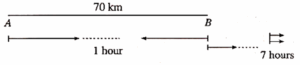
The distance between the two cars is 70 km.
If they travel in the same direction, they meet after 7 hours.
∴ the distance travelled by the car starting from A in 7 hours = 7x km. (Distance = speed x time) and that by the car from B = 7y km.
∴ 7x - 7y = 70 ... (The car starting from A has covered 70 km more)
∴ x – y = 10 ….(1)
If they travel towards each other, the total distance travelled by them will be 70 km.
In 1 hour, the distance travelled by the car starting from A = x km and that by the car from B = y km.
x + y = 70 ….(2)
Adding equations (1) and (2),
(x – y) + (x + y) = 10 + 70
2x = 80
x = 80/2 = 40
Substituting x = 40 in equation (2),
40 + y = 70
∴ y = 70 - 40
∴ y = 30
The speeds of the cars starting from A and B are 40 km/h and 30 km/h respectively.
Question 10. The sum of a two digit number and the number obtained by interchanging its digits is 99. Find the number.
Let the two-digit number be 10x + y
where
x = tens digit,
y = units digit,
x, y are integers from 1 to 9 (since both are digits and the first digit of a two-digit number can't be 0).
The number obtained by interchanging its digits is 10y + x.
According to the question:
(10x + y) + (10y + x) = 99
10x + y + 10y + x = 99
(10x + x) + (10y + y) = 99
11x + 11y = 99
11(x + y) = 99
x + y = 9
Now, the two-digit number is 10x + y, where x + y = 9.
The possible values for x (tens digit) are 1 to 9, and for each, y = 9 – x.
If we take the values of x as 1, 2, 3, ... , etc., the corresponding values of y will be 8, 7, 6, ... etc.
∴ All two-digit numbers such that the sum of their digits is 9 will satisfy this property.
So, the numbers are:
18, 27, 36, 45, 54, 63, 72, 81, 90.