
Solutions
Practice set 4.1
Question 1.1. From the following pairs of numbers, find the reduced form of ratio of first number to second number.
(i) 72, 60
The ratio of 72 to 60 = 72 : 60 = \(\frac{72}{60}\) = \(\frac{72÷12}{60÷12}\) = \(\frac{6}{5}\) ... (HCF of 72 and 60 = 12)
Thus, the reduced form of 72 : 60 is 6 : 5.
(ii) 38,57
The ratio of 38 to 57 = 38 : 57 = \(\frac{38}{57}\) = \(\frac{38÷19}{57÷19}\) = \(\frac{2}{3}\) ... (HCF of 38 and 57 = 19)
Thus, the reduced form of 38 : 57 is 2 : 3.
(iii) 52,78
The ratio of 52 to 78 = 52 : 78 = \(\frac{52}{78}\) = \(\frac{52÷26}{78÷26}\) = \(\frac{2}{3}\) ... (HCF of 52 and 78 = 26)
Thus, the reduced form of 52 : 78 is 2 : 3.
Question 1.2. Find the reduced form of the ratio of the first quantity to second quantity.
(i) 700 ₹, 308 ₹
700 ₹ : 308 ₹ = \(\frac{700}{308}\) = \(\frac{28×25}{28×11}\) = \(\frac{25}{11}\)
Thus, the reduced form of 700 ₹ : 308 ₹ is 25 : 11.
(ii) 14 ₹, 12 ₹. 40 paise.
₹ 14 = 14 x 100 = 1400 paise
₹ 12 p 40 = 12 x 100 + 40 = 1200 + 40 = 1240 paise
₹ 14 : ₹ 12 p 40
= 1400 p: 1240 p = \(\frac{1400}{1240}\) = \(\frac{4×35}{4×31}\) = \(\frac{35}{31}\)
Thus, the reduced form of 14 ₹ : 12 ₹. 40 paise is 35 : 31.
(iii) 5 litre, 2500 ml
5 litres = 5 x 1000 = 5000 ml
5 litres : 2500 ml = 5000 ml : 2500 ml
= \(\frac{5000}{2500}\) = \(\frac{2500×2}{2500×1}\) = \(\frac{2}{1}\)
Thus, the reduced form of 5 litres : 2500 ml = 2 : 1
(iv) 3 years 4 months, 5 years 8 months
3 years 4 months = 3 x 12 + 4 = 40 months
5 years 8 months = 5 x 12 + 8 = 68 months
3 years 4 months : 5 years 8 months
= 40 months : 68 months = \(\frac{40}{68}\) = \(\frac{4×10}{4×17}\) = \(\frac{10}{17}\)
Thus, the reduced form of 3 years 4 months : 5 years 8 months = 10 : 17
(v) 3.8 kg, 1900 gm
3.8 kg = 3.8 x 1000 = 3800 g.
3.8 kg : 1900 g = 3800 g : 1900 g = \(\frac{3800}{1900}\) = \(\frac{1900×2}{1900×1}\) = \(\frac{2}{1}\)
Thus, the reduced form of 3.8 kg : 1900 g = 2 : 1
(vi) 7 minutes 20 seconds, 5 minutes 6 seconds.
7 min 20 sec = 7 x 60 + 20 = 440 sec
5 min 6 sec = 5 x 60 + 6 = 306 sec
7 min 20 sec : 5 min 6 sec = 440 sec : 306 sec
= \(\frac{440}{306}\) = \(\frac{2×220}{2×153}\) = \(\frac{220}{153}\)
Thus, the reduced form of 7 min 20 sec : 5 min 6 sec = 220 : 153
Question 1.3. Express the following percentages as ratios in the reduced form.
(i) 75 : 100
75 : 100 = \(\frac{75}{100}\) = \(\frac{25×3}{25×4}\) = \(\frac{3}{4}\)
Answer is : 3 : 4
(ii) 44 : 100
44 : 100 = \(\frac{44}{100}\) = \(\frac{4×11}{4×25}\) = \(\frac{11}{25}\)
Answer is : 11 : 25
(iii) 6.25%
6.25% = \(\frac{6.25}{100}\) = \(\frac{625}{100×100}\) = \(\frac{25×25}{25×4×25×4}\) = \(\frac{1}{16}\)
Answer is : 1 : 16
(iv) 52 : 100
52 : 100 = \(\frac{52}{100}\) = \(\frac{4×13}{4×25}\) = \(\frac{13}{25}\)
Answer is : 13 : 25
(v) 0.64%
0.64% = \(\frac{0.64}{100}\) = \(\frac{64}{100×100}\) = \(\frac{4×4×4}{25×4×25×4}\) = \(\frac{4}{625}\)
Answer is : 4 : 625
Question 1.4. Three persons can build a small house in 8 days. To build the same house in 6 days, how many persons are required?
The number of persons and the number of days required to build the house are in inverse variation.
So, the product of number of persons and the number of days required to build the house is constant.
Let the number of persons required to build the same house in 6 days be x.
∴ x × 6 = 3 x 8
∴ x = \(\frac{3×8}{6}\) = \(\frac{24}{6}\) = 4
Thus, 4 persons are required to build the same house in 6 days.
Question 1.5. Convert the following ratios into percentage.
(i) 15 : 25
15 : 25 = \(\frac{15}{25}\) x 100 % = 15 x 4 % = 60%
Answer is : 60%
(ii) 47 : 50
47 : 50 = \(\frac{47}{50}\) x 100 % = 47 x 2 % = 94%
Answer is : 94%
(iii) \(\frac{7}{10}\)
\(\frac{7}{10}\) = \(\frac{7}{10}\) x 100 % = 7 x 10 % = 70%
Answer is : 70%
(iv) \(\frac{546}{600}\)
\(\frac{546}{600}\) = \(\frac{546}{600}\) x 100 % = \(\frac{91×6}{6}\) % = 91%
Answer is : 91%
(v) \(\frac{7}{16}\)
\(\frac{7}{16}\) = \(\frac{7}{16}\) x 100 % = \(\frac{700}{16}\) %= 43.75 %
Answer is : 43.75 %
Question 1.6. The ratio of ages of Abha and her mother is 2 : 5. At the time of Abha's birth her mothers age was 27 year. Find the present ages of Abha and her mother.
The ratio of the present ages of Abha and her mother is 2 : 5.
Let the common multiple of the given ratio be x.
Then the present age of Abha is 2x years and that of her mother is 5x years.
The mother's age at the birth of Abha, i.e. 2x years ago was 27 years.
5x - 2x = 27
∴ 3x = 27
x = \(\frac{27}{3}\) ∴ x = 9
2x = 2 × 9 = 18 and 5x = 5 × 9 = 45
Answer is : The present ages of Abha and her mother are 18 years and 45 years respectively.
Question 1.7. Present ages of Vatsala and Sara are 14 years and 10 years respectively. After how many years the ratio of their ages will become 5 : 4?
Let the ratio of the ages of Vatsala and Sara will become 5 : 4 after x years.
Then after x years, Vatsala's age will be (14 + x) years and that of Sara will be (10 + x) years.
From the given condition, (14 + x) : (10 + x) = 5 : 4
∴ \(\frac{14 + x}{10 + x}=\frac{5}{4}\)
∴ 4(14 + x) = 5(10 + x)
∴ 56 + 4x = 50 + 5x
∴ 50 + 5x = 56 + 4x
∴ 5x - 4x = 56 - 50
∴ x = 6
Answer is : After 6 years.
Question 1.8. The ratio of present ages of Rehana and her mother is 2 : 7. After 2 years, the ratio of their ages will be 1 : 3. What is Rehana's present age ?
The ratio of the ages is 2 : 7
Let the common multiple of the given ratio be x.
Then Rehana's present age is 2x years and that of her mother is 7x years.
From the given condition, (2x + 2) : (7x + 2) = 1 : 3.
∴ \(\frac{2x + 2}{7x + 2}=\frac{1}{3}\)
∴ 3(2x + 2) = 1(7x + 2)
∴ 6x + 6 = 7x + 2
∴ 7x + 2 = 6x + 6
∴ 7x - 6x = 6 - 2
∴ x = 4 and 2x = 4 x 2 = 8
Answer is : The present age of Rehana is 8 years.
Practice set 4.2
Question 2.1. Using the property \(\frac{a}{b}=\frac{ak}{bk}\) , fill in the blanks substituting proper numbers in the following.
(i) \(\frac{5}{7}=\frac{....}{28}=\frac{35}{...}=\frac{....}{3.5}\)
\(\frac{5}{7}=\frac{....}{28}=\frac{5×4}{7×4}=\frac{20}{28}\)
\(\frac{5}{7}=\frac{35}{....}=\frac{5×7}{7×7}=\frac{35}{49}\)
\(\frac{5}{7}=\frac{....}{3.5}=\frac{5×\frac{1}{2}}{7×\frac{1}{2}}=\frac{2.5}{3.5}\)
Answer is : \(\frac{5}{7}=\frac{20}{28}=\frac{35}{49}=\frac{2.5}{3.5}\)
(ii) \(\frac{9}{14}=\frac{4.5}{...}=\frac{...}{42}=\frac{....}{3.5}\)
\(\frac{9}{14}=\frac{4.5}{...}=\frac{9×\frac{1}{2}}{14×\frac{1}{2}}=\frac{4.5}{7}\)
\(\frac{9}{14}=\frac{....}{42}=\frac{9×3}{14×3}=\frac{27}{42}\)
\(\frac{9}{14}=\frac{....}{3.5}=\frac{9×\frac{1}{4}}{14×\frac{1}{4}}=\frac{2.25}{3.5}\)
Answer is :\(\frac{9}{14}=\frac{4.5}{7}=\frac{27}{42}=\frac{2.5}{3.5}\)
Question 2.2. Find the following ratios.
(i) The ratio of radius to circumference of the circle.
Let the radius of the circle be r units
∴ Circumference of the circle = 2πr units
Radius of the circle : Circumference of the circle = r : 2πr = \(\frac{r}{2πr}=\frac{1}{2π}\) = 1 : 2π
Answer is : The ratio of radius to circumference of the circle is 1 : 2π
(ii) The ratio of circumference of circle with radius r to its area.
Radius of the circle = r units
∴ Circumference of the circle = 2πr units
Area of the circle = πr2 square units
Circumference of the circle : Area of the circle = 2πr : πr2= \(\frac{2πr}{πr^2}=\frac{2}{r}\) = 2 : r
Answer is : The ratio of circumference of circle with radius r to its area is 2 : r.
(iii) The ratio of diagonal of a square to its side, if the length of side is 7 cm.
Side of the square = 7 cm
∴ Length of diagonal of the square = \(\sqrt{2}\) x Side of the square = 7\(\sqrt{2}\) cm
Length of diagonal of the square : Side of the square = 7\(\sqrt{2}\) cm : 7 cm = \(\frac{7\sqrt{2}}{7}\) = \(\frac{\sqrt{2}}{1}\)
Answer is : The ratio of diagonal of the square to its side is \(\sqrt{2}\) : 1.
(iv) The lengths of sides of a rectangle are 5 cm and 3.5 cm. Find the ratio of its perimeter to area.
Length of the rectangle, l = 5 cm
Breadth of the rectangle, b = 3.5 cm
∴ Perimeter of the rectangle = 2(l + b) = 2 x (5 + 3.5) = 2 x 8.5 = 17 cm
Area of the rectangle = l x b = 5 x 3.5 = 17.5 cm2
Perimeter of the rectangle : Area of the rectangle = 17 : 17.5
= \(\frac{17}{17.5}\) = \(\frac{170}{175}\) = \(\frac{34×5}{35×5}\) = \(\frac{34}{35}\) = 34 : 35
Answer is : The ratio of perimeter to area of the rectangle is 34 : 35.
Question 2.3. Compare the following pairs of ratios.
(i) \(\frac{\sqrt{5}}{3},\frac{3}{\sqrt{7}}\)
\(\sqrt{5}×\sqrt{7}\) = \(\sqrt{35}\)
3 x 3 = 9 = \(\sqrt{81}\)
\(\sqrt{35}\) < \(\sqrt{81}\)
∴ \(\frac{\sqrt{5}}{3}<\frac{3}{\sqrt{7}}\)
(ii) \(\frac{3\sqrt{5}}{5\sqrt{7}},\frac{\sqrt{63}}{\sqrt{125}}\)
\(3\sqrt{5}×\sqrt{125}\) = \(3\sqrt{5}×\sqrt{5×25}\) = \(3\sqrt{5}×5\sqrt{5}\) = 3 x 5 x 5 = 75
\(5\sqrt{7}×\sqrt{63}\) = \(5\sqrt{7}×\sqrt{7×9}\) = \(5\sqrt{7}×3\sqrt{7}\) = 5 x 3 x 7 = 105
75 < 105
∴ \(\frac{3\sqrt{5}}{5\sqrt{7}}<\frac{\sqrt{63}}{\sqrt{125}}\)
(iii) \(\frac{5}{18},\frac{17}{121}\)
5 × 121 = 605
17 x 18 = 306
605 > 306
∴ \(\frac{5}{18}>\frac{17}{121}\)
(iv) \(\frac{\sqrt{80}}{\sqrt{48}},\frac{\sqrt{45}}{\sqrt{27}}\)
\(\frac{\sqrt{80}}{\sqrt{48}}\) = \(\frac{\sqrt{16×5}}{\sqrt{16×3}}\)
= \(\frac{4\sqrt{5}}{4\sqrt{3}}\)
= \(\frac{\sqrt{5}}{\sqrt{3}}\)
\(\frac{\sqrt{45}}{\sqrt{27}}\) = \(\frac{\sqrt{9×5}}{\sqrt{9×3}}\)
= \(\frac{3\sqrt{5}}{3\sqrt{3}}\)
= \(\frac{\sqrt{5}}{\sqrt{3}}\)
∴ \(\frac{\sqrt{80}}{\sqrt{48}}=\frac{\sqrt{45}}{\sqrt{27}}\)
(v) \(\frac{9.2}{5.1},\frac{3.4}{7.1}\)
9.2 × 7.1 = 65.32
5.1 x 3.4 = 17.34
Now, 65.32 > 17.34
∴ \(\frac{9.2}{5.1}>\frac{3.4}{7.1}\)
Question 2.4.
(i) ABCD is a parallelogram. The ratio of ∠ A and ∠ B of this parallelogram is 5 : 4. Find the measure of ∠ B.
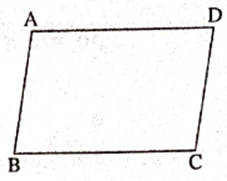
The ratio of ∠ A to ∠ B is 5 : 4.
Let the common multiple of this ratio be x.
Then ∠ A = 5x° and ∠ B = 4x°
∠ A + ∠ B = 180° ... (Interior angles)
∴ 5x° + 4x° = 180°
∴ 5x + 4x = 180
∴ 9x = 180 ∴ x = 20
∠ B = 4x° = 4 × 20° = 80°
Answer is : The measure of ∠ B is 80°.
(ii) The ratio of present ages of Albert and Salim is 5 : 9. Five years hence ratio of their ages will be 3 : 5. Find their present ages.
The ratio of the present ages of Albert and Salim is 5 : 9.
Let the common multiple of this ratio be x.
Then the present ages of Albert and Salim be 5x years and 9x years, respectively.
5 years hence,
Age of Albert = (5x + 5) years
Age of Salim = (9x + 5) years
It is given that five year hence, the ratio of their ages will be 3 : 5.
∴ \(\frac{5x + 5}{9x + 5}=\frac{3}{5}\)
5(5x + 5) = 3(9x + 5)
25x + 25 = 27x + 15
27x - 25x = 25 - 15
2x = 10
x = 5
∴ Present age of Albert = 5x = 5 x 5 = 25 years
∴ Present age of Salim = 9x = 9 x 5 = 45 years
Answer is : The present age of Albert is 25 years and the present age of Salim is 45 years.
(iii) The ratio of length and breadth of a rectangle is 3 : 1, and its perimeter is 36 cm. Find the length and breadth of the rectangle.
Let the common multiple of the ratio 3 : 1 be x.
Then the length and the breadth of the rectangle are 3x cm and x cm respectively.
The perimeter of a rectangle = 2(l + b)
∴ 36 = 2(3x + x) ... (Given : the perimeter 36 cm)
∴ 36 = 2 x 4x
∴ x = \(\frac{9}{2}\)
3x = 3 x \(\frac{9}{2}\) = \(\frac{27}{2}\) = 13.5 cm;
x = \(\frac{9}{2}\) = 4.5 cm;
Answer is : The length of the rectangle is 13.5 cm and breadth is 4.5 cm.
(iv) The ratio of two numbers is 31 : 23 and their sum is 216. Find these numbers.
Let the two numbers be 31x and 23x.
Sum of the two numbers = 216
∴ 31x + 23x = 216
54x = 216
∴ x = \(\frac{216}{54}\) = 4
∴ One number = 31x = 31 x 4 = 124, Other number = 23x = 23 x 4 = 92
Answer is : The two numbers are 92 and 124.
(v) If the product of two numbers is 360 and their ratio is 10 : 9, then find the numbers.
Let the two numbers be 10x and 9x.
Product of the two numbers = 360
∴ 10x × 9x = 360
∴ 90x2 = 360
∴ x2 = 4
∴ x = 2
∴ One number = 10x = 10 x 2 = 20, Other number = 9x = 9 x 2 = 18
Answer is : The two numbers are 18 and 20.
Question 2.5. If a : b = 3 : 1 and b : c = 5 : 1 then find the value of
(i) \([\frac{a^3}{15b^2c}]^3\) (ii) \(\frac{a^2}{7bc}\)
a : b = 3 : 1. ∴ \(\frac{a}{b}=\frac{3}{1}\)
∴ a = 3b ….(1)
b : c = 5 : 1. ∴ \(\frac{b}{c}=\frac{5}{1}\)
∴ b = 5c ….(2)
From (1) and (2),
a = 3b = 3 x 5c = 15c .. a = 15c ….(3)
(i) \([\frac{a^3}{15b^2c}]^3\) = \([\frac{(15c)^3}{15(5c)^2c}]^3\) …[From (2) and (3)]
= \([\frac{15×15×15×c^3}{15×5×5×c^3}]^3\)
= \([\frac{15×15}{5×5}]^3\)
= (3 × 3)3 = (9)3 = 729
Answer is : The required value is 729.
(ii) \(\frac{a^2}{7bc}\) = \(\frac{(15c)^2}{7(5c)c}\) …[From (2) and (3)]
= \(\frac{15×15×c^2}{7×5×c^2}\)
= \(\frac{45}{7}\)
Answer is : The required value is \(\frac{45}{7}\).
Question 2.6. If \(\sqrt{0.04×0.4×a}\) = 0.4 × 0.04 × \(\sqrt{b}\) then find the ratio
\(\sqrt{0.04×0.4×a}\) = 0.4 × 0.04 × \(\sqrt{b}\)
\(\frac{\sqrt{a}}{\sqrt{b}}\) = \(\frac{0.4 × 0.04}{\sqrt{0.4 × 0.04}}\)
∴ \(\frac{a}{b}\) = \(\frac{(0.4 × 0.04)^2}{(0.4 × 0.04)}\) …(squaring both sides)
= 0.4 × 0.04 = \(\frac{4}{10}×\frac{4}{100}\) = \(\frac{2}{5}×\frac{1}{25}\) = \(\frac{2}{125}\)
∴ \(\frac{a}{b}\) = \(\frac{2}{125}\)
Answer is : a : b = 2 : 125
Question 2.7. (x + 3) : (x + 11) = (x - 2) : (x + 1) then find the value of x.
(x + 3) : (x + 11) = (x - 2) : (x + 1)
∴ \(\frac{x + 3}{x + 11}\) = \(\frac{x - 2}{x + 1}\)
(x + 3)(x + 1) = (x - 2)(x + 11)
∴ x(x + 1) + 3(x + 1) = x(x + 11) - 2(x + 11)
∴ x2 + x + 3x + 3 = x2 + 11x - 2x -22
∴ x2 + 4x + 3 = x2 + 9x - 22
∴ 4x - 9x = - 22 - 3
∴ -5x = - 25
∴ x = -25/-5 = 5
Answer is : The value of x is 5.
Practice set 4.3
Question 3.1. If \(\frac{a}{b}=\frac{7}{3}\) then find the values of the following ratios.
(i) \(\frac{5a + 3b}{5a - 3b}\)
\(\frac{a}{b}=\frac{7}{3}\) ….(Given)
Let the common multiple be k.
∴ a = 7k, b = 3k
∴ \(\frac{5a + 3b}{5a - 3b}\) = \(\frac{5(7k) + 3(3k)}{5(7k) - 3(3k)}\)
= \(\frac{35k + 9k}{35k - 9k}\)
= \(\frac{44k}{26k}\)
= \(\frac{22}{13}\)
Answer is : \(\frac{5a + 3b}{5a - 3b}\) = 22 : 13
(ii) \(\frac{2a^2 + 3b^2}{2a^2 - 3b^2}\)
\(\frac{a}{b}=\frac{7}{3}\) ….(Given)
Let the common multiple be k.
∴ a = 7k, b = 3k
∴ \(\frac{2a^2 + 3b^2}{2a^2 - 3b^2}\) = \(\frac{2(7k)^2 + 3(3k)^2}{2(7k)^2 - 3(3k)^2}\)
= \(\frac{2×49k^2 + 3×9k^2}{2×49k^2 - 3×9k^2}\)
= \(\frac{98k^2 + 27k^2}{98k^2 - 27k^2}\)
= \(\frac{125k^2 }{71k^2 }\)
= \(\frac{125}{71}\)
Answer is : \(\frac{2a^2 + 3b^2}{2a^2 - 3b^2}\) = 125 : 71
(iii) \(\frac{a^3 - b^3}{b^3}\)
\(\frac{a}{b}=\frac{7}{3}\) ….(Given)
Let the common multiple be k.
∴ a = 7k, b = 3k
∴ \(\frac{a^3 - b^3}{b^3}\) = \(\frac{(7k)^3 - (3k)^3}{(3k)^3}\)
= \(\frac{343k^3 - 27k^3}{27k^3}\)
= \(\frac{316k^3}{27k^3}\)
= \(\frac{316}{27}\)
Answer is : \(\frac{a^3 - b^3}{b^3}\) = 316 : 27
(iv) \(\frac{7a + 9b}{7a - 9b}\)
\(\frac{a}{b}=\frac{7}{3}\) ….(Given)
Let the common multiple be k.
∴ a = 7k, b = 3k
∴ \(\frac{7a + 9b}{7a - 9b}\) = \(\frac{7(7k) + 9(3k)}{7(7k) - 9(3k)}\)
= \(\frac{49k + 27k}{49k - 27k}\)
= \(\frac{76k}{22k}\)
= \(\frac{38}{11}\)
Answer is : \(\frac{7a + 9b}{7a - 9b}\) = 38 : 11
Question 3.2. If \(\frac{15a^2 + 4b^2}{15a^2 - 4b^2}=\frac{47}{7}\) then find the values of the following ratios.
(i) \(\frac{a}{b}\)
\(\frac{15a^2 + 4b^2}{15a^2 - 4b^2}=\frac{47}{7}\)
Applying componendo and dividendo, we get
\(\frac{(15a^2 + 4b^2)+(15a^2 - 4b^2)}{(15a^2 + 4b^2)-(15a^2 - 4b^2)}=\frac{47+7}{47-7}\)
\(\frac{30a^2}{8b^2}=\frac{54}{40}\)
\(\frac{a^2}{b^2}=\frac{54×8}{40×30}=\frac{54}{150}=\frac{9}{25}\)
∴ \(\frac{a}{b}=\frac{3}{5}\) ... (Taking positive square root)
Answer is : \(\frac{a}{b}\) = 3 : 5
(ii) \(\frac{7a - 3b}{7a + 3b}\)
\(\frac{a}{b}=\frac{3}{5}\) … [from Q.3.2(i)]
Now dividing each term of \(\frac{7a - 3b}{7a + 3b}\) by b.
∴ \(\frac{7a - 3b}{7a + 3b}\) = \(\frac{7\frac{a}{b} - 3\frac{b}{b}}{7\frac{a}{b} + 3\frac{b}{b}}\) …
= \(\frac{7\frac{3}{5} - 3}{7\frac{3}{5} + 3}\) … \((\frac{a}{b}=\frac{3}{5})\)
= \(\frac{\frac{21-15}{5}}{\frac{21+15}{5}}\)
= \(\frac{6}{36}\) = \(\frac{1}{6}\)
Answer is : \(\frac{7a - 3b}{7a + 3b}\) = 1 : 6
(iii) \(\frac{b^2 - 2a^2}{b^2 + 2a^2}\)
\(\frac{a}{b}=\frac{3}{5}\) … [from Q.3.2(i)]
∴ \(\frac{a^2}{b^2}=\frac{9}{25}\)
Now dividing each term of \(\frac{b^2 - 2a^2}{b^2 + 2a^2}\) by b2.
∴ \(\frac{b^2 - 2a^2}{b^2 + 2a^2}\) = \(\frac{(b^2)(b^2) - (2a^2)/(b^2)}{(b^2)/(b^2) + (2a^2)/(b^2)}\)
= \(\frac{1 - 2(\frac{a^2}{b^2})}{1 + 2(\frac{a^2}{b^2})}\)
= \(\frac{1 - 2(\frac{9}{25})}{1 + 2(\frac{9}{25})}\)
= \(\frac{1 - \frac{18}{25}}{1 + \frac{18}{25}}\)
= \(\frac{\frac{25-18}{25}}{\frac{25+18}{25}}\)
= \(\frac{7}{43}\)
Answer is : \(\frac{b^2 - 2a^2}{b^2 + 2a^2}\) = 7 : 43
(iv) \(\frac{b^3 - 2a^3}{b^3 + 2a^3}\)
\(\frac{a}{b}=\frac{3}{5}\) … [from Q.3.2(i)]
∴ \(\frac{a^3}{b^3}=\frac{27}{125}\)
Now dividing each term of \(\frac{b^3 - 2a^3}{b^3 + 2a^3}\) by b3.
∴ \(\frac{b^3 - 2a^3}{b^3 + 2a^3}\) = \(\frac{(b^3)(b^3) - (2a^3)/(b^3)}{(b^3)/(b^3) + (2a^3)/(b^3)}\)
= \(\frac{1 - 2(\frac{a^3}{b^3})}{1 + 2(\frac{a^3}{b^3})}\)
= \(\frac{1 - 2(\frac{27}{125})}{1 + 2(\frac{27}{125})}\)
= \(\frac{1 - \frac{54}{125}}{1 + \frac{54}{125}}\)
= \(\frac{\frac{125-54}{125}}{\frac{125+54}{125}}\)
= \(\frac{71}{179}\)
Answer is : \(\frac{b^3 - 2a^3}{b^3 + 2a^3}\) = 71 : 179
Question 3.3. If \(\frac{3a + 7b}{3a - 7b}=\frac{4}{3}\) then find the value of the ratio \(\frac{3a^2 - 7b^2}{3a^ + 7b^2}\)
\(\frac{3a + 7b}{3a - 7b}=\frac{4}{3}\) ….(Given)
Applying componendo and dividendo, we get
∴ \(\frac{(3a + 7b)+(3a - 7b)}{(3a + 7b)-(3a - 7b)}=\frac{4+3}{4-3}\)
∴ \(\frac{6a}{14b}=\frac{7}{1}\)
∴ \(\frac{a}{b}=\frac{7×14}{1×6}=\frac{49}{3}\)
∴ \(\frac{a^2}{b^2}=\frac{49^2}{3^2}=\frac{2401}{9}\)
∴ \(\frac{a^2}{b^2}×\frac{3}{7}=\frac{49^2}{3^2}=\frac{2401}{9}×\frac{3}{7}\) ...(Multiplying both the sides by \(\frac{3}{7}\))
∴ \(\frac{3a^2}{7b^2}=\frac{343}{3}\)
∴ \(\frac{3a^2 + 7b^2}{3a^ - 7b^2}=\frac{343+3}{343-3} \) ….... (By componendo-dividendo)
∴ \(\frac{3a^2 + 7b^2}{3a^ - 7b^2}=\frac{346}{340}=\frac{173}{170}\)
∴ \(\frac{3a^2 - 7b^2}{3a^ + 7b^2}=\frac{346}{340}=\frac{170}{173}\) ….... (By invertendo)
Answer is : The value of the ratio \(\frac{3a^2 - 7b^2}{3a^ + 7b^2}\) is 170 : 173
Question 3.4. Solve the following equations.
(i) \(\frac{x^2+12x-20}{3x - 5}=\frac{x^2+8x+12}{2x+3}\)
Let us first decide whether x = 0 or x ≠ 0.
If x = 0, LHS = \(\frac{-20}{-5}\) = 4 and RHS = \(\frac{12}{3}\) = 4.
∴ LHS = RHS
∴ x = 0 is a solution of the given equation.
If x ≠ 0, then
\(\frac{x^2+12x-20}{3x - 5} × \frac{1}{4}=\frac{x^2+8x+12}{2x+3}× \frac{1}{4}\) …(Multiplying both the sides by \(\frac{1}{4}\))
∴ \(\frac{x^2+12x-20}{12x - 20} =\frac{x^2+8x+12}{8x+12}\)
∴ \(\frac{x^2+12x-20-(12x-20)}{12x - 20} =\frac{x^2+8x+12-(8x+12)}{8x+12}\) ….... (By dividendo)
∴ \(\frac{x^2}{12x - 20} =\frac{x^2}{8x+12}\)
∴ (12x - 20) = (8x + 12) ... (Dividing both the sides by x2)
∴ 12x - 8x = 12 + 20
∴ 4x = 32
∴ x = 8
Answer is : x = 0 or x = 8 is the solution of the given equation.
(ii) \(\frac{10x^2+15x+63}{5x^2-25x+12}=\frac{2x+3}{x-5}\)
Let us first decide whether x = 0 or x ≠ 0.
If x = 0, LHS = \(\frac{63}{12}\) = \(\frac{21}{4}\) and RHS = \(\frac{3}{-5}\)
∴ LHS ≠ RHS ∴ x ≠ 0
\(\frac{10x^2+15x+63}{5x^2-25x+12}=\frac{2x+3}{x-5}\)
\(\frac{5x(2x+3)+63}{5x(x-5)+12}=\frac{2x+3}{x-5}\)
Substituting a for 2x + 3 and b for x -5,
∴ \(\frac{5xa+63}{5xb+12}=\frac{a}{b}\)
∴ b(5xa + 63) = a(5xb + 12)
5xab + 63b = 5axb + 12a
∴ 63b = 12a
∴ 21b = 4a
Substituting the values of a and b,
21(x - 5) = 4(2x + 3)
∴ 21x – 105 = 8x + 12
∴ 21x – 8x = 12 + 105
∴ 13x = 117
∴ x = \(\frac{117}{13}\) ∴ x = 9
Answer is : x = 9 is the solution of the given equation.
(iii) \(\frac{(2x+1)^2+(2x-1)^2}{(2x+1)^2-(2x-1)^2}=\frac{17}{8}\)
\(\frac{(2x+1)^2+(2x-1)^2}{(2x+1)^2-(2x-1)^2}=\frac{17}{8}\)
Applying componendo and dividendo, we get
\(\frac{(2x+1)^2+(2x-1)^2+[(2x+1)^2-(2x-1)^2]}{(2x+1)^2+(2x-1)^2-[(2x+1)^2-(2x-1)^2]}=\frac{17+8}{17-8}\)
∴ \(\frac{(2x+1)^2+(2x-1)^2+(2x+1)^2-(2x-1)^2}{(2x+1)^2+(2x-1)^2-(2x+1)^2+(2x-1)^2}=\frac{25}{9}\)
∴ \(\frac{2(2x+1)^2}{2(2x-1)^2}=\frac{25}{9}\)
∴ \(\frac{(2x+1)^2}{(2x-1)^2}=\frac{25}{9}\)
∴ \(\frac{2x+1}{2x-1}=\frac{5}{3}\) …..(Taking square roots of both sides)
∴ 6x + 3 = 10x - 5
∴ 10x – 6x = 5 + 3
∴ 4x = 8
∴ x = 2
Answer is : x = 2 is the solution of the given equation.
(iv) \(\frac{\sqrt{4x+1}+\sqrt{x+3}}{\sqrt{4x+1}-\sqrt{x+3}} = \frac{4}{1}\)
\(\frac{\sqrt{4x+1}+\sqrt{x+3}}{\sqrt{4x+1}-\sqrt{x+3}} = \frac{4}{1}\)
Applying componendo and dividendo, we get
\(\frac{\sqrt{4x+1}+\sqrt{x+3}+(\sqrt{4x+1}-\sqrt{x+3})}{\sqrt{4x+1}-\sqrt{x+3}-(\sqrt{4x+1}-\sqrt{x+3})} = \frac{4+1}{4-1}\)
∴ \(\frac{\sqrt{4x+1}+\sqrt{x+3}+\sqrt{4x+1}-\sqrt{x+3}}{\sqrt{4x+1}-\sqrt{x+3}-\sqrt{4x+1}+\sqrt{x+3}} = \frac{4+1}{4-1}\)
∴ \(\frac{2\sqrt{4x+1}}{2\sqrt{x+3}} = \frac{5}{3}\)
∴ \(\frac{\sqrt{4x+1}}{\sqrt{x+3}} = \frac{5}{3}\)
∴ \(\frac{4x+1}{x+3} = \frac{25}{9}\) …..(Squaring both sides)
∴ 36x + 9 = 25x + 75
∴ 36x - 25x = 75 - 9
∴ 11x = 66
∴ x = 6
Answer is : x = 6 is the solution of the given equation
(v) \(\frac{(4x+1)^2+(2x+3)^2}{4x^2+12x+9}=\frac{61}{36}\)
\(\frac{(4x+1)^2+(2x+3)^2}{4x^2+12x+9}=\frac{61}{36}\)
\(\frac{(4x+1)^2+(2x+3)^2}{(2x+3)^2}=\frac{61}{36}\)
Applying dividendo, we get
\(\frac{(4x+1)^2+(2x+3)^2-(2x+3)^2}{(2x+3)^2}=\frac{61-36}{36}\)
∴ \(\frac{(4x+1)^2}{(2x+3)^2}=\frac{25}{36}\)
∴ \(\frac{(4x+1)}{(2x+3)}=\frac{5}{6}\) …..(Taking square roots of both sides)
∴ 24x + 6 = 10x + 15
∴ 24x - 10x = 15 - 6
∴ 14x = 9
∴ x = \(\frac{9}{14}\)
Answer is : x = \(\frac{9}{14}\) is the solution of the given equation
(vi) \(\frac{(3x-4)^3-(x+1)^3}{(3x-4)^3+(x+1)^3}=\frac{61}{189}\)
\(\frac{(3x-4)^3-(x+1)^3}{(3x-4)^3+(x+1)^3}=\frac{61}{189}\)
Applying componendo and dividendo, we get
\(\frac{(3x-4)^3-(x+1)^3+[(3x-4)^3+(x+1)^3]}{(3x-4)^3-(x+1)^3-[(3x-4)^3+(x+1)^3]}=\frac{61+189}{61-189}\)
∴ \(\frac{(3x-4)^3-(x+1)^3+(3x-4)^3+(x+1)^3}{(3x-4)^3-(x+1)^3-(3x-4)^3-(x+1)^3}=\frac{61+189}{61-189}\)
∴ \(\frac{2(3x-4)^3}{-2(x+1)^3}=\frac{250}{-128}\)
∴ \(\frac{(3x-4)^3}{(x+1)^3}=\frac{125}{64}\)
∴ \(\frac{(3x-4)}{(x+1)}=\frac{5}{4}\) …..(Taking cube roots of both sides)
∴ 12x - 16 = 5x + 5
∴ 12x - 5x = 5 + 16
∴ 7x = 21
∴ x = 3
Answer is : x = 3 is the solution of the given equation
Practice set 4.4
Question 4.1. Fill in the blanks of the following
(i) \(\frac{x}{7}=\frac{y}{3}=\frac{3x+5y}{....}=\frac{7x-9y}{....}\)
\(\frac{x}{7}=\frac{y}{3}=\frac{3x+5y}{....}=\frac{7x-9y}{....}\)
By the theorem on equal ratios;
\(\frac{3x+5y}{3(7)+5(3)}=\frac{7x-9y}{7(7)-9(3)}\)
\(\frac{3x+5y}{21+15}=\frac{7x-9y}{49-27}\)
\(\frac{3x+5y}{36}=\frac{7x-9y}{22}\)
\(\frac{x}{7}=\frac{y}{3}=\frac{3x+5y}{36}=\frac{7x-9y}{22}\)
(ii) \(\frac{a}{3}=\frac{b}{4}=\frac{c}{7}=\frac{a-2b+3c}{....}=\frac{....}{6-8+14}\)
\(\frac{a}{3}=\frac{b}{4}=\frac{c}{7}=\frac{a-2b+3c}{....}=\frac{....}{6-8+14}\)
By the theorem on equal ratios;
\(\frac{a-2b+3c}{3-2(4)+3(7}=\frac{2a-2b+2c}{6-8+14}\)
\(\frac{a-2b+3c}{3-8+21}=\frac{2a-2b+2c}{6-8+14}\)
\(\frac{a}{3}=\frac{b}{4}=\frac{c}{7}=\frac{a-2b+3c}{16}=\frac{2a-2b+2c}{6-8+14}\)
Question 4.2. 5m - n = 3m + 4n then find the values of the following expressions.
(i) \(\frac{m^2+n^2}{m^2-n^2}\)
5m – n = 3m + 4n
∴ 5m - 3m = 4n + n
∴ 2m = 5n
∴ \(\frac{m}{n}=\frac{5}{2}\)
∴ \(\frac{m^2}{n^2}=\frac{25}{4}\) …..(Squaring both sides)
Applying componendo and dividendo, we get
\(\frac{m^2+n^2}{m^2-n^2}=\frac{25+4}{25-4}\)
\(\frac{m^2+n^2}{m^2-n^2}=\frac{29}{21}\)
Answer is : The value of the given expression is \(\frac{29}{21}\)
(ii) \(\frac{3m+4n}{3m-4n}\)
5m – n = 3m + 4n
∴ 5m - 3m = 4n + n
∴ 2m = 5n
∴ \(\frac{m}{n}=\frac{5}{2}\)
∴ \(\frac{m}{n}×\frac{3}{4}=\frac{5}{2}×\frac{3}{4}\) …(Multiplying both the sides by \(\frac{3}{4} )
∴ \(\frac{3m}{4n}=\frac{15}{8}\)
Applying componendo and dividendo, we get
\(\frac{3m+4n}{3m-4n}=\frac{15+8}{15-8}\)
\(\frac{3m+4n}{3m-4n}=\frac{23}{7}\)
Answer is : The value of the given expression is \(\frac{23}{7}\)
Question 4.3.
(i) If a(y + z) = b(z + x) = c(x + y) and out of a, b, c no two of them are equal then show that,
No two of a, b, c are equal
∴ the value of each of (a-b), (b- c), (c - a) is not zero.
a(y + z) = b(z + x) = c(x + y)
∴ \(\frac{y + z}{bc} = \frac{z + x}{ca} = \frac{x + y}{ab}\) ... (Dividing by abc)
By the theorem on equal ratios, each ratio
\(\frac{(x + y)-(z+x)}{ab-ca}=\frac{(y + z)-(x+y)}{bc-ab} = \frac{(z + x)-(y+z)}{ca-bc}\)
Also each ratio = \(\frac{(x + y)-(z+x)}{ab-ca}=\frac{x + y - z - x)}{a(b-c)}=\frac{y - z)}{a(b-c)}\) …(i)
each ratio = \(\frac{(y + z)-(x+y)}{bc-ab} = \frac{y + z - x - y}{b(c-a)}=\frac{z - x}{b(c-a)}\) …(ii)
each ratio = \(\frac{(z + x)-(y+z)}{ca-bc}=\frac{z + x - y -z}{c(a-b)}=\frac{x - y}{c(a-b)}\) …(iii)
From (i), (ii) and (iii),
\(\frac{y - z)}{a(b-c)}\) = \(\frac{z - x}{b(c-a)}\) = \(\frac{x - y}{c(a-b)}\)
(ii) If \(\frac{x}{3x-y-z} = \frac{y}{3y-z-x} = \frac{z}{3z-y-x}\) and x + y + z ≠ 0 then show that the value of each ratio is equal to 1.
\(\frac{x}{3x-y-z} = \frac{y}{3y-z-x} = \frac{z}{3z-y-x}\)
By the theorem on equal ratios,
each ratio = \(\frac{x+y+z}{(3x-y-z)+(3y-z-x)+(3z-y-x)}\)
= \(\frac{x+y+z}{3x-y-z+3y-z-x+3z-y-x}\)
= \(\frac{x+y+z}{x+y+z}\) = 1 …( x + y + z ≠ 0)
(iii) If \(\frac{ax+by}{x+y} = \frac{bx+az}{x+z} = \frac{ay+bz}{y+z}\) and x + y + z ≠ 0 then show that \(\frac{a+b}{2}\)
\(\frac{ax+by}{x+y} = \frac{bx+az}{x+z} = \frac{ay+bz}{y+z}\)
By the theorem on equal ratios,
each ratio = \(\frac{(ax+by)+(bx+az)+(ay+bz)}{(x+y)+(x+z)+(y+z)}\)
= \(\frac{ax+by+bx+az+ay+bz}{x+y+x+z+y+z}\)
= \(\frac{x(a+b)+y(a+b)+z(a+b)}{2(x+y+z)}\)
= \(\frac{(a+b)(x+y+z)}{2(x+y+z)}\)
= \(\frac{a+b}{2}\)
(iv) If \(\frac{y+z}{a} = \frac{z+x}{b} = \frac{x+y}{c}\) then show that \(\frac{x}{b+c-a} = \frac{y}{c+a-b} = \frac{z}{a+b-c}\)
\(\frac{y+z}{a} = \frac{z+x}{b} = \frac{x+y}{c}\)
By the theorem on equal ratios,
each ratio = \(\frac{z+x+x+y-y-z}{b+c-a}\)
= \(\frac{2}{b+c-a}\)…(i)
each ratio = \(\frac{x+y+y+z-z-x}{c+a-b}\)
= \(\frac{2y}{c+a-b}\)…(ii)
each ratio = \(\frac{y+z+z+x-x-y}{a+b-c}\)
= \(\frac{2z}{a+b-c}\) …(iii)
From (i), (ii) and (iii),
\(\frac{2x}{b+c-a} = \frac{2y}{c+a-b} = \frac{2z}{a+b-c}\)
Multiplying each ratio by \(\frac{1}{2}\)
\(\frac{x}{b+c-a} = \frac{y}{c+a-b} = \frac{z}{a+b-c}\)
(v) If \(\frac{3x-5y}{5z+3y} = \frac{x+5z}{y-5x} = \frac{y-z}{x-z}\) then show that every ratio = \(\frac{x}{y}\)
\(\frac{3x-5y}{5z+3y} = \frac{x+5z}{y-5x} = \frac{y-z}{x-z}\)
Multiplying numerator and denominator of third ratio by 5
∴ \(\frac{3x-5y}{5z+3y} = \frac{x+5z}{y-5x} = \frac{5(y-z)}{5(x-z)}\)
∴ \(\frac{3x-5y}{5z+3y} = \frac{x+5z}{y-5x} = \frac{5y-5z}{5x-5z}\)
By the theorem on equal ratios,
\(\frac{3x-5y+x+5z+5y-5z}{5z+3y+y-5x+5x-5z}\)
= \(\frac{4x}{4y}\) = \(\frac{x}{y}\)\)
Question 4.4. Solve.
(i) \(\frac{16x^2-20x+9}{8x^2+12x+21}\) = \(\frac{4x-5}{2x+3}\)
Let us first decide whether x = 0 or x ≠ 0.
If x = 0, LHS = \(\frac{9}{21}\) = \(\frac{3}{7}\) and RHS = \(\frac{-5}{3}\)
∴ LHS ≠ RHS ∴ x ≠ 0
\(\frac{16x^2-20x+9}{8x^2+12x+21}\) = \(\frac{4x-5}{2x+3}\)
Multiplying the numerator and the denominator of the second ratio by 4x
\(\frac{16x^2-20x+9}{8x^2+12x+21}\) = \(\frac{4x(4x-5)}{4x(2x+3)}\)
∴\(\frac{16x^2-20x+9}{8x^2+12x+21}\) = \(\frac{16x^2-20x)}{8x^2+12)}\)
By the theorem on equal ratios,
each ratio = \(\frac{16x^2-20x+9-(16x^2-20x)}{8x^2+12x+21-(8x^2+12)}\)
∴ \(\frac{16x^2-20x+9-16x^2+20x)}{8x^2+12x+21-8x^2-12)}\) = \(\frac{9}{21}\) = \(\frac{3}{7}\)
∴ \(\frac{4x-5}{2x+3}\) = \(\frac{3}{7}\)
∴ 7(4x - 5) = 3(2x + 3)
∴ 28x - 35 = 6x + 9
∴ 28x - 6x = 9 + 35
∴ 22x = 44
∴ x = 44/22 = 2
Answer is : 2 is the solution of the given equation.
(ii) \(\frac{5y^2+40y-12}{5y+10y^2-4}\) = \(\frac{y+8}{1+2y}\)
Let us first decide whether y = 0 or y ≠ 0.
If y = 0, LHS = \(\frac{-12}{-4}\) = 3 and RHS = \(\frac{8}{1}\) = 8
∴ LHS ≠ RHS ∴ y ≠ 0
\(\frac{5y^2+40y-12}{5y+10y^2-4}\) = \(\frac{y+8}{1+2y}\)
Multiplying the numerator and the denominator of the second ratio by 5y
∴ \(\frac{5y^2+40y-12}{5y+10y^2-4}\) = \(\frac{5y(y+8)}{5y(1+2y)}\)
∴ \(\frac{5y^2+40y-12}{5y+10y^2-4}\) = \(\frac{5y^2+40y}{5y+10y^2}\)
By the theorem on equal ratios,
each ratio = \(\frac{5y^2+40y-12-(5y^2+40y)}{5y+10y^2-4-(5y+10y^2)}\) = \(\frac{-12}{-4}\) = 3
∴ \(\frac{y+8}{1+2y}\) = 3
∴ y + 8 = 3(1 + 2y)
∴ y + 8 = 3 + 6y
∴ y - 6y = 3 - 8
∴ -5y = - 5
∴ y = -5/-5 = 1
Answer is : y = 1 is the solution of the given equation.
Practice set 4.5
Question 5.1. Which number should be subtracted from 12, 16 and 21 so that resultant numbers are in continued proportion?
Let the number x to be subtracted to each of the given numbers.
Then the numbers (12 - x), (16 - x) and (21 - x) are in continued proportion.
\(\frac{12-x}{16-x}\) = \(\frac{16-x}{21-x}\) = k ... (Say)
∴ k = \(\frac{12-x-(16-x)}{16-x-(21-x)}\) = \(\frac{12-x-16+x}{16-x-21+x)}\) = \(\frac{-4}{-5}\) = \(\frac{4}{5}\)
∴ \(\frac{12-x}{16-x}\) = \(\frac{4}{5}\)
∴ 5(12 - x) = 4(16 - x)
∴ 60 - 5x = 64 - 4x
∴ -5x + 4x = 64 - 60
∴ -x = 4
∴ x = -4
-4 should be subtracted to each of the given numbers.
i.e. 12 - (-4) = 16.
16 - (-4) = 20
21 - (-4) = 25
Check if 16, 20, and 25 are in continued proportion:
\(\frac{16}{20}\) = \(\frac{4}{5}\)
\(\frac{20}{25}\) = \(\frac{4}{5}\)
The number to be subtracted is −4.
This means adding 4 to each number results in 16, 20, and 25, which are in continued proportion with a common ratio of \(\frac{4}{5}\)
Question 5.2. If (28 - x) is the mean proportional of (23 - x) and (19 - x) then find the value of x.
(28 - x) is the mean proportional of (23 - x) and (19 - x)
∴ \(\frac{23-x}{28-x}\) = \(\frac{28-x}{19-x}\)
By dividendo
\(\frac{23-x-(28-x)}{28-x}\) = \(\frac{28-x-(19-x)}{19-x}\)
∴ \(\frac{23-x-28+x}{28-x}\) = \(\frac{28-x-19+x}{19-x}\)
∴ \(\frac{-5}{28-x}\) = \(\frac{9}{19-x}\)
∴ -5(19 - x) = 9(28 - x)
∴ -95 + 5x = 252 - 9x
∴ 5x + 9x = 252 + 95
∴ 14x = 347
∴ x = \(\frac{347)}{14}\)
Question 5.3. Three numbers are in continued proportion, whose mean proportional is 12 and the sum of the remaining two numbers is 26, then find these numbers.
Let a, b and c be the three numbers in continued proportion.
Then b = 12 and a + c = 26 ... (1)
b2 = ac
∴ (12)2 = ac
∴ ac = 144 ∴ a = \(\frac{144}{c}\) ... (2)
Substituting a = from (2) in a + c = 26 in (1),
∴ \(\frac{144}{c}\) + c = 26
∴ 144 + c2 = 26c ... (Multiplying both the sides by c)
∴ c2 - 26c + 144 = 0
∴ c2 - 18c - 8c + 144 = 0
∴ c(c - 18) - 8(c - 18) = 0
∴ (c - 18) (c - 8) = 0
∴ c – 18 = 0 or c – 8 = 0
c = 18 or c = 8
Now, a + c = 26
∴ a + 18 = 26
∴ a = 26 - 18
∴ a = 8
OR a + c = 26
∴ a + 8 = 26
∴ a = 26 - 8
∴ a = 18
Answer is : The required numbers are 8, 12 and 18 or 18, 12 and 8.
Question 5.4. If (a + b + c) (a - b + c) = a2 + b2 + c2 show that a, b, c are in continued proportion.
(a + b + c)(a – b + c) = a2 + b2 + c2
∴ [(a + c) + b][(a + c) - b] = a2 + b2 + c2
∴ (a + c) 2 - b2 = a2 + b2 + c2
∴ [(a + b)(a - b) = a2 - b2]
∴ a2 + 2ac + c2 - b2 = d2 + b2 + c2
∴ 2ac = b2 + b2
∴ 2ac = 2b2
∴ b2 = ac
∴ a, b, c are in the continued proportion.
Question 5.5. If \(\frac{a)}{b}\) = \(\frac{b)}{c}\) and a, b, c > 0 then show that,
(i) (a + b + c) (b - c) = ab - c2
\(\frac{a)}{b}\) = \(\frac{b)}{c}\)
∴ b2 = ac
LHS = (a + b + c)(b - c)
=ab + b2+ bc - ca - bc - c2
= ab - c2 + b2 - ca
=ab - c2 + ca - ca
= ab - c2
= RHS
Note : This question can be solved using k-method.
(ii) (a2 + b2) (b2 + c2) = (ab + bc)2
Using k-method.
\(\frac{a)}{b}\) = \(\frac{b)}{c}\) = k
∴ a = bk, b = ck
∴ a = ck.k = ck2
LHS = (a2 + b2)(b2 + c2)
= [(ck2)2 + (ck)2][(ck)2 + c2]
= [c2k4 + c2k2][c2k2 + c2]
= [c2k2(k2 + 1)][c2(k2 + 1)]
= c4k2(k2 + 1)2 …..(i)
RHS = (ab + bc)2
= [b(a + c)]2
= b2(a + c)2
= c2k2(ck2 + c)2
= c2k2c2(k2 + 1)2
= c4k2(k2 + 1)2 …..(ii)
From (i) and (ii),
(a2 + b2)(b2 + c2) = (ab + bc)2.
(iii) \(\frac{a^2+b^2}{ab}\) = \(\frac{a+c}{b}\)
Using k-method.
\(\frac{a)}{b}\) = \(\frac{b)}{c}\) = k
∴ a = bk, b = ck
∴ a = ck.k = ck2
LHS = \(\frac{a^2+b^2)}{ab}\) = \(\frac{(ck^2)^2+(ck)^2)}{(ck^2)(ck)}\)
= \(\frac{c^2k^4+(c^2k^2)}{(c^2k^3)}\)
= \(\frac{c^2k^2(k^2+1)}{c^2k^3}\)
= \(\frac{k^2+1}{k}\) …..(i)
RHS = \(\frac{a+c)}{b}\) = \(\frac{ck^2+c)}{ck}\)
= \(\frac{c(k^2+1))}{ck}\)
= \(\frac{k^2+1}{k}\) …..(ii)
From (i) and (ii),
\(\frac{a^2+b^2}{ab}\) = \(\frac{a+c}{b}\)
Question 5.6. Find mean proportional of \(\frac{x+y)}{x-y}\) = \(\frac{x^2-y^2}{x^2y^2}\)
Let the mean proportional of \(\frac{x+y)}{x-y}\) and \(\frac{x^2-y^2}{x^2y^2}\) be m.
Then, m2 = \(\frac{x+y)}{x-y}\) x \(\frac{x^2-y^2}{x^2y^2}\)
= \(\frac{x+y)}{x-y}\) x \(\frac{(x+y)(x-y)}{x^2y^2}\)
∴ m2 = \(\frac{(x+y)^2}{x^2y^2}\)
∴ m = \(\frac{x+y}{xy}\) ... (Taking square root of both the sides)
The mean proportional is \(\frac{x+y}{xy}\)
For Problem set Solutions Buy PDF