
Solutions- Practice Set and Problem Sets
Practice set 2.1
Question 1.1. Classify the decimal form of the given rational numbers into terminating and non-terminating recurring type :
(i) \(\frac{13}{5}\) (ii) \(\frac{2}{11}\) (iii) \(\frac{29}{16}\) (iv) \(\frac{17}{125}\) (v) \(\frac{11}{6}\)
Rational numbers (i) \(\frac{13}{5}\) , (iii) \(\frac{29}{16}\), (iv) \(\frac{11}{6}\) are terminating type, because their denominators are prime factors 2 or 5.
Rational numbers (ii) \(\frac{2}{11}\), (v) \(\frac{11}{6}\) are non-terminating recurring type, because their denominators are other than prime factors 2 or 5.
Question 1.2. Write the following rational numbers in decimal form :
(i) \(\frac{127}{200}\), (ii) \(\frac{25}{99}\), (iii) \(\frac{23}{7}\), (iv) \(\frac{4}{5}\), (v) \(\frac{17}{8}\)
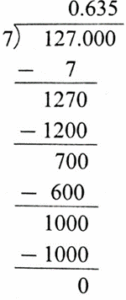
| (i) \(\frac{127}{200}\)
Answer is : \(\frac{127}{200}\) = 0.635 |
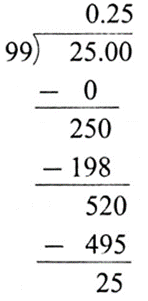
(ii) \(\frac{25}{99}\)
Answer is : \(\frac{25}{99}=0.\overline{25}\) |
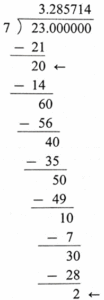
| (iii) \(\frac{23}{7}\)
Answer is : \(\frac{23}{7}=3.\overline{285714}\) |
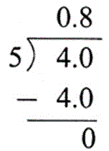
(iv) \(\frac{4}{5}\)
Answer is : \(\frac{4}{5}\) = 0.8 ------------------- (v) \(\frac{17}{8}\)
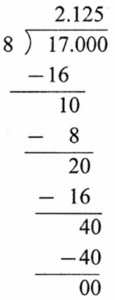
Answer is : \(\frac{17}{8}\) = 2.125 |
Question 1.3. Write the following rational numbers in \(\frac{p}{q}\) form :
(i) \(0.\dot{6}\)
Let x = \(0.\dot{6}\) Here, 6 is the only recurring digit.
So multiply both the sides by 10
10x = \(6.\dot{6}\)
∴ 10x – x = \(6.\dot{6}\) - \(0.\dot{6}\)
∴ 9x = 6
∴ x = \(\frac{6}{9}=\frac{2}{3}\)
∴ \(0.\dot{6}=\frac{2}{3}\)
(ii) \(0.\overline{37}\)
(ii) \(0.\overline{37}\)
Let x = \(0.\overline{37}\) Here, 3 and 7 are the two recurring digits.
So multiply both the sides by 100.
100x = \(37.\overline{37}\)
∴ 100x – x = - \(37.\overline{37}-0.\overline{37}\)
∴ 99x = 37 ∴ x = \(\frac{37}{99}\)
∴ \(0.\overline{37}\) = \(\frac{37}{99}\)
(iii) \(3.\overline{17}\)
Let x = \(3.\overline{17}\). Here, 1 and 7 are the two recurring digits.
So multiply both the sides by 100.
100x = \(317.\overline{17}\)
∴ 100x – x = \(317.\overline{17}\) - \(3.\overline{17}\)
∴ 99x = 314 ∴ x = \(\frac{314}{99}\)
∴ \(3.\overline{17}\) = \(\frac{314}{99}\)
(iv) \(15.\overline{89}\)
Let x = \(15.\overline{89}\). Here, 8 and 9 are the two recurring digits.
So multiply both the sides by 100.
100x = \(1589.\overline{89}\)
∴ 100x – x = \(1589.\overline{89}\) - \(15.\overline{89}\)
∴ 99x = 1574 ∴ x = \(\frac{1574}{99}\)
∴ \(15.\overline{89}\) = \(\frac{1574}{99}\)
(v) \(2.\overline{514}\)
Let x = \(2.\overline{514}\). Here, 5, 1 and 4 are the two recurring digits.
So multiply both the sides by 1000.
1000x = \(2514.\overline{514}\)
∴ 1000x – x = \(2514.\overline{514}\) - \(2.\overline{514}\)
∴ 999x = 2512 ∴ x = \(\frac{2512}{999}\)
∴ \(2.\overline{514}\) = \(\frac{2512}{999}\)
Practice set 2.2
Question 2.1. Show that \(4\sqrt{2}\) is an irrational number.
Proof : Let us suppose that \(4\sqrt{2}\) is a rational number.
∴ \(4\sqrt{2}\) = \(\frac{a}{b}\), (b ≠ 0). a and b are integers.
∴ \(\sqrt{2}\) = \(\frac{a}{4b}\) ……..(1)
∴ \(\frac{a}{4b}\) is a rational number. Because integers are rational numbers.
The right hand side of equation (1) is a rational number and the left hand side [\(\sqrt{2}\)] is an irrational number.
This is contradictory.
∴ our supposition that \(4\sqrt{2}\) is a rational number is wrong.
∴ \(4\sqrt{2}\) is an irrational number.
Question 2.2. Prove that 3 + \(\sqrt{5}\) is an irrational number.
Proof : Let us suppose that 3 + \(\sqrt{5}\) is a rational number.
3 + \(\sqrt{5}\) = \(\frac{a}{b}\), b ≠ 0. a and b are integers.
\(\sqrt{5}\) = \(\frac{a}{b}\) - 3 ……..(1)
Here, the right hand side of equation (1) is a rational number and the left hand side [\(\sqrt{5}\)] is an irrational number.
This is contradictory.
∴ our supposition that 3 + \(\sqrt{5}\) is a rational number is wrong.
∴ 3 + \(\sqrt{5}\) is an irrational number.
Question 2.3. Represent the numbers \(\sqrt{5}\) and \(\sqrt{10}\) on a number line.
Draw a number line n. Take OP = 2 units.
Draw PQ ⊥ line n.
Take PQ = 1 unit.
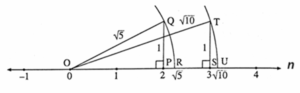
In right angled Δ OPQ, by Pythagoras' theorem,
OQ2 = OP2 + PQ2
= (2)2 + (1)2
= 4 + 1
= 5
∴ OQ = \(\sqrt{5}\).
With centre O and OQ as radius, draw an arc intersecting line n in the point R.
OR = \(\sqrt{5}\) on the number line n.
i.e. the coordinate of the point R is \(\sqrt{5}\).
Similarly, we can find point U on the number line n
such that OU = \(\sqrt{10}\).
Question 2.4. Write any three rational numbers between the two numbers given below :
(i) 0.3 and - 0.5
\(\frac{1}{2}\)[0.3 + (-0.5)]
= \(\frac{1}{2}\)(0.3 - 0.5)
= \(\frac{1}{2}\)(-0.2) = -0.1
\(\frac{1}{2}\)[-0.1 + (-0.5)]
= \(\frac{1}{2}\)(-0.1 - 0.5)
= \(\frac{1}{2}\)(-0.6) = -0.3
\(\frac{1}{2}\)[-0.1 + 0.3)]
= \(\frac{1}{2}\)(0.2) = 0.1
Answer is : - 0.3, -0.1 and 0.1 are the three rational numbers between the numbers 0.3 and -0.5.
(ii) - 2.3 and - 2.33
- 2.3 = - 2.300 and - 2.33 = - 2.330
\(\frac{1}{2}\)[-2.300 + (-2.330)]
\(\frac{1}{2}\)[-2.300 -2.330]
\(\frac{1}{2}\)[-4.630] = -2.315
\(\frac{1}{2}\)[-2.315 + (-2.300)]
\(\frac{1}{2}\)[-2.315 -2.300]
\(\frac{1}{2}\)[-4.615] = - 2.3075
\(\frac{1}{2}\)[-2.315 + (-2.330)]
\(\frac{1}{2}\)[-2.315 -2.330]
\(\frac{1}{2}\)[-4.645] = - 2.3225
Answer is : - 2.3075, - 2.315, - 2.3225 are the three rational numbers between - 2.3 and - 2.33.
(iii) 5.2 and 5.3
The three rational numbers between 5.2 and 5.3 are 5.21, 5.22, 5.23, etc.
(iv) -4.5 and - 4.6.
The three rational numbers between -4.5 and - 4.6 are - 4.51, - 4.52, - 4.53, etc.
[Note : There are infinite rational numbers between any two given numbers. Students can choose the numbers of their choice. ]
Practice set 2.3
Question 3.1. State the order of the surds given below :
(i) \(\sqrt[3]{7}\) (ii) \(5\sqrt{12}\) (iii) \(\sqrt[4]{10}\) (iv) \(\sqrt{39}\) (v) \(\sqrt[3]{18}\)
The order of the given surds are (i) 3, (ii) 2, (iii) 4, (iv) 2, (v) 3.
Question 3.2. State which of the following are surds. Justify.
(i) \(\sqrt[3]{51}\) (ii) \(\sqrt[4]{16}\) (iii) \(\sqrt[5]{81}\) (iv) \(\sqrt{256}\) (v) \(\sqrt[3]{64}\) (vi) \(\sqrt{\frac{22}{7}}\)
(a) (i), (iii) and (vi) are surds.
Justification : Because the radicands are positive rational numbers and the order of the surd, n > 1.
(b) (ii), (iv) and (v) are not surds.
Justification :
(ii) \(\sqrt[4]{16}\) = (16)1/4 = (24)1/4 = 2 which is not an irrational number.
(iv) \(\sqrt{256}\) = (256)1/2 = (162)1/2 = 16 which is not an irrational number.
(v) \(\sqrt[3]{64}\) = (64)1/3 = (43)1/3 = 4 which is not an irrational number.
Question 3.3. Classify the given pair of surds into like surds and unlike surds :
(i) \(\sqrt{52}\), \(5\sqrt{13}\) (ii) \(\sqrt{68}\), \(5\sqrt{13}\) (iii) \(4\sqrt{18}\), \(7\sqrt{2}\) (iv) \(19\sqrt{12}\), \(6\sqrt{3}\) (v) \(5\sqrt{22}\), \(7\sqrt{33}\) (vi) \(5\sqrt{5}\), \(\sqrt{75}\)
For two surds to be like surds, their order should be equal and radicands are equal.
Like surds : (i), (iii), (iv).
(i) \(\sqrt{52}\) = \(\sqrt{4×13}\) = \(\sqrt{4}×\sqrt{13}\) = \(2\sqrt{13}\)
\(2\sqrt{13}\) and \(5\sqrt{13}\) are like surds.
(iii) \(4\sqrt{18}\) = 4 x \(\sqrt{9×2}\) = 4 x \(\sqrt{9}×\sqrt{2}\) = 4 × 3 × \(\sqrt{2}\) = 12\(\sqrt{2}\) .
12\(\sqrt{2}\) and 7\(\sqrt{2}\) are like surds.
(iv) (19\sqrt{12}\) = 19 x \(\sqrt{4×3}\) = 19 x \(\sqrt{4}×\sqrt{3}\) = 19 × 2 × \(\sqrt{3}\) = 38\(\sqrt{3}\) .
38\(\sqrt{3}\) and 6\(\sqrt{3}\) are like surds.
Unlike surds : (ii), (v), (vi).
(ii) \(\sqrt{68}\) = \(\sqrt{4×17}\) = \(\sqrt{4}×\sqrt{17}\) = 2\(\sqrt{17}\).
∴ 2\(\sqrt{17}\) and 5\(\sqrt{13}\) have their order equal but radicands are different.
(v) \(5\sqrt{22}\), \(7\sqrt{33}\) have their order equal but radicands are different.
(vi) \(\sqrt{75}\) = \(\sqrt{25×3}\) = \(\sqrt{25}×\sqrt{3}\) = 5\(\sqrt{3}\)
5\(\sqrt{5}\) and 5\(\sqrt{3}\) have their order equal but radicands are different.
Question 3.4. Simplify the following surds :
(i) \(\sqrt{27}\) (ii) \(\sqrt{50}\) (iii) \(\sqrt{250}\) (iv) \(\sqrt{112}\) (v) \(\sqrt{168}\) .
(i) \(\sqrt{27}\) = \(\sqrt{9×3}\) = \(\sqrt{9}×\sqrt{3}\) = 3\(\sqrt{3}\).
(ii) \(\sqrt{50}\) = \(\sqrt{25×2}\) = \(\sqrt{25}×\sqrt{2}\) = 5\(\sqrt{2}\).
(iii) \(\sqrt{250}\) = \(\sqrt{25×10}\) = \(\sqrt{25}×\sqrt{10}\) = 5\(\sqrt{10}\).
(iv) \(\sqrt{112}\) = \(\sqrt{16×7}\) = \(\sqrt{16}×\sqrt{7}\) = 4\(\sqrt{7}\).
(v) \(\sqrt{168}\) = \(\sqrt{4×42}\) = \(\sqrt{4}×\sqrt{42}\) = 2\(\sqrt{42}\).
Question 3.5. Compare the following pairs of surds :
(i) 7\(\sqrt{2}\), 5\(\sqrt{3}\)
7\(\sqrt{2}\) = \(\sqrt{49}×\sqrt{2}\) = \(\sqrt{98}\).
5\(\sqrt{3}\) = \(\sqrt{25}×\sqrt{3}\) = \(\sqrt{75}\).
98 > 75 ∴ \(\sqrt{98}\) > \(\sqrt{75}\) ∴ 7\(\sqrt{2}\) > 5\(\sqrt{3}\)
Answer is : 7\(\sqrt{2}\) > 5\(\sqrt{3}\) .
(ii) \(\sqrt{247}\), \(\sqrt{274}\)
Here, the order of the surds is same (2).
247 < 274 ∴ \(\sqrt{247}\) < \(\sqrt{274}\)
Answer is : \(\sqrt{247}\) < \(\sqrt{274}\)
(iii) 2\(\sqrt{7}\), \(\sqrt{28}\)
2\(\sqrt{7}\) = \(\sqrt{4}×\sqrt{7}\) = \(\sqrt{28}\).
Here, \(\sqrt{28}\) = \(\sqrt{28}\).
Answer is : 2\(\sqrt{7}\) = \(\sqrt{28}\)
(iv) 5\(\sqrt{5}\), 7\(\sqrt{2}\)
5\(\sqrt{5}\) = \(\sqrt{25}×\sqrt{5}\) = \(\sqrt{125}\)
7\(\sqrt{2}\) = \(\sqrt{49}×\sqrt{2}\) = \(\sqrt{98}\)
125 > 98 ∴ \(\sqrt{125}\) > \(\sqrt{98}\)
Answer is : 5\(\sqrt{5}\) > 7\(\sqrt{2}\)
(v) 4\(\sqrt{42}\) , 9\(\sqrt{2}\)
4\(\sqrt{42}\) = \(\sqrt{16}×\sqrt{42}\) = \(\sqrt{672}\)
9\(\sqrt{2}\) = \(\sqrt{81}×\sqrt{2}\) = \(\sqrt{162}\)
672 > 162 ∴ \(\sqrt{672}\) > \(\sqrt{162}\)
Answer is : 4\(\sqrt{42}\) > 9\(\sqrt{2}\)
(vi) 5\(\sqrt{3}\), 9
5\(\sqrt{3}\) = \(\sqrt{25}×\sqrt{3}\) = \(\sqrt{75}\)
9 = \(\sqrt{81}\)
75 < 81 ∴ \(\sqrt{75}\) < \(\sqrt{81}\)
Answer is : 5\(\sqrt{3}\) < 9
(vii) 7, 2\(\sqrt{5}\).
7 = \(\sqrt{49}\)
2\(\sqrt{5}\) = \(\sqrt{4}×\sqrt{5}\) = \(\sqrt{20}\)
49 > 20 ∴ \(\sqrt{49}\) < \(\sqrt{20}\)
Answer is : 7 > 2\(\sqrt{5}\).
Question 3.6. Simplify :
(i) 5\(\sqrt{3}\) + 8\(\sqrt{3}\)
5\(\sqrt{3}\) + 8\(\sqrt{3}\) = (5 + 8)\(\sqrt{3}\) = 13\(\sqrt{3}\)
Answer is : 13\(\sqrt{3}\)
(ii) 9\(\sqrt{5}\) - 4\(\sqrt{5}\) + \(\sqrt{125}\)
9\(\sqrt{5}\) - 4\(\sqrt{5}\) + \(\sqrt{125}\)
= (9 – 4)\(\sqrt{5}\) + \(\sqrt{125}\)
= 5\(\sqrt{5}\) + \(\sqrt{25×5}\)
= 5\(\sqrt{5}\) + 5\(\sqrt{5}\)
= (5 + 5)\(\sqrt{5}\)
= 10\(\sqrt{5}\)
Answer is : 10\(\sqrt{5}\)
(iii) 7\(\sqrt{48}\) - \(\sqrt{27}\) - \(\sqrt{3}\)
7\(\sqrt{48}\) - \(\sqrt{27}\) - \(\sqrt{3}\)
= 7\(\sqrt{16×3}\) - \(\sqrt{9×3}\) - \(\sqrt{3}\) - -
= 7 x \(\sqrt{16}\) x \(\sqrt{3}\) - \(\sqrt{9}\) x \(\sqrt{3}\) - \(\sqrt{3}\)
= 7 x 4 x \(\sqrt{3}\) – 3 x \(\sqrt{3}\) - \(\sqrt{3}\)
= 28 \(\sqrt{3}\) - 3 \(\sqrt{3}\) - 1 \(\sqrt{3}\)
= (28 – 3 - 1) \(\sqrt{3}\)
= 24 \(\sqrt{3}\)
Answer is : 24\(\sqrt{3}\)
(iv) \(\sqrt{7}\) - \(\frac{3}{5}\sqrt{7}\) + 2\(\sqrt{7}\)
\(\sqrt{7}\) - \(\frac{3}{5}\sqrt{7}\) + 2\(\sqrt{7}\)
= \((1-\frac{3}{5}+2)\)\(\sqrt{7}\)
= \((\frac{5-3+10}{5})\)\(\sqrt{7}\)
= \((\frac{12}{5})\)\(\sqrt{7}\)
Answer is : \((\frac{12}{5})\)\(\sqrt{7}\)
Question 3.7. Multiply and write the answer in the simplest form :
(i) 3\(\sqrt{12}\) x \(\sqrt{18}\)
3\(\sqrt{12}\) x \(\sqrt{18}\)
= 3 x \(\sqrt{4}\) x \(\sqrt{3}\) x \(\sqrt{9}\) x \(\sqrt{2}\)
= 3 x 2 x \(\sqrt{3}\) x 3 x \(\sqrt{2}\)
= 18 x \(\sqrt{6}\)
Answer is : 18\(\sqrt{6}\)
(ii) 3\(\sqrt{12}\) x 7\(\sqrt{15}\)
3\(\sqrt{12}\) x 7\(\sqrt{15}\)
= 3 x \(\sqrt{4}\) x \(\sqrt{3}\) x 7 x \(\sqrt{5}\) x \(\sqrt{3}\)
= 3 x 2 x 7 x ( \(\sqrt{3}\) x \(\sqrt{3}\)) x \(\sqrt{5}\)
= 3 x 2 x 7 x 3 x \(\sqrt{5}\)
= 126 x \(\sqrt{5}\)
Answer is : 126\(\sqrt{5}\)
(iii) 3\(\sqrt{8}\) x \(\sqrt{5}\)
3\(\sqrt{8}\) x \(\sqrt{5}\)
= 3 x \(\sqrt{4}\) x \(\sqrt{2}\) x \(\sqrt{5}\)
= 3 x 2 x \(\sqrt{10}\)
= 6 x \(\sqrt{10}\)
Answer is : 6\(\sqrt{10}\)
(iv) 5\(\sqrt{8}\) x 2\(\sqrt{8}\).
5\(\sqrt{8}\) x 2\(\sqrt{8}\).
= 5 x 2 x \(\sqrt{8}\) x \(\sqrt{8}\)
= 10 x 8 = 80
Answer is : 80
Question 3.8. Divide and write the answer in the simplest form :
(i) \(\sqrt{98}\) ÷ \(\sqrt{2}\)
\(\sqrt{98}\) ÷ \(\sqrt{2}\) = \(\sqrt{\frac{98}{2}}\) = \(\sqrt{49}\) = 7
Answer is : 7
(ii) \(\sqrt{125}\) ÷ \(\sqrt{50}\)
\(\sqrt{125}\) ÷ \(\sqrt{50}\) = \(\sqrt{\frac{125}{50}}\) = \(\sqrt{\frac{5}{2}}\)
Answer is : \(\sqrt{\frac{5}{2}}\)
(iii) \(\sqrt{54}\) ÷ \(\sqrt{27}\)
\(\sqrt{54}\) ÷ \(\sqrt{27}\) = \(\sqrt{\frac{54}{27}}\) = \(\sqrt{2}\)
Answer is : \(\sqrt{2}\)
(iv) \(\sqrt{310}\) ÷ \(\sqrt{5}\)
\(\sqrt{310}\) ÷ \(\sqrt{5}\) = \(\sqrt{\frac{310}{5}}\) = \(\sqrt{62}\)
Answer is : \(\sqrt{62}\)
Question 3.9. Rationalize the denominator :
(i) \(\frac{3}{\sqrt{5}}\)
\(\frac{3}{\sqrt{5}}\) = \(\frac{3×\sqrt{5}}{\sqrt{5}×\sqrt{5}}\) ... (Multiplying the numerator and the denominator by \(\sqrt{5}\) )
= \(\frac{3\sqrt{5}}{5}\)
Answer is : \(\frac{3\sqrt{5}}{5}\)
(ii) \(\frac{1}{\sqrt{14}}\)
\(\frac{1}{\sqrt{14}}\) = \(\frac{1×\sqrt{14}}{\sqrt{14}×\sqrt{14}}\) ... (Multiplying the numerator and the denominator by \(\sqrt{14}\) )
= \(\frac{\sqrt{14}}{14}\)
Answer is : \(\frac{\sqrt{14}}{14}\)
(iii) \(\frac{5}{\sqrt{7}}\)
\(\frac{5}{\sqrt{7}}\) = \(\frac{5×\sqrt{7}}{\sqrt{7}×\sqrt{7}}\) ... (Multiplying the numerator and the denominator by \(\sqrt{7}\) )
= \(\frac{5\sqrt{7}}{7}\)
Answer is : \(\frac{5\sqrt{7}}{7}\)
(iv) \(\frac{6}{9\sqrt{3}}\)
\(\frac{6}{9\sqrt{3}}\) = \(\frac{6×\sqrt{3}}{9×\sqrt{3}×\sqrt{3}}\) ... (Multiplying the numerator and the denominator by \(\sqrt{3}\) )
= \(\frac{6×\sqrt{3}}{9×3}\)
= \(\frac{2×\sqrt{3}}{9}\)
Answer is : \(\frac{2\sqrt{3}}{9}\)
(v) \(\frac{11}{\sqrt{3}}\)
\(\frac{11}{\sqrt{3}}\) = \(\frac{11×\sqrt{3}}{\sqrt{3}×\sqrt{3}}\) ... (Multiplying the numerator and the denominator by \(\sqrt{3}\) )
= \(\frac{11\sqrt{3}}{3}\)
Answer is : \(\frac{11\sqrt{3}}{3}\)
Practice set 2.4
Question 4.1. Multiply :
(i) \(\sqrt{3}\)(\(\sqrt{7}\) - \(\sqrt{3}\))
\(\sqrt{3}\) (\(\sqrt{7}\) - \(\sqrt{3}\) )
= \(\sqrt{3}\) × \(\sqrt{7}\) - \(\sqrt{3}\) x \(\sqrt{3}\)
= \(\sqrt{3×7}\) - \(\sqrt{3}\) x \(\sqrt{3}\)
= \(\sqrt{21}\) - 3
Answer is : \(\sqrt{21}\) - 3.
(ii) (\(\sqrt{5}\) - \(\sqrt{7}\))\(\sqrt{2}\)
(\(\sqrt{5}\) - \(\sqrt{7}\))\(\sqrt{2}\)
= \(\sqrt{5}\) × \(\sqrt{2}\) - \(\sqrt{7}\) x \(\sqrt{2}\)
= \(\sqrt{5×2}\) - \(\sqrt{7×2}\)
= \(\sqrt{10}\) - \(\sqrt{14}\)
Answer is : \(\sqrt{10}\) - \(\sqrt{14}\).
(iii) (3\(\sqrt{2}\) - \(\sqrt{3}\))(4\(\sqrt{3}\) - \(\sqrt{2}\))
(3\(\sqrt{2}\) - \(\sqrt{3}\))(4\(\sqrt{3}\) - \(\sqrt{2}\))
= 3\(\sqrt{2}\)(4\(\sqrt{3}\) - \(\sqrt{2}\)) - \(\sqrt{3}\)(4\(\sqrt{3}\) - \(\sqrt{2}\))
= 3\(\sqrt{2}\) x 4\(\sqrt{3}\) - 3\(\sqrt{2}\) x \(\sqrt{2}\) - \(\sqrt{3}\) x 4\(\sqrt{3}\) - \(\sqrt{3}\) x (-\(\sqrt{2}\))
= 12 x \(\sqrt{2×3}\) – 3 x 2 – 4 x 3 + \(\sqrt{3×2}\)
= 12 x \(\sqrt{6}\) – 6 – 12 + \(\sqrt{6}\)
= 12 x \(\sqrt{6}\) + \(\sqrt{6}\) – 18
= \(\sqrt{6}\)(12 + 1) - 18
= 13\(\sqrt{6}\) - 18
Answer is : 13\(\sqrt{6}\) – 18
Question 4.2. Rationalize the denominator :
(i) \(\frac{1}{\sqrt{7}+\sqrt{2}}\)
\(\frac{1}{\sqrt{7}+\sqrt{2}}\)
The conjugate of \(\sqrt{7}+\sqrt{2}\) is \(\sqrt{7}-\sqrt{2}\)
\(\frac{1}{\sqrt{7}+\sqrt{2}}\) = \(\frac{1}{\sqrt{7}+\sqrt{2}}\) x \(\frac{\sqrt{7}-\sqrt{2}}{\sqrt{7}-\sqrt{2}}\)
= \(\frac{\sqrt{7}-\sqrt{2}}{(\sqrt{7})^2-(\sqrt{2})^2}\)
= \(\frac{\sqrt{7}-\sqrt{2}}{7-2}\)
= \(\frac{\sqrt{7}-\sqrt{2}}{5}\)
Answer is : \(\frac{\sqrt{7}-\sqrt{2}}{5}\)
(ii) \(\frac{3}{2\sqrt{5}-3\sqrt{2}}\)
\(\frac{3}{2\sqrt{5}-3\sqrt{2}}\)
The conjugate of \(2\sqrt{5}-3\sqrt{2}\) is \(2\sqrt{5}+3\sqrt{2}\)
\(\frac{3}{2\sqrt{5}-3\sqrt{2}}\) = \(\frac{3}{2\sqrt{5}-3\sqrt{2}}\) x \(\frac{2\sqrt{5}+3\sqrt{2}}{2\sqrt{5}+3\sqrt{2}}\)
= \(\frac{3×(2\sqrt{5}+3\sqrt{2})}{(2\sqrt{5})^2-(3\sqrt{2})^2}\)
= \(\frac{3×(2\sqrt{5}+3\sqrt{2})}{4×5-9×2}\)
= \(\frac{3×(2\sqrt{5}+3\sqrt{2})}{20-18}\)
= \(\frac{3×(2\sqrt{5}+3\sqrt{2})}{2}\)
Answer is : \(\frac{3×(2\sqrt{5}+3\sqrt{2})}{2}\)
(iii) \(\frac{4}{7+4\sqrt{3}}\)
\(\frac{4}{7+4\sqrt{3}}\)
The conjugate of \(7+4\sqrt{3}\) is \(7-4\sqrt{3}\)
\(\frac{4}{7+4\sqrt{3}}\) = \(\frac{4}{7+4\sqrt{3}}\) x \(\frac{7-4\sqrt{3}}{7-4\sqrt{3}}\)
= \(\frac{4(7-4\sqrt{3})}{(7)^2-(4\sqrt{3})^2}\)
= \(\frac{28-16\sqrt{3})}{49-16×3}\)
= \(\frac{28-16\sqrt{3})}{49-48}\)
= \(\frac{28-16\sqrt{3})}{1}\)
= 28 - 16\(\sqrt{3}\)
Answer is : 28 - 16\(\sqrt{3}\)
(iv) \(\frac{\sqrt{5}-\sqrt{3}}{\sqrt{5}+\sqrt{3}}\)
\(\frac{\sqrt{5}-\sqrt{3}}{\sqrt{5}+\sqrt{3}}\)
The conjugate of \(\sqrt{5}+\sqrt{3}\) is \(\sqrt{5}-\sqrt{3}\)
\(\frac{\sqrt{5}-\sqrt{3}}{\sqrt{5}+\sqrt{3}}\) = \(\frac{\sqrt{5}-\sqrt{3}}{\sqrt{5}+\sqrt{3}}\) x \(\frac{\sqrt{5}-\sqrt{3}}{\sqrt{5}-\sqrt{3}}\)
= \(\frac{(\sqrt{5}-\sqrt{3})^2}{(\sqrt{5})^2-(\sqrt{3})^2}\)
= \(\frac{(\sqrt{5})^2-2\sqrt{5}×\sqrt{3}+(\sqrt{3})^2}{5-3}\)
= \(\frac{5-2\sqrt{15}+3}{5-3}\)
= \(\frac{8-2\sqrt{15}}{2}\)
= \(\frac{2(4-\sqrt{15})}{2}\)
= 4 - \(\sqrt{15}\)
Answer is : 4 - \(\sqrt{15}\)
Practice set 2.5
Question 5.1. Find the value :
(i) |15 - 2|
|15 - 2| = | 13| = 13
Answer is : 13
(ii) |4 - 9|
|4 - 9| = |- 5| = 5
Answer is : 5
(iii) |7| x |- 4|
|7| x |- 4| = 7 x 4 =28
Answer is : 28
Question 5.2. Solve :
(i) |3x - 5| = 1
|3x - 5| = 1
∴ 3x – 5 = +1 or 3x - 5 = -1
∴ 3x = 1 + 5 or 3x = -1 + 5
∴ 3x = 6 or 3x = 4
∴ x = 6/3 or x = 4/3
∴ x = 2 or x = \(\frac{4}{3}\)
Answer is : x = 2 or x = \(\frac{4}{3}\)
(ii) |7 - 2x| = 5
|7 - 2x| = 5
∴ 7 - 2x = +5 or 7 - 2x = -5
∴ -2x = 5 – 7 or -2x = -5 - 7
∴ -2x = - 2 or -2x = - 12
∴ x = 2/2 or x = 12/2
∴ x = 1 or x = 6
Answer is : x = 1 or x = 6
(iii) \(|\frac{8-x}{2}|\) = 5
\(|\frac{8-x}{2}|\) = 5
\(\frac{8-x}{2}\) = 5 or \(\frac{8-x}{2}\) = -5
∴ 8 – x = 5 × 2 or 8 – x = (-5) × 2 ... (Multiplying both the sides by 2)
∴ 8 – x = 10 or 8 – x = -10
∴ – x = 10 – 8 = 2 or – x = -10 – 8 = -18
∴ x = -2 or x = 18 ... (Multiplying both the sides by -1)
Answer is : x = -2 or x = 18
(iv) \(|5+\frac{x}{4}|\) = 5
\(|5+\frac{x}{4}|\) = 5
\(5+\frac{x}{4}\) = 5 or \(5+\frac{x}{4}\) = -5
∴ \(\frac{x}{4}\) = 5 - 5 or \(\frac{x}{4}\) = -5 - 5
∴ \(\frac{x}{4}\) = 0 or \(\frac{x}{4}\) = -10
∴ x = 0 or x = -40
Answer is : x = 0 or x = -40
Problem set 2
Question 1. Choose the correct alternative answer for the following questions given below :
(i) Which one of the following is an irrational number?
(A) \(\sqrt{\frac{16}{25}}\) (B) \(\sqrt{5}\) (C) \(\frac{3}{9}\) (D) \(\sqrt{196}\)
(B) \(\sqrt{5}\)
(ii) Which of the following is an irrational number ?
(A) 0.17 (B) 1.\(\overline{513}\) (C) 0.27\(\overline{46}\) (D) 0.101001000 ...
(D) 0.101001000 ...
[The given number 0.101001000 ... is a non-terminating non-recurring number. So it is an irrational number. ]
(iii) Decimal expansion of which of the following is non-terminating recurring?
(A) \(\frac{2}{5}\) (B) \(\frac{3}{16}\) (C) \(\frac{3}{11}\) (D) \(\frac{137}{25}\)
(C) \(\frac{3}{11}\)
[The denominator 11 does not have 2 or 5 as a prime factor. So \(\frac{3}{11}\) is non-terminating recurring.]
(iv) Which of the following numbers is represented by every point on the number line?
(A) Natural numbers (B) Irrational numbers
(C) Rational numbers (D) Real numbers.
(D) Real numbers.
(v) The number 0.4 in \(\frac{p}{q}\) form is
(A) \(\frac{4}{9}\) (B) \(\frac{40}{9}\) (C) \(\frac{3.6}{9}\) (D) \(\frac{36}{9}\)
(A) \(\frac{4}{9}\)
[Let x = 0.4, ∴ 10x = 4.4,
∴ 10x – x = 4.4 - 0.4
∴ 9x = 4
∴ x = \(\frac{4}{9}\) ]
(vi) What is \(\sqrt{n}\), if n is not a perfect square number?
(A) Natural number
(B) Rational number
(C) Irrational numbers
(D) Options A, B, C all are correct.
(C) Irrational numbers
[If the number is not a perfect square, then its root is always an irrational number.]
(vii) Which of the following is not a surd?
(A) \(\sqrt{7}\) (B) \(\sqrt[3]{17}\) (C) \(\sqrt[3]{64}\) (D) \(\sqrt{193}\)
(C) \(\sqrt[3]{64}\)
[ \(\sqrt[3]{64}\) = (64)1/3 = (43)1/3 = 43×1/3 = 41 = 4. This is not an irrational number.
∴ \(\sqrt[3]{64}\) is not a surd.]
(viii) What is the order of the surd \(\sqrt[3]{\sqrt{5}}\)
(A) 3 (B) 2 (C) 6 (D) 5
(C) 6
[\(\sqrt[3]{\sqrt{5}}\) = (\(\sqrt{5}\))1/3 = (51/2)1/3 = 51/6 = .]
(ix) Which one of the conjugate of 2\(\sqrt{5}\) + \(\sqrt{3}\) ?
(A) -2\(\sqrt{5}\) + \(\sqrt{3}\) (B) -2\(\sqrt{5}\) - \(\sqrt{3}\) (C) 2\(\sqrt{3}\) - \(\sqrt{5}\) (D) \(\sqrt{3}\) + 2\(\sqrt{5}\)
(A) -2\(\sqrt{5}\) + \(\sqrt{3}\)
(x) The value of |12 - (13 + 7) × 4| is ….
(A) -68 (B) 68 (C) -32 (D) 32
(B) 68
[|12 - (13 + 7) × 4|=|12 - (20) × 4| = |12 - 80| = |-68| = 68.]
Question 2. Write the following numbers in \(\frac{p}{q}\) form :
(i) 0.555 ...
Let x = 0.555 ... = \(0.\dot{5}\)
Here, 5 is the only recurring digit.
So multiply both the sides by 10.
10x = \(5.\dot{5}\)
∴ 10x – x = \(5.\dot{5}\) - \(0.\dot{5}\) = 5.
∴ 9x = 5.
x = 5/9
Answer is : 0.555 ... = 5/9
(ii) 29.\(\overline{568}\)
Let x = 29.\(\overline{568}\)
Here, 5, 6 and 8 are three recurring digits.
So multiply both the sides by 1000.
∴ 1000x = 29568.\(\overline{568}\)
∴1000x – x = 29568.\(\overline{568}\) - 29.\(\overline{568}\)
∴ 999x = 29539
∴ x = \(\frac{29539}{999}\)
Answer is : 29.\(\overline{568}\) = \(\frac{29539}{999}\)
(iii) 9.315315 ...
Let x = 9.315315 ... = 9.\(\overline{315}\)
Here, 3, 1 and 5 are three recurring digits.
So multiply both the sides by 1000.
∴ 1000x = 9315.\(\overline{315}\)
∴ 1000x – x = 9315.\(\overline{315}\) - 9.\(\overline{315}\)
∴ 999x = 9306
∴ x = \(\frac{9306}{999}\)
Answer is : 9.315315 ... = \(\frac{9306}{999}\)
(iv) 357.417417 ...
Let x = 357.417417 ... = 357.\(\overline{417}\)
Here, 4, 1 and 7 are three recurring digits.
So multiply both the sides by 1000.
∴ 1000x = 357417.\(\overline{417}\)
∴ 1000x - x = 357417.\(\overline{417}\) - 357.\(\overline{417}\)
∴ 999x = 357060
∴ x = \(\frac{357060}{999}\)
Answer is : 357.417417 ... = \(\frac{357060}{999}\)
(v) 30.\(\overline{219}\)
Let x = 30.\(\overline{219}\)
Here, 2, 1 and 9 are three recurring digits.
So multiply both the sides by 1000.
∴ 1000x = 30219.\(\overline{219}\)
∴ 1000x – x = 30219.\(\overline{219}\) - 30.\(\overline{219}\)
∴ 999x = 30189
∴ x = \(\frac{30189}{999}\)
Answer is : 30.\(\overline{219}\) = \(\frac{30189}{999}\)
Question 3. Write the following numbers in their decimal form :
| (i) \(-\frac{5}{7}\)
Solution :
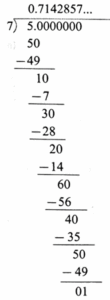
\(-\frac{5}{7}\)
Answer is : \(-\frac{5}{7}\) = − 0.\(\overline{714285}\)
|
(ii) \(\frac{9}{11}\)
Solution :
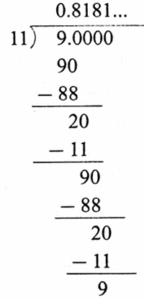
\(\frac{9}{11}\)
Answer is : \(\frac{9}{11}\) = 0.\(\overline{81}\)
|
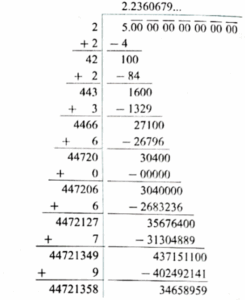
| (iii) \(\sqrt{5}\)
Solution :
\(\sqrt{5}\)
Answer is : = 2.2360679 ...
|
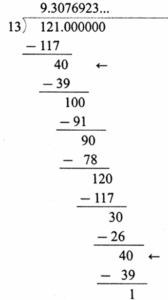
(iv) \(\frac{121}{13}\)
Solution :
\(\frac{121}{13}\)
Answer is : \(\frac{121}{13}\) = 9.\(\overline{307692}\)
|
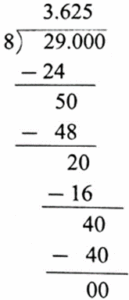
| (v) \(\frac{29}{8}\)
Solution :
\(\frac{29}{8}\)
Answer is : \(\frac{29}{8}\) = 3.625
|
Question 4. Show that 5 + \(\sqrt{7}\) is an irrational number.
Proof : Let us assume that 5 + \(\sqrt{7}\) is a rational number.
∴ 5 + \(\sqrt{7}\) = \(\frac{p}{q}\), q ≠ 0, p and q are integers.
∴ \(\sqrt{7}\) = \(\frac{p}{q}\) - 5
Here, the right hand side, \(\frac{p}{q}\) - 5, is a rational number, while the left hand side, \(\sqrt{7}\), is an irrational number.
This is contradictory.
∴ our assumption that 5 + \(\sqrt{7}\) is a rational number is wrong.
∴ 5 + \(\sqrt{7}\) is an irrational number.
Question 5. Write the following surds in the simplest form :
(i) \(\frac{3}{4}\sqrt{8}\)
\(\frac{3}{4}\sqrt{8}\) = \(\frac{3}{4}\sqrt{4×2}\) = \(\frac{3}{4}\sqrt{4}×\sqrt{2}\)
= \(\frac{3}{4}×2×\sqrt{2}\)
= \(\frac{3}{2}\sqrt{2}\)
Answer is : \(\frac{3}{2}\sqrt{2}\)
(ii) \(-\frac{5}{9}\sqrt{45}\)
\(-\frac{5}{9}\sqrt{45}\) = \(-\frac{5}{9}\sqrt{9×5}\) = \(-\frac{5}{9}\sqrt{9}×\sqrt{5}\)
= \(-\frac{5}{9}×3×\sqrt{5}\)
= \(-\frac{5}{3}\sqrt{5}\)
Answer is : \(-\frac{5}{3}\sqrt{5}\)
Question 6. Write the simplest form of the rationalizing factor for the given surds :
(i) \(\sqrt{32}\)
\(\sqrt{32}\) = \(\sqrt{16×2}\) = 4\(\sqrt{2}\)
∴ 4 × \(\sqrt{2}\) × \(\sqrt{2}\) = 4 × 2 = 8
8 is a rational number.
Answer is : The simplest rationalizing factor is \(\sqrt{2}\)
(ii) \(\sqrt{50}\)
\(\sqrt{50}\) = \(\sqrt{25×2}\) = 5\(\sqrt{2}\)
∴ 5 × \(\sqrt{2}\) × \(\sqrt{2}\) = 5 × 2 = 10
10 is a rational number.
Answer is : The simplest rationalizing factor is \(\sqrt{2}\)
(iii) \(\sqrt{27}\)
\(\sqrt{27}\) = \(\sqrt{9×3}\) = 3\(\sqrt{3}\)
∴ 3 × \(\sqrt{3}\) × \(\sqrt{3}\) = 3 × 3 = 9
9 is a rational number.
Answer is : The simplest rationalizing factor is \(\sqrt{3}\)
(iv) \(\frac{3}{5}\sqrt{10}\)
\(\frac{3}{5}\sqrt{10}\) = \(\frac{3}{5}×\sqrt{10}×\sqrt{10}\)
∴ \(\frac{3}{5}\) x 10 = 3 × 2 = 6
6 is a rational number.
Answer is : The simplest rationalizing factor is \(\sqrt{10}\)
(v) 3\(\sqrt{72}\)
3\(\sqrt{72}\) = 3 × \(\sqrt{36×2}\) = 3 x 6 x \(\sqrt{2}\)
= 18 x \(\sqrt{2}\)
∴ 18 × \(\sqrt{2}\) × \(\sqrt{2}\) = 18 × 2 = 36
36 is a rational number.
Answer is : The simplest rationalizing factor is \(\sqrt{2}\)
(vi) 4\(\sqrt{11}\)
4(\sqrt{11}\) = 4 x (\sqrt{11}\) × (\sqrt{11}\) = 4 × 11 = 44
44 is a rational number.
Answer is : The simplest rationalizing factor is (\sqrt{11}\)
Question 7. Simplify.
(i) \(\frac{4}{7}\sqrt{147}+ \frac{3}{8}\sqrt{192}-\frac{1}{5}\sqrt{75}\)
\(\frac{4}{7}\sqrt{147}+ \frac{3}{8}\sqrt{192}-\frac{1}{5}\sqrt{75}\)
= \(\frac{4}{7}\sqrt{49×3}+ \frac{3}{8}\sqrt{64×3}-\frac{1}{5}\sqrt{25×3}\)
= \(\frac{4}{7}×7\sqrt{3}+ \frac{3}{8}×8\sqrt{3}-\frac{1}{5}×5\sqrt{3}\)
= 4\(\sqrt{3}\) + 3\(\sqrt{3}\) - \(\sqrt{3}\)
= (4 + 3 – 1)\(\sqrt{3}\) = 6\(\sqrt{3}\)
Answer is : 6\(\sqrt{3}\)
(ii) 5\(\sqrt{3}\) + 2\(\sqrt{27}\) + \(\frac{1}{\sqrt{3}}\)
5\(\sqrt{3}\) + 2\(\sqrt{27}\) + \(\frac{1}{\sqrt{3}}\) = 5\(\sqrt{3}\) + 2\(\sqrt{9×3}\) + \(\frac{1×\sqrt{3}}{\sqrt{3}×\sqrt{3}}\)
= 5\(\sqrt{3}\) + 2 x 3 x \(\sqrt{3}\) + \(\frac{\sqrt{3}}{3}\)
= 5\(\sqrt{3}\) + 6\(\sqrt{3}\) + \(\frac{\sqrt{3}}{3}\)
= (5 + 6 + \(\frac{1}{3}\))\(\sqrt{3}\)
= \((\frac{15+18+1}{3})\)\(\sqrt{3}\)
= \((\frac{34}{3})\)\(\sqrt{3}\)
Answer is : \((\frac{34}{3})\)\(\sqrt{3}\)
(iii) \(\sqrt{216}\) - 5\(\sqrt{6}\) + \(\sqrt{294}\) - \(\frac{3}{\sqrt{6}}\)
\(\sqrt{216}\) - 5\(\sqrt{6}\) + \(\sqrt{294}\) - \(\frac{3}{\sqrt{6}}\) = \(\sqrt{36×6}\) - 5\(\sqrt{6}\) + \(\sqrt{49×6}\) - \(\frac{3}{\sqrt{6}}×\frac{\sqrt{6}}{\sqrt{6}}\)
= 6\(\sqrt{6}\) - 5\(\sqrt{6}\) + 7\(\sqrt{6}\) - \(\frac{3\sqrt{6}}{6}\)
= (6 – 5 + 7 - \(\frac{3}{6}\))\(\sqrt{6}\)
= \((\frac{36-30+42-3}{6})\)\(\sqrt{6}\)
= \((\frac{45}{6})\)\(\sqrt{6}\)
= \((\frac{15}{2})\)\(\sqrt{6}\)
Answer is : \((\frac{15}{2})\)\(\sqrt{6}\)
(iv) 4\(\sqrt{12}\) - \(\sqrt{75}\) - 7\(\sqrt{48}\)
4\(\sqrt{12}\) - \(\sqrt{75}\) - 7\(\sqrt{48}\) = 4\(\sqrt{4×3}\) - \(\sqrt{25×3}\) - 7\(\sqrt{16×3}\)
= 4 x 2 x \(\sqrt{3}\) – 5 x \(\sqrt{3}\) – 7 x 4 x \(\sqrt{3}\)
= 8\(\sqrt{3}\) – 5\(\sqrt{3}\) – 28\(\sqrt{3}\)
= (8 – 5 – 28)\(\sqrt{3}\)
= -25\(\sqrt{3}\)
Answer is : -25\(\sqrt{3}\)
(v) 2\(\sqrt{48}\) - \(\sqrt{75}\) - \(\frac{1}{\sqrt{3}}\)
2\(\sqrt{48}\) - \(\sqrt{75}\) - \(\frac{1}{\sqrt{3}}\)= 2 x \(\sqrt{16×3}\) - \(\sqrt{25×3}\) - \(\frac{1}{\sqrt{3}}×\frac{\sqrt{3}}{\sqrt{3}}\)
= 2 x 4 x \(\sqrt{3}\) – 5 x \(\sqrt{3}\) - \(\frac{1×\sqrt{3}}{3}\)
= 8\(\sqrt{3}\) – 5\(\sqrt{3}\) - \(\frac{1}{3}×\sqrt{3}\)
= (8 – 5 - \(\frac{1}{3}\))\(\sqrt{3}\)
= \((\frac{24-15-1}{3})\)\(\sqrt{3}\) = \(\frac{8}{3}\)\(\sqrt{3}\)
Answer is : \(\frac{8}{3}\)\(\sqrt{3}\)
Question 8. Rationalize the denominator.
(i) \(\frac{1}{\sqrt{5}}\)
\(\frac{1}{\sqrt{5}}\) = \(\frac{1}{\sqrt{5}}×\frac{\sqrt{5}}{\sqrt{5}}\) ... ( \(\sqrt{5}\) is the rationalizing factor of the denominator \(\sqrt{5}\))
= \(\frac{\sqrt{5}}{5}\)
Answer is : \(\frac{\sqrt{5}}{5}\)
(ii) \(\frac{2}{3\sqrt{7}}\)
\(\frac{2}{3\sqrt{7}}\) = \(\frac{2}{3\sqrt{7}}\) x \(\frac{sqrt{7}}{\sqrt{7}}\) ... ( \({\sqrt{7}}\) is the rationalizing factor of the denominator 3\({\sqrt{7}}\) )
= \(\frac{2\sqrt{7}}{3×7}\)
= \(\frac{2\sqrt{7}}{21}\)
Answer is : \(\frac{2\sqrt{7}}{21}\)
(iii) \(\frac{1}{\sqrt{3}-\sqrt{2}}\)
\(\frac{1}{\sqrt{3}-\sqrt{2}}\) = \(\frac{1}{\sqrt{3}-\sqrt{2}}\) × \(\frac{\sqrt{3}+\sqrt{2}}{\sqrt{3}+\sqrt{2}}\)
= \(\frac{1×(\sqrt{3}+\sqrt{2})}{(\sqrt{3})^2-(\sqrt{2})^2}\)
= \(\frac{\sqrt{3}+\sqrt{2}}{3-2}\)
= \(\sqrt{3}+\sqrt{2}\)
Answer is : \(\sqrt{3}+\sqrt{2}\)
(iv) \(\frac{1}{3\sqrt{5}+2\sqrt{2}}\)
\(\frac{1}{3\sqrt{5}+2\sqrt{2}}\) = \(\frac{1}{3\sqrt{5}+2\sqrt{2}}\) x \(\frac{3\sqrt{5}-2\sqrt{2}}{3\sqrt{5}-2\sqrt{2}}\)
= \(\frac{3\sqrt{5}-2\sqrt{2}}{(3\sqrt{5})^2-(2\sqrt{2})^2}\)
= \(\frac{3\sqrt{5}-2\sqrt{2}}{9×5-4×2}\)
= \(\frac{3\sqrt{5}-2\sqrt{2}}{45-8}\)
= \(\frac{3\sqrt{5}-2\sqrt{2}}{37}\)
Answer is : \(\frac{3\sqrt{5}-2\sqrt{2}}{37}\)
(v) \(\frac{12}{4\sqrt{3}-\sqrt{2}}\)
\(\frac{12}{4\sqrt{3}-\sqrt{2}}\) = \(\frac{12}{4\sqrt{3}-\sqrt{2}}\) x \(\frac{4\sqrt{3}+\sqrt{2}}{4\sqrt{3}+\sqrt{2}}\)
= \(\frac{12×(4\sqrt{3}-\sqrt{2})}{(4\sqrt{3})^2-(\sqrt{2})^2}\)
= \(\frac{12(4\sqrt{3}-\sqrt{2})}{16×3-2}\)
= \(\frac{12(4\sqrt{3}-\sqrt{2})}{46}\)
= \(\frac{6(4\sqrt{3}-\sqrt{2})}{23}\)
Answer is : \(\frac{6(4\sqrt{3}-\sqrt{2})}{23}\)