Notes
|
Topics to be learn :
|
Parallel lines : The lines in the same plane which do not intersect each other are called parallel lines.
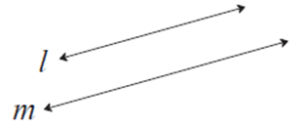
In the figure line l and line m are parallel lines,’ Symbolically, we write line l || line m’.
Transversal :
If a line intersects two or more given lines in two or more distinct points then the line is called a transversal of those two or more lines.
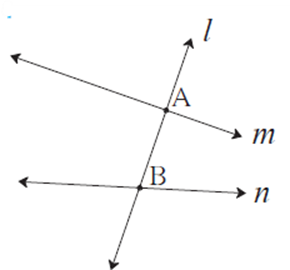
In the figure, line l intersects lines m and n in two distinct points 'A' and 'B' respectively. Line l is the transversal of lines m and n.
Angles made by a transversal :
When a transversal intersects two lines, two distinct points of intersection are created (e.g., points M and N). At each point, four angles are formed, totaling eight angles. Each angle has one arm on the transversal and the other on one of the intersected lines.
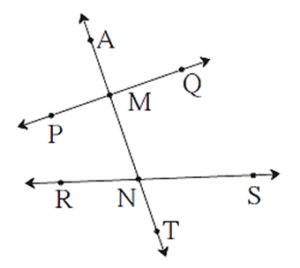
These are classified into the following pairs:
(i) Corresponding Angles :
A pair of angles is considered "corresponding" if the arms on the transversal are in the same direction and the other arms are on the same side of the transversal.
Pairs of corresponding angles in the given figure -
(i) ∠AMP and ∠MNR
(ii) ∠PMN and ∠RNT
(iii) ∠AMQ and ∠MNS
(iv) ∠QMN and ∠SNT
(ii) Interior angles : A pair of angles which are on the same side of the transversal and inside the given lines is called a pair of interior angles.
In the figure, there are two pairs of interior angles.
They are as follows :
(i) ∠PMN and ∠MNR
(ii) ∠QMN and ∠MNS
(iii) Alternate angles : Pairs of angles which are on the opposite sides of transversal and their arms on the transversal show opposite directions is called a pair of alternate angles.
In the figure, there are two pairs of interior alternate angles and two pairs of exterior alternate angles.
- Interior alternate angles : (Angles at the inner side of lines)
(i) ∠PMN and ∠MNS
(ii) ∠QMN and ∠RNM
- Exterior alternate angles : (Angles at the outer side of lines)
(i) ∠AMP and ∠TNS
(ii) ∠AMQ and ∠RNT
Properties of angles formed by two parallel lines and a transversal :
(1) Property of corresponding angles : Each pair of corresponding angles formed by two parallel lines and their transversal is of congruent angles.
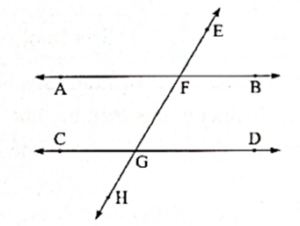
In the figure, line AB || line CD. Line EH is the transversal.
Corresponding angles : (They are in the same relative position on each intersection.)
- ∠EFB ≅ ∠FGD
- ∠EFA ≅ ∠FGC
- ∠HGD ≅ ∠GFB
- ∠HGC ≅ ∠GFA
(2) Property of alternate angles : Each pair alternate angles formed by two
parallel lines and their transversal is of congruent angles.
In the figure, line AB || line CD. Line EH is the transversal
Interior alternate angles : (They lie between the two parallel lines and on opposite sides of the transversal.)
- ∠AFG ≅ ∠FGD
- ∠BFG ≅ ∠FGC
Exterior alternate angles : (They lie outside the parallel lines and on opposite sides of the transversal.)
- ∠EFB ≅ ∠CGH
- ∠EFA ≅ ∠HGD
(3) Property of interior angles : Each pair of interior angles formed by two parallel lines and their transversal is of supplementary angles.
In the figure, line AB || line CD. Line EH is the transversal
Interior angles : (They lie between the parallel lines and on the same side of the transversal.)
m∠AFG + m∠FGC = 180°
m∠BFG + m∠FGD = 180°
Remember :
When two parallel lines are intersected by a transversal, the angles formed in each pair of
- corresponding angles are congruent
- alternate angles are congruent
- interior angles are supplementary
To draw a line parallel to the given line :
Construction (I) : To draw a line parallel to the given line through a point outside the given line using set - square.
Method I : Steps of the construction
(1) Draw line l.
(2) Take a point P outside the line l.
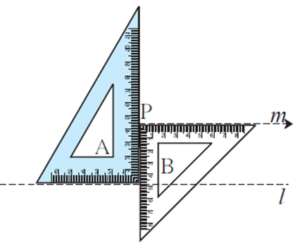
(3) As shown in the figure, place two set - squares touching each other. Hold set – squares A and B. One edge of set - square A is close to point P. Draw a line along the edge of B.
(4) Name the line as m.
(5) Line m is parallel to line l.
Method II : Steps of construction
(1) Draw line l
(2) Take a point P outside line l
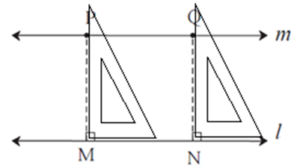
(3) Place one side of set square (containing the right angle) along line l passing through P.
(4) Draw seg PM ⊥ line l such that M lies on line l
(5) Take another point N on line l
(6) Using set square, draw a line ⊥ line l passing through N. Mark Q on it such that l(NQ) = l(MP)
(7) Draw line m passing through points P and Q
(8) Thus line m is parallel to line m
Construction (II) : To draw a parallel line to a given line at a given distance.
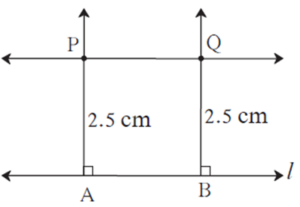
Method : Draw a line parallel to line l at a distance 2.5 cm.
Steps of construction :
(1) Draw line l.
(2) Take two points A and B on the line l.
(3) Draw perpendiculars to the line l from points A and B.
(4) On the perpendicular lines take points P and Q at a distance of 2.5cm from A and B respectively.
(5) Draw line PQ.
(6) Line PQ is a line parallel to the line l at a distance 2.5cm.